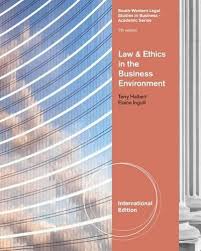
Law and Ethics in the Business Environment International Edition 7th Edition by Terry Halbert - Test Bank

Law and Ethics in the Business Environment International Edition 7th Edition by Terry Halbert - Test Bank   Instant Download - Complete Test Bank With Answers     Sample Questions Are Posted Below   LAW & ETHICS IN THE BUSINESS ENVIRONMENT CHAPTER 5 Workers Rights as Human Rights: Health and Safety in the Workplace   …

$19.99

Law and Ethics in the Business Environment International Edition 7th Edition by Terry Halbert – Test Bank


Instant Download – Complete Test Bank With Answers


Sample Questions Are Posted Below


LAW & ETHICS IN THE BUSINESS ENVIRONMENT

CHAPTER 5

Workers Rights as Human Rights: Health and Safety in the Workplace


Questions

  1. According to the court in the World Trade Center, the Fifth Amendment Substantive Due Process clause has all of the following meanings except:
    1. Individual protection against arbitrary actions of the government
    2. No deprivation of life, liberty or property without due process of law
    3. The government is bound to follow certain processes when arresting or trying someone for a crime
    4. The government is not allowed to behave in a manner that shocks the conscience

ANSWER:    C                                   PAGE:  168


  1. With the adoption of the ____________, the S. began to address the need to prevent, or minimize, workplace accidents and health hazards.
  1. Securities Act
  2. Occupational Safety and Health Act
  3. Environmental Protection Agency
  4. National Insurance Act

ANSWER:  B                         PAGE:  173


  1. Employers have __________ been held criminally responsible for workplace injuries and deaths to workers.
  1. rarely
  2. marginally
  3. mostly
  4. always

ANSWER:  A                         PAGE:  176

  1. Typically individual stockholders are not held responsible for the actions of a corporation. Exceptions usually relate to comingling of funds, underinsuring, or similar actions by the corporate leadership. This is called:
    1. Risking liability
    2. Piercing the corporate veil
    3. The privilege of the stockholders
    4. Free market trading of stocks

ANSWER:  B             PAGE:  177


  1. When an employee is injured on the job, that employee may:
  2. File a worker’s compensation claim and accept the government-determined value for the injury.
  3. File a tort claim in state court to recover damages above the worker’s compensation amount.
  • File a complaint with OSHA to have the employer investigated and charged if violations are present.
    1. I only
    2. I and II only
    3. III only
    4. I and III only

ANSWER:  D             PAGE:  183-4


  1. The purpose of OSHA and the MSHA is to eliminate injury in the workplace.
    1. True
    2. False

ANSWER:  B.                                    PAGE:  180 – the purpose is to reduce harm or to manage risk.


  1. Which of the following is true about worker’s compensation in America?
    1. Employers pay the employees directly for injuries caused on the job.
    2. Employees collect workers compensation for on the job injuries but are not allowed to sue employers for negligence.
    3. Employees collect workers compensation for on the job injuries but are not allowed to sue employers for any claim related to the injury.
    4. Employers cannot opt out of the system even if they can self-insure against workplace injury.

ANSWER:  B                         PAGE 184

  1. One example of modern day slavery, as discussed in the interview with Kevin Bales, is:
    1. Purchased human labor for farming – just as it existed in early U.S. History with humans being kidnapped, transported and sold on the open market.
    2. Debt bondage – where families borrow money with the collateral being their future labor and the future labor of their offspring.
    3. People being offered very low wages and poor working conditions because the market will bear those conditions.
    4. Children working for their family businesses doing manual labor that is legal under exceptions to the child labor laws.


ANSWER:   B                        PAGE:  188


  1. According to Henry Shue, firms are not in the business of protecting the interests of their workers, except when this is a means to accomplish the organizational objectives.
  1. True
  2. False

ANSWER: A              PAGE 195


  1. According to Henry Shue, who should have responsibility to protect workers from potential harm caused by imported goods?
  2. The employers of the workers facing the potential harm
  3. The governments of the people who may be harmed
  • The companies importing the goods
  1. Consumers who ultimately buy the goods


  1. I only
  2. I and II
  3. I, II and III
  4. I, II, III and IV


ANSWER:  D             PAGE 196 (the author states that all should have responsibility but ultimately the reality is that consumers have responsibility because the others fail)


Essay Questions


  1. According to Michael Silverstein, what are four types of risks workers find on the job today?

ANSWER:  (a) Dangers in the workplace; (b) Hazards present in 1970 but not fully appreciated by those who wrote the OSH Act, such as musculoskeletal disorders, forceful exertions, repetitive movements, violence, and biohazards; (c) New hazards that have entered the workplace that were unknown in 1970; (d) Changes in the political, economic, and legal landscape of work that have brought about new safety and health challenges such as globalization of businesses, downsizing of manufacturing, increased outsourcing, reduced pension security, erosion of labor law, an aging workforce, declining unionization, and increased immigrant workers.

PAGE:  175


  1. Explain how worker’s compensation in the S. works.

ANSWER:  Firms contribute to a fund that is used to pay benefits to employees accidentally injured in the workplace.  Instead of suing, an employee’s legal task is simplified; employees need only file a claim indicating that they were hurt in the course of employment.  The employee need not prove the company was negligent, and the company cannot raise any of the traditional defenses to negligence to defeat the claim.

PAGE:  184


  1. When Nike faced public criticism for its affiliation with sweatshops, it started a public relations campaign to counter its negative image. Some detractors sued Nike to stop the campaign, alleging that it was misleading and false.  Discuss why you, as a judge, would either allow Nike to continue its campaign, or would make Nike stop the campaign.

PAGE:  192-94


  1. Workplace harm is an area of concern for employers, employees and the government.  Explain what each group has done, or might do, to address this concern.


ANSWER:  Employers can implement and enforce safety regulations, can use the safest equipment and can have a reporting process for injuries.  Employees can unionize, can whistleblow (back to Chapter 1).  The government has passed legislation that can be improved and enforced.  PAGES:  Throughout chapter.


  1. Though slavery was outlaws in the United States during the mid-1800’s, several authors and experts express concern that slavery still exists in actuality and through sweatshops.  Discuss what has been done to combat these issues and how companies charged with slavery of sweatshop affiliations have reacted.

ANSWER:  Will vary but should be based on the Bales article and the Nike case.

Additional information

Add Review

Your email address will not be published. Required fields are marked *