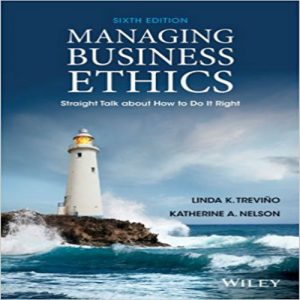
Managing Business Ethics Straight Talk About How to Do It Right 6th Edition By Trevino - Test Bank

Managing Business Ethics Straight Talk About How to Do It Right 6th Edition By Trevino - Test Bank   Instant Download - Complete Test Bank With Answers     Sample Questions Are Posted Below       File: Chapter 5, Ethics as Organizational Culture       Matching       Reference: Matching Key Terms …

$19.99

Managing Business Ethics Straight Talk About How to Do It Right 6th Edition By Trevino – Test Bank


Instant Download – Complete Test Bank With Answers


Sample Questions Are Posted Below


File: Chapter 5, Ethics as Organizational Culture


Matching


Reference: Matching Key Terms and Definitions

  1. a) Strong organizational culture
  2. b) Weak organizational culture
  3. c) Socialization (or enculturation)


  1. Standards and guidelines that are known and widely shared by all.


Ans: a

Response: See page  152.

Difficulty: Easy


  1. Subcultures within divisions or departments that are more likely to guide behavior.


Ans: b

Response: See page  152.

Difficulty: Easy


  1. Process promoted through formal and informal transmission of norms.


Ans: c

Response: See page  152

Difficulty: Easy


Reference: Matching Key Terms and Definitions

  1. a) Heroes
  2. b) Norms
  3. c) Rituals
  4. d) Myths


  1. Symbolically tells employees what the organization wants them to do and how it expects them to do it.


Ans: c

Response: See page  181.

Difficulty: Easy


  1. Standards of behavior that are accepted as appropriate by members of a group.


Ans: b

Response: See page  180.

Difficulty: Easy


  1. Symbolic figures who set standards of performance by modeling certain behaviors.


Ans: a

Response: See page  179.

Difficulty: Easy


  1. Anecdotes about a sequence of events drawn from an organization’s history.


Ans: d

Response: See page  182.

Difficulty: Easy


True/False


  1. Organization cultures vary widely, even within the same industry.


Ans: True

Response: See page  151.

Difficulty: Easy


  1. Organization cultures are maintained through formal systems alone.


Ans: False

Response: See page  153.

Difficulty: Easy


  1. An ethical culture is maintained through alignment between the formal and informal systems.


Ans.: True

Response:  See page 153.

Difficulty: Easy


  1. A 2006 study found that 82 percent of Americans would prefer to be paid less but work for an ethical company than be paid more and work for an unethical company.


Ans.: True

Response: See page 155

Difficulty: Medium


  1. The US Sentencing Guidelines call for more attention to developing and maintaining the ethical culture of the organization.


Ans: True

Response: See page  156.

Difficulty: Easy


  1. Unethical leaders can just as negatively affect the culture of a company as ethical leaders can affect the ethical culture.


Ans: True

Response: See page 161

Difficulty: Medium


  1. An ethically neutral leader is not clearly unethical, but is perceived to be more self-centered and more focused on the bottom line.


Ans: True

Response: See page 163.

Difficulty: Medium


  1. Research has found that executive ethical leadership is critical to investors but not the employees.


Ans. False

Response: See page 165.

Difficulty: Difficult


  1. Research has found that employees working in organizations with an enforced code of ethics report that they engage in less unethical behavior.


Ans: True

Response: See page 169.

Difficulty: Easy


  1. Most people, according to cognitive moral development, are looking outside of themselves for guidance on decision-making. This means that stated organizational policy can be an important source of guidance foe employees in making decisions.


Ans.: True

Response: See page 170.

Difficulty: Difficult


  1. Alignment of the goals and rewards of an organization with the organization’s values is essential because employees will generally do what is measured and rewarded.


Ans.: True

Response: See page 173.

Difficulty: Moderate


  1. Loyalty is paramount in business and employees who question unethical direction or an unethical boss are doomed.


Ans: False

Response: See page 174.

Difficulty: Moderate


  1. Today, with advances in technology, very few modern organizations are bureaucratic.


Ans: False

Response: See page 174.

Difficulty: Medium


  1. The more a firm demands unquestioning obedience to authority, the more likely the firm will experience higher levels of unethical conduct among their employees.


Ans: True

Response: See page 175.

Difficulty: Medium


  1. Given the less hierarchical organizational structures that are more common place today, it is less important for to have strongly aligned ethical culture to guide employees in their independent decision-making.


Ans: False

Response: See page 175-176

Difficulty: Difficult


  1. Companies that look for advice from consultants will do well to find a “spray and pray” plan.


Ans: False

Response: See page  189.

Difficulty: Easy


  1. The only way to determine if the culture is aligned to support ethical behavior is to conduct regular, comprehensive audits of all relevant cultural systems, both formal and informal.


Ans: True

Response: See page 190.

Difficulty: Easy


Multiple Choice


  1. Weak organizational cultures are:


  1. a) desirable if an organization has many subcultures.
  2. b) desirable if an organization wants diversity of thought and action.
  3. c) desirable if an organization wants behavioral consistency.
  4. d) undesirable in all situations.


Ans: b

Response: See page  152.

Difficulty: Medium


  1. Which of these is NOT a part of informal system in an organization?:


  1. a) Norms
  2. b) Rituals
  3. c) Language
  4. d) Decision processes


Ans: d

Response: See page  153.

Difficulty: Medium


  1. Why did the US Sentencing Commission begin to focus on the ethical culture of the organization in 2004?


  1. a) Researchers had just recently introduced the idea of an “ethical culture” in 2002.
  2. b) More and more consultants were discussing “ethical culture” in their programs.
  3. c) Prior to the change, organizations used formal programs as “window dressing”.
  4. d) None of the above


Ans: c

Response: See page  156.

Difficulty: Medium


  1. The “moral person” component of ethical leadership:


  1. a) Tells employees how the leader expects them to behave.
  2. b) Tells employees how the leader is likely to behave.
  3. c) Shows that ethics and values are an important part of the leader’s message.
  4. d) Demonstrates a reputation for ethical leadership among employees.


Ans: b

Response: See page  159.

Difficulty: Medium


  1. According to the Executive Ethical Leadership Reputation Matrix, ___________ is an executive characterized as a weak “moral person” and a strong “moral manager.”


  1. a) Unethical leader
  2. b) Ethical leader
  3. c) Ethically neutral leader
  4. d) Hypocritical leader


Ans: d

Response: See pages  159.

Difficulty: Easy


  1. According to the Executive Ethical Leadership Reputation Matrix, ___________ is an executive characterized as a strong “moral person” and a strong “moral manager.”


  1. a) Unethical leader
  2. b) Ethical leader
  3. c) Ethically neutral leader
  4. d) Hypocritical leader


Ans: b

Response: See pages 159.

Difficulty: Easy


  1. ______ are symbolic figures who set standards of performance by modeling certain behaviors, and they can be the organization’s formal leaders.


  1. a) Heroes
  2. b) First-line managers
  3. c) Large investors in an organization
  4. d) Hypocritical leader


Ans: a

Response: See pages 179.

Difficulty: Easy


  1. “The way we do things around here” addresses an organization’s


  1. a) heroes.
  2. b) rituals.
  3. c) norms.
  4. d) myths.


Ans: c

Response: See pages 180.

Difficulty: Medium


  1. _____ tell people symbolically what the organization wants them to do and how it expects them to do it.


  1. a) Heroes
  2. b) Myths
  3. c) Norms
  4. d) Rituals


Ans: d

Response: See pages 181.

Difficulty: Medium


  1. When an organization “cares” about multiple stakeholders, including employees, customers, and the broader community and public, it is said to have which of these?


  1. a) Benevolence climate
  2. b) Self-interest climate
  3. c) Rule-based climate
  4. d) Fairness climate


Ans: a

Response: See pages 185.

Difficulty: Medium


  1. Under which of these climates little attention is given to the social consequences of one’s actions?


  1. a) Benevolence climate
  2. b) Self-interest climate
  3. c) Rule-based climate
  4. d) Fairness climate


Ans: b

Response: See pages 185.

Difficulty: Medium


  1. Which of the following is false?


  1. a) Any attempt to change an organization’s ethics must consider the entire cultural system.
  2. b) A cultural system includes both formal and informal systems.
  3. c) An effective culture change may take as long as 1 to 2 years.
  4. d) New rules and values must be reinforced via training programs and reward systems.


Ans: c

Response: Culture changes are not short-term and may take as much as 6 to 15 years.  See page 191.

Difficulty: Medium


Short Answer


  1. Briefly describe what is meant by alignment of ethical culture. Provide an example of how an ethical culture might be misaligned.


Ans: Students should be able to demonstrate that ethical culture consists of informal and formal systems that must be sending the same message.  Therefore, a reward system that focuses strictly on the bottom line and makes no allowances for how a goal is met is misaligned with the organization’s ethical culture.

Response: An ethical culture consists of both an informal and formal system of communication.  If messages from the informal and formal system differ, then the ethical culture of an organization is out of alignment.  For example, a CEO may state in speeches to the employees that “our company cares about the environment.”  However, if the reward system focuses strictly on the bottom line and makes no allowances for how goals are met, the ethical culture is misaligned.

Difficulty: Difficult


  1. Briefly describe and provide examples of three steps involved in changing an organization’s culture.


Ans: Students should include steps related to diagnosis, implementation, and subsequent evaluation.

Response: Changing an organization’s culture is a multi-dimensional process that must be taken seriously.  The major steps include a detailed diagnosis of the current culture, implementation of the new plan, and evaluation after the plan is in motion.  The implementation of the plan is probably the most difficult step because it involves the “art” of changing the informal systems as well as the informal systems.

Difficulty: Difficult


Additional information

Add Review

Your email address will not be published. Required fields are marked *