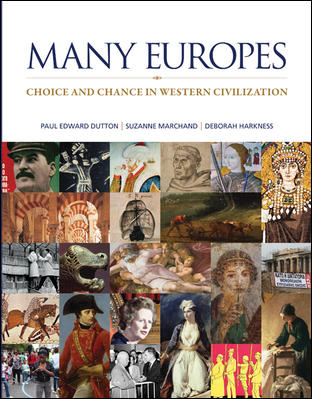
Many Europes Choice and Chance in Western Civilization Ist Edition By Paul Dutton And Suzanne - Test Bank

Many Europes Choice and Chance in Western Civilization Ist Edition By Paul Dutton And Suzanne - Test Bank   Instant Download - Complete Test Bank With Answers     Sample Questions Are Posted Below   Chapter 5 From Republic to Empire MULTIPLE-CHOICE QUESTIONS   Cicero was executed in 43 BCE because he sought to overthrow …

$19.99

Many Europes Choice and Chance in Western Civilization Ist Edition By Paul Dutton And Suzanne – Test Bank


Instant Download – Complete Test Bank With Answers


Sample Questions Are Posted Below


Chapter 5

From Republic to Empire

MULTIPLE-CHOICE QUESTIONS


  1. Cicero was executed in 43 BCE because he sought to
  2. overthrow the Senate’s power.
  3. assassinate Julius Caesar.
  4. preserve the Roman Republic.
  5. make himself emperor.

Answer: c

Page: 133


  1. The imperial government Augustus established truly took hold in the
  2. first century BCE.
  3. first century CE.
  4. second century BCE.
  5. second century CE.

Answer: d

Page: 134


  1. Why did the agreements and shared interests of the Roman peoples break down in the Late Roman Republic?
  2. What worked for a city-state worked less well for the governance of a vast territory.
  3. Patricians and plebeians could not agree on how to distribute the spoils of the Punic Wars.
  4. The Gauls were invading Italy, and the Latin allies were no longer willing to protect Rome.
  5. Competition for political posts had decreased, making civic leaders weak and corrupt.

Answer: a

Page: 135


  1. In order to thrive, Republican Rome depended most on
  2. slavery.
  3. continual growth.
  4. conservative values.
  5. clientage.

Answer: b

Page: 135


  1. The highest office in Republican Rome was
  2. quaestor.
  3. tribune.
  4. aedile.
  5. consul.

Answer: d

Page: 136


  1. What was the consequence of holders of political office in Republican Rome receiving no pay?
  2. Too few people were willing to compete to hold political offices.
  3. Office-holders became clients of powerful patrons, which reinforced factional loyalties.
  4. The Roman government lacked enough money and manpower to offer the services the people expected from their government.
  5. Blood, ancestry, and personal connections became completely unimportant; merit alone counted in obtaining political office.

Answer: b

Page: 136


  1. As a result of the conquest of the eastern Mediterranean, new ideas and cultural influences came to Italy, including
  2. Greek learning.
  3. mystery religions from Spain.
  4. Chinese cultural practices.
  5. agricultural practices from Gaul.

Answer: a

Page: 136


  1. Why did many small landholders in Late Republican Rome quit farming and drift with their families to the city of Rome?
  2. They hoped to become clients of powerful patrons in Rome and obtain political office.
  3. They wanted to immigrate to Roman colonies outside of Italy.
  4. They could not compete against large plantation-like estates worked by imported slaves.
  5. They no longer wanted to work and hoped to enjoy “bread and circuses” in Rome.

Answer: c

Page: 136


  1. The two reformers who probably represented the last best chance for Rome to undertake the political changes necessary to preserve the Republic were
  2. Cicero and Sallust.
  3. Julius and Augustus Caesar.
  4. the Gracchi brothers.
  5. Cato the Elder and Scipio Africanus.

Answer: c

Page: 136


  1. Tiberius Gracchus’s political reforms were aimed at
  2. abolishing slavery, or at least improving their working conditions.
  3. returning Rome to its ancient social contract.
  4. introducing Athenian-style democracy to Rome.
  5. overthrowing the Roman Senate.

Answer: b

Page: 136-138


  1. The legacy of the Gracchi brothers was to
  2. leave Rome more socially and politically fractured.
  3. heal the divisions in Rome and prolong the life of the Republic.
  4. abolish slavery with the support of the landless lower classes.
  5. peacefully achieve lasting land reform and break the senatorial monopoly on power.

Answer: a

Page: 138


  1. What does the case of Jugurtha, the Numidian king, demonstrate?
  2. how efficiently Roman justice could still function to reign in rebellious citizens
  3. how powerful the Vestal Virgins remained in Republican Rome
  4. how corrupt the Republic had become
  5. how desperate the Gracchi brothers were to achieve their reforms

Answer: c

Page: 138


  1. How did the great consul generals bend the Republic to the breaking point?
  2. They sided with reformers such as the Gracchi brothers.
  3. They refused to follow the Senate’s orders to pacify North Africa.
  4. They abolished the office of tribune.
  5. They subverted and bypassed the Senate.

Answer: d

Page: 139


  1. Gaius Marius’s great innovation was to
  2. extend citizenship to Rome’s Italian allies.
  3. privatize the Roman army.
  4. refuse reelection as consul after his first term.
  5. hand Jugurtha over to his protégé Sulla.

Answer: b

Page: 139


  1. Who fought Rome in the Social War of 90–88 BCE?
  2. Rome’s Italian allies
  3. the Carthaginians
  4. the Numidians
  5. the Gauls

Answer: a

Page: 139


  1. What finally ended the Social War?
  2. Sulla’s brilliant military strategy
  3. the recall of Marius to conduct the war
  4. the Senate’s offer of citizenship to the Italians
  5. the help of Mithridates, ruler of Pontus

Answer: c

Page: 139


  1. Which of the following best describes Sulla?
  2. a conservative who tried to restore Rome to its golden Republican past
  3. a military ruler who radically subverted the Roman order
  4. a supporter of the reforms of the Gracchi
  5. a client of Julius Caesar

Answer: b

Page: 140


  1. The next great consul general after Sulla was
  2. Spartacus.
  3. Crassus.
  4. Octavian.
  5. Pompey.

Answer: d

Page: 140


  1. Why is the case of Catiline important?
  2. The plot was a real danger to the state.
  3. It offered Cicero the opportunity to suppress the conspiracy, the greatest achievement of his career.
  4. The actions of Catiline and his followers were symptomatic of the troubles of the late Republic.
  5. It led the Senate to recall Sulla from retirement to suppress the conspiracy.

Answer: c

Page: 141


  1. The greatest poets of the last phase of the Republic were
  2. Lucretius and Cicero.
  3. Catullus and Catiline.
  4. Sallust and Lucretius.
  5. Lucretius and Catullus.

Answer: d

Page: 141


  1. The three members of the Caesarian Faction were
  2. Pompey, Cicero, and Caesar.
  3. Caesar, Crassus, and Marius.
  4. Pompey, Crassus, and Caesar.
  5. Sulla, Pompey, and Caesar.

Answer: c

Page: 142


  1. In his rise to power, Caesar relied on
  2. popular support.
  3. the equestrians.
  4. the support of the patricians.
  5. the slaves.

Answer: a

Page: 142


  1. In the battle of Pharsalus in July 48 BCE, Caesar’s army defeated that of
  2. the Gauls.
  3. the Senate.
  4. the Italian Allies.
  5. Egypt.

Answer: b

Page: 143


  1. The leaders of the plot to assassinate Julius Caesar were
  2. Pompey and Mark Antony.
  3. Octavian and Pompey.
  4. Crassus and Brutus.
  5. Brutus and Cassius.

Answer: d

Page: 144


  1. At part of his last campaign to restore the Republic, Cicero wrote a series of stinging orations against
  2. Octavian.
  3. Lepidus.
  4. Antony.
  5. Caesar.

Answer: c

Page: 144


  1. Who were the members of the official Triumvirate of 42–33 BCE?
  2. Octavian, Caesar, and Antony
  3. Lepidus, Cicero, and Octavian
  4. Antony, Lepidus, and Caesar
  5. Lepidus, Octavian, and Antony

Answer: d

Page: 144


  1. Why did Romans despise Cleopatra?
  2. She was both foreign and royal.
  3. She aspired to rule Rome.
  4. She was both poor and unpopular in Egypt.
  5. She had deposed her brother to become queen.

Answer: a

Page: 145


  1. One of Antony’s greatest problems was that
  2. he drank too much and was easily led astray by a wily foreigner.
  3. he had Hellenistic leanings and ambitions.
  4. few Roman soldiers were willing to fight for a foreign queen.
  5. Egypt possessed few resources and little wealth with which Antony could pay his soldiers.

Answer: c

Page: 146


  1. In his attempt to restore Roman order, what did Octavian change militarily?
  2. He established a standing army over which he was the sole ruler.
  3. He turned over control of the army to the Senate.
  4. He settled his soldiers in Egypt so they could not foment revolts in Italy.
  5. He disbanded most of the army except for a small Praetorian Guard.

Answer: a

Page: 147


  1. Because Octavian possessed authority over the state, the Senate bestowed upon him the title of
  2. Caesar.
  3. Praetorian.
  4. Augur.
  5. Augustus.

Answer: d

Page: 147


  1. Why did Augustus succeed where Caesar had not?
  2. Augustus was by far the greater military leader.
  3. Augustus engaged in a slow and sensitive reordering of the Roman world.
  4. Augustus forcibly brought about the collapse of the traditional Republic.
  5. Augustus restored to the Senate power over foreign, military, and financial affairs.

Answer: b

Page: 147


  1. Augustus controlled the senators and aristocratic elite by making them his
  2. patrons.
  3. slaves.
  4. clients.
  5. advisors.

Answer: c

Page: 147


  1. Why was the disaster at the Teutoburg Forest in 9 CE a turning point in Rome’s territorial ambitions?
  2. Germania was never to be as Romanized as Gaul.
  3. Augustus’s loyal commander Agrippa was forced to commit suicide.
  4. Rome lost control of Gaul and parts of Germany.
  5. Three Roman legions under Varus revolted against Roman rule and defected to the German side.

Answer: a

Page: 147


  1. Rather than present himself as absolute ruler, Augustus preferred to represent himself as
  2. Pontifex Maximus.
  3. primus inter pares.
  4. chief tribune.
  5. a simple soldier.

Answer: b

Page: 147


  1. To honor Augustus after the campaigns in Spain and Gaul, the Senate commissioned the erection of
  2. a triumphal arch.
  3. the Prima Porta statue.
  4. an Altar of Peace.
  5. the Pantheon.

Answer: c

Page: 148


  1. The three great Latin poets of the Augustan age were
  2. Virgil, Hesiod, and Sallust.
  3. Horace, Ovid, and Maecenas.
  4. Ovid, Catullus, and Virgil.
  5. Virgil, Horace, and Ovid.

Answer: d

Page: 149


  1. Just as Augustus had a supreme military operative in Agrippa, he possessed a sophisticated political operative and cultural advisor in
  2. Virgil.
  3. Maecenas.
  4. Horace.
  5. Ovid.

Answer: b

Page: 150


  1. In what way did the Aeneid constitute excellent Augustan propaganda?
  2. It idealized Roman agriculture and the joys of pastoral life in Italy.
  3. It eulogized Augustus after his death.
  4. It celebrated Augustus’s vision of Rome’s exceptionalism.
  5. It declared that the Romans were descended from the Greek hero Achilles.

Answer: c

Page: 151


  1. Ovid’s masterpiece is the
  2. Metamorphoses.
  3. Georgics.
  4. Carmen saeculare.
  5. Bucolics.

Answer: a

Page: 151


  1. In the late Republic, traditional Roman religion was under pressure from which of the following?
  2. atheistic emperors
  3. a lack of complexity in its pantheon of gods
  4. ideas encountered in the Mediterranean world
  5. the increase of Judaism within Rome

Answer: c

Page: 152


  1. Why did Romans of the imperial age find the new mystery cults attractive?
  2. They were attracted to eastern culture in a broader sense, wanting to merge Roman culture with that of Asia.
  3. They were seeking forms of personal religion that were more satisfying than traditional Roman religion.
  4. They were morally dismayed by the emphasis on sacrifice in traditional Roman religion.
  5. They offered an attractive alternative to the cult of the emperors that began under Augustus.

Answer: b

Page: 152


  1. In the late Republic, only one religion stood aside from polytheism and its root assumptions. That religion was
  2. Christianity.
  3. Isis worship.
  4. the cult of Bacchus.
  5. Judaism.

Answer: d

Page: 152


  1. The Arch of Titus in the Roman Forum depicts Titus’s soldiers carrying back to Rome
  2. the holy goods removed from the Temple in Jerusalem.
  3. the standards lost by three Roman legions during the battle at Teutoburg Forest.
  4. the property of equestrians seized after the Battle of Philippi.
  5. portions of the Dead Sea Scrolls.

Answer: a

Page: 152


  1. For most Romans, Christianity was
  2. a divinely inspired, satisfying new form of spirituality.
  3. an insulting and dangerous superstition.
  4. a deadly threat to the very existence of the empire.
  5. a viable new alternative to the cult of emperor worship.

Answer: b

Page: 153


  1. By the time of Augustus, the city of Rome had a population of about
  2. 500,000 people.
  3. one million people.
  4. five million people.
  5. ten million people.

Answer: b

Page: 153


  1. One factor in the reduced numbers of women in Rome was
  2. that many women married soldiers and emigrated to the colonies.
  3. that parents preferred to rear their daughters in the countryside, where there was less risk of disease.
  4. that all but eldest daughters were sold into slavery.
  5. the selective infanticide of females.

Answer: d

Page: 155


  1. What was the paramount problem that Augustus never solved?
  2. how to create a peaceful and prosperous empire
  3. how to conquer and control Germany
  4. how to solve the problem of imperial succession
  5. how to pacify the Jews

Answer: c

Page: 157


  1. The successors of Augustus, who sprang from his own extended family, are called the
  2. “Five Good Emperors.”
  3. Flavians.
  4. Nervan-Antonians.
  5. Julio-Claudians.

Answer: d

Page: 157


  1. How did the Romans during the reigns of the “five good emperors” find a way to overcome the inherent weakness of family rule?
  2. by restoring the power of traditional Roman institutions such as the Senate
  3. by relying on the Praetorian Guard to choose the successor to the reigning emperor
  4. by reaching outside the imperial family to adopt excellence
  5. by instituting a system of civil service examinations to recruit talented rulers

Answer: c

Page: 158


  1. A competent administrator and gifted general, ________ was the most successful of all the emperors in many ways.
  2. Claudius
  3. Trajan
  4. Hadrian
  5. Marcus Aurelius

Answer: b

Page: 159


ESSAY QUESTIONS


  1. Why was the last century of the Roman Republic filled with turmoil and civil discord? Was the violence a cause or a symptom of political dysfunction? Explain.


  1. Discuss the career of Julius Caesar. How did he obtain power in Rome? Why was he assassinated?


  1. Discuss the struggle between Mark Antony and Octavian. Why might the Mediterranean world have turned in a different direction had Antony triumphed over Octavian?


  1. Explain the success of Augustus in establishing a new imperial order in Rome. Why was he able to retain his popularity despite his authoritarian rule?


  1. How did Rome and its empire benefit from Augustus’s rule? How did he change the physical appearance and infrastructure of Rome itself?


  1. How and why did the cult of emperors begin under Augustus? What role did literary figures such as Virgil, Ovid, and Horace play in the growth of that cult? To what extent did Augustus himself nurture it?


  1. What was daily life like for a typical prosperous male Roman citizen? How did gender and social class impact how people lived?


Additional information

Add Review

Your email address will not be published. Required fields are marked *