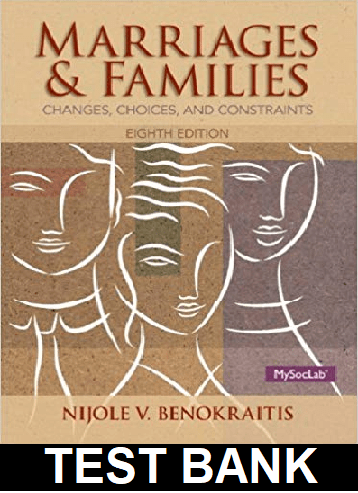
Marriages And Families 8th Edition By Benokraitis - Test Bank

Marriages And Families 8th Edition By Benokraitis - Test Bank   Instant Download - Complete Test Bank With Answers     Sample Questions Are Posted Below   Chapter 5 Socialization and Gender Roles   5.1 Quick Quiz   1) ________ refers to the chromosomal, hormonal, anatomical, and other physiological attributes of an individual. A) Race …

$19.99

Marriages And Families 8th Edition By Benokraitis – Test Bank


Instant Download – Complete Test Bank With Answers


Sample Questions Are Posted Below


Chapter 5 Socialization and Gender Roles


5.1 Quick Quiz


1) ________ refers to the chromosomal, hormonal, anatomical, and other physiological attributes of an individual.

  1. A) Race
  2. B) Ethnicity
  3. C) Gender
  4. D) Sex

Answer: D

Page Ref: 114

A-head: How Women and Men Are Similar and Different

Skill level: Know the Facts

Difficulty: Easy

Learning Objective: 5.1 Define and illustrate the following concepts: sex, gender, gender identity, gender roles, and gender stereotypes.


2) Which of the following is true about gender roles?

  1. A) They are determined through interactions with the society.
  2. B) They are determined by people’s genes.
  3. C) They are innate and unchangeable.
  4. D) They are the biological characteristics of people.

Answer: A

Page Ref: 115

A-head: How Women and Men Are Similar and Different

Skill level: Know the Facts

Difficulty: Easy

Learning Objective: 5.1 Define and illustrate the following concepts: sex, gender, gender identity, gender roles, and gender stereotypes.


3) The hormone that is dominant in females and is produced by the ovaries is known as ________.

  1. A) androstenedione
  2. B) estrogen
  3. C) testosterone
  4. D) androgen

Answer: B

Page Ref: 116

A-head: The Nature–Nurture Debate

Skill level: Know the Facts

Difficulty: Easy

Learning Objective: 5.2 Describe the nature–nurture debate and the evidence for each perspective.


4) Which theory maintains that people learn new attitudes, beliefs, and behaviors through social interaction as a result of reinforcement, imitation, and modeling?

  1. A) the rational-choice theory
  2. B) the social learning theory
  3. C) the cognitive development theory
  4. D) the sociobiology theory

Answer: B

Page Ref: 121

A-head: Why Do Gender Roles Differ?

Skill level: Know the Facts

Difficulty: Moderate

Learning Objective: 5.3 Compare five theoretical perspectives that explain why gender roles differ.


5) Which of the following is a similarity between the feminist theories and symbolic interactionist theories with respect to gender?

  1. A) Both propose that children acquire female or male values on their own by thinking.
  2. B) Both view gender as a socially constructed role.
  3. C) Both state that children go through a series of developmental stages in learning gender-appropriate behavior.
  4. D) Both consider genetic factors responsible for the differences between male and female behavior.

Answer: B

Page Ref: 123

A-head: Why Do Gender Roles Differ?

Skill level: Analyze It

Difficulty: Moderate

Learning Objective: 5.3 Compare five theoretical perspectives that explain why gender roles differ.


6) Gary believes in the idea of equality between gender roles. He states that men and women should have shared breadwinning roles in a family. In this scenario, Gary’s belief is an example of ________.

  1. A) egalitarian ideologies
  2. B) patriarchal ideologies
  3. C) traditional gender role ideologies
  4. D) matriarchal ideologies

Answer: A

Page Ref: 130

A-head: Gender Ideologies and Traditional Gender Roles

Skill level: Apply What You Know

Difficulty: Moderate

Learning Objective: 5.5 Explain how gender ideologies affect traditional and nontraditional gender roles.


7) Amy, who recently got married, often plays the role of a kin-keeper. While growing up, she used to observe her mother play the role and now performs this role efficiently in her new family. Which of the following is Amy most likely doing as a part of the kin-keeper role?

  1. A) Amy is keeping her new home clean and organized.
  2. B) Amy is maintaining relationships with relatives.
  3. C) Amy is ensuring her family’s safety.
  4. D) Amy is providing financial security for her family.

Answer: B

Page Ref: 131

A-head: Gender Ideologies and Traditional Gender Roles

Skill level: Apply What You Know

Difficulty: Moderate

Learning Objective: 5.5 Explain how gender ideologies affect traditional and nontraditional gender roles.


8) Which of the following is most likely a reason why women in America prevent themselves from running for office?

  1. A) They do not see themselves as doers.
  2. B) They require greater educational qualifications than men.
  3. C) They have strong leadership and decision making qualities.
  4. D) They do not have equal legislative rights.

Answer: A

Page Ref: 136

A-head: Gender Roles in Adulthood

Skill level: Understand the Concepts

Difficulty: Moderate

Learning Objective: 5.6 Describe and illustrate how gender roles vary in adulthood.

9) Which of the following statements, if true, is likely to weaken the argument that Saudi Arabia continues to restrict political empowerment of women?

  1. A) Saudi Arabia ranks 71st in women empowerment, well below many African and European countries.
  2. B) Like Egypt and Yemen, Saudi Arabia provides restricted voting rights for women.
  3. C) Women comprise two percent of those in high-level political positions in the country.
  4. D) Saudi Arabia has recently announced that women can run as candidates in municipal elections.

Answer: D

Page Ref: 142

A-head: Gender Inequality Across Cultures

Skill level: Analyze It

Difficulty: Moderate

Learning Objective: 5.7 Compare gender inequality across cultures.


10) The Global Gender Gap Index is not an overall measure of a country’s development or wealth. Explain with the help of an example.

Answer: The Global Gender Gap Index (GGGI) isn’t an overall measure of a country’s development or wealth; rather, it gauges the relative equality between men and women on an indicator. For example, Saudi Arabia, one of the wealthiest countries in the world, and which has some of the most educated women in the world (including STEM college and advanced degrees), ranks near or at the bottom in terms of women’s economic and political participation.

Page Ref: 140

A-head: Gender Inequality Across Cultures

Skill level: Understand the Concepts

Difficulty: Moderate

Learning Objective: 5.7 Compare gender inequality across cultures.


5.2 Test Questions


1) ________ refers to biological characteristics that determine whether people have male or female genitalia, whether they menstruate, how much body hair they have, and whether they are able to bear children.

  1. A) Sex
  2. B) Gender
  3. C) Ethnicity
  4. D) Race

Answer: A

Page Ref: 114

A-head: How Women and Men Are Similar and Different

Skill level: Know the Facts

Difficulty: Easy

Learning Objective: 5.1 Define and illustrate the following concepts: sex, gender, gender identity, gender roles, and gender stereotypes.


2) Which of the following is true of sex?

  1. A) It does not determine how we act.
  2. B) It defines how people think.
  3. C) It determines how people feel.
  4. D) It does not influence people’s behavior.

Answer: A

Page Ref: 114

A-head: How Women and Men Are Similar and Different

Skill level: Understand the Concepts

Difficulty: Moderate

Learning Objective: 5.1 Define and illustrate the following concepts: sex, gender, gender identity, gender roles, and gender stereotypes.


3) Which of the following is true of gender?

  1. A) It is based on physical traits.
  2. B) It is based on cultural expectations.
  3. C) It is associated with anatomical differences.
  4. D) It is determined by genetic characteristics.

Answer: B

Page Ref: 114

A-head: How Women and Men Are Similar and Different

Skill level: Understand the Concepts

Difficulty: Moderate

Learning Objective: 5.1 Define and illustrate the following concepts: sex, gender, gender identity, gender roles, and gender stereotypes.


4) ________ refers to a person’s perception of themselves as either masculine or feminine.

  1. A) Gender identity
  2. B) Gender stereotype
  3. C) Gender role
  4. D) Sex

Answer: A

Page Ref: 114

A-head: How Women and Men Are Similar and Different

Skill level: Know the Facts

Difficulty: Easy

Learning Objective: 5.1 Define and illustrate the following concepts: sex, gender, gender identity, gender roles, and gender stereotypes.


5) ________ refers to characteristics, attitudes, feelings, and behaviors that society expects of males and females.

  1. A) Sex
  2. B) Gender identity
  3. C) Gender role
  4. D) Race

Answer: C

Page Ref: 115

A-head: How Women and Men Are Similar and Different

Skill level: Know the Facts

Difficulty: Easy

Learning Objective: 5.1 Define and illustrate the following concepts: sex, gender, gender identity, gender roles, and gender stereotypes.


6) ________ refers to the expectations about how people will look, act, think, and feel based on their sex.

  1. A) Biological categorization
  2. B) Gender continuum
  3. C) Gender identity
  4. D) Gender stereotype

Answer: D

Page Ref: 115

A-head: How Women and Men Are Similar and Different

Skill level: Know the Facts

Difficulty: Easy

Learning Objective: 5.1 Define and illustrate the following concepts: sex, gender, gender identity, gender roles, and gender stereotypes.


7) In the nature–nurture debate, which of the following differences between males and females do biologists propose?

  1. A) Boys mature faster than girls.
  2. B) Boys become ill less frequently than girls.
  3. C) The senses of smell are more acute in women than men.
  4. D) Men have a higher risk of developing diabetes than women.

Answer: C

Page Ref: 116

A-head: The Nature–Nurture Debate

Skill level: Know the Facts

Difficulty: Moderate

Learning Objective: 5.2 Describe the nature–nurture debate and the evidence for each perspective.


8) Social scientists and biologists attribute different factors for the differences in men and women’s behavior. Which of the following is a difference between their points of view?

  1. A) Social scientists believe that human development is innate whereas biologists do not.
  2. B) Biologists state that human development is fairly fixed whereas social scientists do not.
  3. C) Social scientists argue that human development is influenced by heredity whereas biologists do not.
  4. D) Biologists state that human development is learned whereas social scientists do not.

Answer: B

Page Ref: 116

A-head: The Nature–Nurture Debate

Skill level: Analyze It

Difficulty: Moderate

Learning Objective: 5.2 Describe the nature–nurture debate and the evidence for each perspective.


9) During a discussion about the effect of hormones, Carl states that male hormones are more likely to be responsible for long-term ailments in men as opposed to women. On the other hand, Sean argues that women produce higher levels of life threatening hormones. Which of the following statements, if true, is likely to strengthen Carl’s argument?

  1. A) Women are four times more likely than men to suffer from autism, attention deficit disorder, and dyslexia.
  2. B) Women undergo higher levels of stress than men.
  3. C) Testosterones in men strengthen muscles but also threaten the heart by clogging arteries.
  4. D) Research indicates that hormones have little or no impact on long-term ailments in men and women.

Answer: C

Page Ref: 117

A-head: The Nature–Nurture Debate

Skill level: Analyze It

Difficulty: Moderate

Learning Objective: 5.2 Describe the nature–nurture debate and the evidence for each perspective.


10) James believes that male violence rates across the world are determined by cultural attributes of a society. Which of the following statements, if true, is most likely to strengthen James’s argument?

  1. A) Men are innately more violent and aggressive than women.
  2. B) Societies in which men are cooperative and sensitive, rarely engage in violence or warfare.
  3. C) Studies have shown that societies in which men are physiologically stronger has higher rates of crime.
  4. D) Research indicates that deviant behavior in individuals is determined by biological factors.

Answer: B

Page Ref: 118

A-head: The Nature–Nurture Debate

Skill level: Analyze It

Difficulty: Hard

Learning Objective: 5.2 Describe the nature–nurture debate and the evidence for each perspective.


11) Male violence is more likely to occur in ________ societies.

  1. A) matriarchal
  2. B) patriarchal
  3. C) egalitarian
  4. D) classless

Answer: B

Page Ref: 119

A-head: The Nature–Nurture Debate

Skill level: Understand the Concepts

Difficulty: Moderate

Learning Objective: 5.2 Describe the nature–nurture debate and the evidence for each perspective.


12) Lloyd was born with both male and female sex organs. During his early childhood, his parents decided to raise him as a boy. As he grew older, Lloyd identified himself as a boy rather than as a girl. In this scenario, Lloyd is a(n) ________.

  1. A) transvestite
  2. B) intersexual
  3. C) homosexual
  4. D) transsexual

Answer: B

Page Ref: 119

A-head: The Nature–Nurture Debate

Skill level: Apply What You Know

Difficulty: Moderate

Learning Objective: 5.2 Describe the nature–nurture debate and the evidence for each perspective.


13) ________ argue that evolution and genetic factors can explain why men are generally more aggressive than women.

  1. A) Symbolic interactionists
  2. B) Feminists
  3. C) Sociobiologists
  4. D) Social learning theorists

Answer: C

Page Ref: 121

A-head: Why Do Gender Roles Differ?

Skill level: Know the Facts

Difficulty: Easy

Learning Objective: 5.3 Compare five theoretical perspectives that explain why gender roles differ.


14) Which of the following is a reason why sociobiological explanations of behavioral differences between males and females are controversial?

  1. A) They assume that male and female behaviors will vary considerably across cultures.
  2. B) They overlook the effect of evolution and genetic factors on human behavior.
  3. C) There ignore that practically every behavior is influenced by socialization and culture.
  4. D) They focus excessively on the effect of imitation and reinforcement on social interaction.

Answer: C

Page Ref: 121

A-head: Why Do Gender Roles Differ?

Skill level: Understand the Concepts

Difficulty: Moderate

Learning Objective: 5.3 Compare five theoretical perspectives that explain why gender roles differ.


15) Dorothy, a teenager, is often expected to help out her mother with household chores. Her mother often scolds her when she does not help out. However, she notices that Harold, her brother, is never expected to perform any domestic chores. Dorothy soon learns that girls need to perform domestic chores whereas boys need not. Which of the following best represents this scenario?

  1. A) direct reinforcement
  2. B) indirect reinforcement
  3. C) role modeling
  4. D) imitation

Answer: A

Page Ref: 121

A-head: Why Do Gender Roles Differ?

Skill level: Apply What You Know

Difficulty: Hard

Learning Objective: 5.3 Compare five theoretical perspectives that explain why gender roles differ.


16) At school, Timothy noticed that his friend Albert was teased by his classmates because he wore pink colored pants. They teased him saying, “Boys don’t wear pink. Don’t you know that?” After the incident, Timothy refused to wear pink clothes. According to the social learning theory, Timothy is learning gender roles through ________.

  1. A) direct reinforcement
  2. B) indirect reinforcement
  3. C) role modeling
  4. D) imitation

Answer: A

Page Ref: 121

A-head: Why Do Gender Roles Differ?

Skill level: Apply What You Know

Difficulty: Moderate

Learning Objective: 5.3 Compare five theoretical perspectives that explain why gender roles differ.


17) Kimberly watches her mother vacuum the house and asks for a toy vacuum so that she can also clean the house. According to the social learning theory, Kimberly is learning gender roles through ________.

  1. A) reinforcement
  2. B) imitation
  3. C) modeling
  4. D) maturation

Answer: B

Page Ref: 121

A-head: Why Do Gender Roles Differ?

Skill level: Apply What You Know

Difficulty: Moderate

Learning Objective: 5.3 Compare five theoretical perspectives that explain why gender roles differ.


18) Which theory argues that children acquire male or female values on their own by thinking, reasoning, and interpreting information in their environment?

  1. A) the social learning theory
  2. B) the cognitive development theory
  3. C) the gender-schema theory
  4. D) the feminist theory

Answer: B

Page Ref: 122

A-head: Why Do Gender Roles Differ?

Skill level: Understand the Concepts

Difficulty: Moderate

Learning Objective: 5.3 Compare five theoretical perspectives that explain why gender roles differ.


19) Which of the following is true according to the cognitive development theory?

  1. A) Children use cues to evaluate the behavior of others as either gender appropriate or not.
  2. B) Individual differences among children are more important than the relationship between maturation and learning gender roles.
  3. C) Sex typing tends to be most rigid during childhood as opposed to during adolescence.
  4. D) Children acquire female or male values based on evolution and genetic factors.

Answer: A

Page Ref: 122

A-head: Why Do Gender Roles Differ?

Skill level: Understand the Concepts

Difficulty: Moderate

Learning Objective: 5.3 Compare five theoretical perspectives that explain why gender roles differ.


20) Which of the following is a limitation of the cognitive development theory?

  1. A) It focuses excessively on the cultural context of behavior.
  2. B) It overlooks the relationship between maturation and learning gender roles.
  3. C) It ignores childhood behaviors and concentrates primarily on adult behaviors.
  4. D) It exaggerates gender learning as something that children do themselves.

Answer: D

Page Ref: 122

A-head: Why Do Gender Roles Differ?

Skill level: Understand the Concepts

Difficulty: Moderate

Learning Objective: 5.3 Compare five theoretical perspectives that explain why gender roles differ.


21) According to ________, gender roles are socially constructed categories that emerge in social situations.

  1. A) sociobiology
  2. B) evolutionary psychology
  3. C) the cognitive development theory
  4. D) the symbolic interaction theory

Answer: D

Page Ref: 122

A-head: Why Do Gender Roles Differ?

Skill level: Know the Facts

Difficulty: Easy

Learning Objective: 5.3 Compare five theoretical perspectives that explain why gender roles differ.


22) Sociologist Erving Goffman refers to ________ as a process in which we provide information and cues to others to present ourselves in a favorable light while downplaying or concealing our less appealing qualities.

  1. A) gender scripting
  2. B) cognitive development
  3. C) impression management
  4. D) stereotyping

Answer: C

Page Ref: 122

A-head: Why Do Gender Roles Differ?

Skill level: Know the Facts

Difficulty: Easy

Learning Objective: 5.3 Compare five theoretical perspectives that explain why gender roles differ.


23) Which of the following is a limitation of symbolic interactionism?

  1. A) It credits people with more free will than they have.
  2. B) It tends to focus excessively on structural factors.
  3. C) It fails to explain how gender roles shape people’s everyday lives.
  4. D) It focusses on childhood socialization rather than development across life courses.

Answer: A

Page Ref: 123

A-head: Why Do Gender Roles Differ?

Skill level: Understand the Concepts

Difficulty: Moderate

Learning Objective: 5.3 Compare five theoretical perspectives that explain why gender roles differ.


24) Which of the following is a similarity between feminist and symbolic interaction theories?

  1. A) Both argue that children undergo gender learning themselves, without the influence of external factors.
  2. B) Both believe that differences between gender roles are a result of genetic factors.
  3. C) Both state that gender scripts result, over time, in valuing women more than men.
  4. D) Both view gender as a role that is taught carefully and repeatedly.

Answer: D

Page Ref: 123

A-head: Why Do Gender Roles Differ?

Skill level: Analyze It

Difficulty: Moderate

Learning Objective: 5.3 Compare five theoretical perspectives that explain why gender roles differ.


25) ________ is an attitude or behavior that discriminates against one sex, usually females, based on the assumed superiority of the other sex.

  1. A) Genderism
  2. B) Homophobia
  3. C) Sexism
  4. D) Heterosexism

Answer: C

Page Ref: 123

A-head: Why Do Gender Roles Differ?

Skill level: Know the Facts

Difficulty: Easy

Learning Objective: 5.3 Compare five theoretical perspectives that explain why gender roles differ.


26) During a debate about feminism, Ben states that feminist theories are too narrow and focuses solely on women’s rights. However, Judith argues that feminist theories take a balanced approach toward men and women. Which of the following statements, if true, is likely to weaken Judith’s argument?

  1. A) Feminists focus on a wide range of issues that range from poverty, gender discrimination, and education.
  2. B) Feminists overlook cases of women in upper classes who have more freedom than men in lower classes.
  3. C) Feminist theorists focus on how gender roles and sexist stereotypes harm men and women.
  4. D) Feminist theorists use egalitarian gender ideologies to explain gender roles.

Answer: B

Page Ref: 123

A-head: Why Do Gender Roles Differ?

Skill level: Analyze It

Difficulty: Hard

Learning Objective: 5.3 Compare five theoretical perspectives that explain why gender roles differ.


27) Jack states that parents treat their children in the same manner, irrespective of the sex of the child. However, Daniel argues otherwise and states that parents usually create gender based discriminations. Which of the following statements, if true, is likely to strengthen Daniel’s argument?

  1. A) Mothers usually expect the eldest child to shoulder more responsibilities than the younger child.
  2. B) Mothers often give sons a greater degree of freedom to explore their environment when compared to daughters.
  3. C) Research indicates that there is a rising trend of fathers teaching their children to play outdoor sports.
  4. D) Studies show that boys and girls in most households help out their mothers in performing household chores.

Answer: B

Page Ref: 124

A-head: How Do We Learn Gender Roles?

Skill level: Analyze It

Difficulty: Moderate

Learning Objective: 5.4 Describe and illustrate five sources of learning gender roles.


28) If a father gives his son advice on how to play soccer and a mother teaches her daughter how to be a good cook, the parents’ expectations can be described as ________.

  1. A) gender typed
  2. B) sexist
  3. C) sex-segregated
  4. D) gender stratified

Answer: A

Page Ref: 125

A-head: How Do We Learn Gender Roles?

Skill level: Apply What You Know

Difficulty: Moderate

Learning Objective: 5.4 Describe and illustrate five sources of learning gender roles.


29) A(n)________ can be described as a group of people who are similar in age, social status, and interests.

  1. A) family
  2. B) local community
  3. C) peer group
  4. D) outgroup

Answer: C

Page Ref: 125

A-head: How Do We Learn Gender Roles?

Skill level: Know the Facts

Difficulty: Easy

Learning Objective: 5.4 Describe and illustrate five sources of learning gender roles.


30) Charles’s family lives in a suburban neighborhood. He plays and socializes with kids of his age living in the neighborhood. His parents often discourage him from playing with kids outside the neighborhood, who belong to a different socio-economic group. In this scenario, the kids Charles’s plays with can be referred to as his ________.

  1. A) peer group
  2. B) family
  3. C) outgroup
  4. D) interest group

Answer: A

Page Ref: 125

A-head: How Do We Learn Gender Roles?

Skill level: Apply What You Know

Difficulty: Moderate

Learning Objective: 5.4 Describe and illustrate five sources of learning gender roles.


31) Which of the following is true of peer influences as socialization agents?

  1. A) It reduces when children enter their adolescent years.
  2. B) Peers and not siblings serve as role models.
  3. C) They are especially influential until people reach their mid-twenties.
  4. D) Peer influences are always negative.

Answer: C

Page Ref: 125-126

A-head: How Do We Learn Gender Roles?

Skill level: Understand the Concepts

Difficulty: Moderate

Learning Objective: 5.4 Describe and illustrate five sources of learning gender roles.


32) Which of the following is true of the role that schools play as socialization agents?

  1. A) Teachers become a part of a child’s peer group when he/she joins school.
  2. B) Teachers encourage gender stereotypes solely in high school.
  3. C) Teachers are among the most important socialization agents.
  4. D) Schools are always a child’s first socialization agent.

Answer: C

Page Ref: 128

A-head: How Do We Learn Gender Roles?

Skill level: Understand the Concepts

Difficulty: Moderate

Learning Objective: 5.4 Describe and illustrate five sources of learning gender roles.


33) During a discussion about the effects of media advertising on women, David states that media has a very limited effect on audiences. However, his colleague, Jane, argues that exposure to unrealistic advertisements can create an adverse effect on women. Which of the following statements, if true, is likely to support Jane’s argument?

  1. A) Recent surveys have indicated that over 90 percent of the public do not pay attention to marketing activities and advertisements.
  2. B) Print media advertisements reinforce sex stereotyping twice as much as Internet media.
  3. C) Media advertising portraying women often encourage audiences to eat healthy and be fit.
  4. D) Studies show that there’s a direct correlation between unhealthy eating habits and ads depicting ultrathin models.

Answer: D

Page Ref: 129

A-head: How Do We Learn Gender Roles?

Skill level: Analyze It

Difficulty: Moderate

Learning Objective: 5.4 Describe and illustrate five sources of learning gender roles.


34) ________ gender ideologies endorse women’s and men’s shared breadwinning and nurturing family roles.

  1. A) Egalitarian
  2. B) Matriarchal
  3. C) Patriarchal
  4. D) Traditional

Answer: A

Page Ref: 130

A-head: Gender Ideologies and Traditional Gender Roles

Skill level: Know the Facts

Difficulty: Easy

Learning Objective: 5.5 Explain how gender ideologies affect traditional and nontraditional gender roles.


35) A father who is the sole breadwinner for his family is performing a(n) ________ role.

  1. A) expressive
  2. B) instrumental
  3. C) institutional
  4. D) nurturing

Answer: B

Page Ref: 131

A-head: Gender Ideologies and Traditional Gender Roles

Skill level: Apply What You Know

Difficulty: Moderate

Learning Objective: 5.5 Explain how gender ideologies affect traditional and nontraditional gender roles.


36) The person, usually the mother or a daughter, who spends a lot of time emailing family members, visiting friends and families, and organizing family gatherings during special events like birthdays and anniversaries is called a(n) ________.

  1. A) kin-keeper
  2. B) protector
  3. C) instrumental role player
  4. D) breadwinner

Answer: A

Page Ref: 131

A-head: Gender Ideologies and Traditional Gender Roles

Skill level: Apply What You Know

Difficulty: Moderate

Learning Objective: 5.5 Explain how gender ideologies affect traditional and nontraditional gender roles.


37) Which of the following is a benefit of traditional gender roles?

  1. A) They provide stability and continuity.
  2. B) They encourage men to help out with household chores.
  3. C) They allow men to spend lots of time with their children.
  4. D) They encourage women to take part in activities other than domestic work.

Answer: A

Page Ref: 131

A-head: Gender Ideologies and Traditional Gender Roles

Skill level: Understand the Concepts

Difficulty: Moderate

Learning Objective: 5.5 Explain how gender ideologies affect traditional and nontraditional gender roles.


38) Research indicates that stay-at-home mothers are more likely than employed mothers to report experiencing negative emotions such as sadness, anger, and depression. Which of the following is most likely to strengthen this statement?

  1. A) Studies show that children of stay-at-home mothers tend to be happier and well-rounded than those of working mothers.
  2. B) Most stay-at-home mothers have the time to nurture and strengthen the husband-wife relationship.
  3. C) Most women in traditional relationships have to juggle between domestic work and employment tasks which prevent them from giving sufficient time to their families.
  4. D) Many husbands in traditional relationships take their wives for granted which makes them feel unappreciated.

Answer: D

Page Ref: 131

A-head: Gender Ideologies and Traditional Gender Roles

Skill level: Analyze It

Difficulty: Hard

Learning Objective: 5.5 Explain how gender ideologies affect traditional and nontraditional gender roles.


39) During a debate about gender roles, Keith states that traditional gender roles are profitable for businesses. However, James disagrees and states that egalitarian and not traditional gender roles are profitable for businesses. Which of the following statements is most likely to strengthen Keith’s argument?

  1. A) Companies have a wider pool of employees to choose from when traditional gender roles exist.
  2. B) Traditional gender roles can provide a sense of accomplishment in meeting a family’s needs.
  3. C) Traditional roles allow companies to pay lesser salary packages and benefits to men in comparison to those provided to women.
  4. D) Companies do not have to provide their employees child care services because of the unpaid work that stay-at-mothers do.

Answer: D

Page Ref: 133

A-head: Gender Ideologies and Traditional Gender Roles

Skill level: Analyze It

Difficulty: Hard

Learning Objective: 5.5 Explain how gender ideologies affect traditional and nontraditional gender roles.


40) ________ refers to people’s unequal access to wealth, power, status, opportunity, and other valued resources because of their sex.

  1. A) Gender stratification
  2. B) Status accentuation
  3. C) Gender classification
  4. D) Economic differentiation

Answer: A

Page Ref: 133-134

A-head: Gender Roles in Adulthood

Skill level: Know the Facts

Difficulty: Easy

Learning Objective: 5.6 Describe and illustrate how gender roles vary in adulthood.


41) Jake, a researcher at AVS Corporation, conducted a study on families which revealed that fathers are more likely to be worried about neglecting their children than mothers. However, his colleague, Ryan, disputed the findings and argued that mothers tend to worry more than fathers. Which of the following statements, if true, is likely to strengthen Jake’s argument?

  1. A) Mothers are more likely to experience guilt about being preoccupied with external work pressures as compared to men.
  2. B) Fathers devote lesser time per week to childcare compared to mothers which makes them feel more concerned about their children.
  3. C) In egalitarian families, men and not women have equal responsibilities in childcare, nurturing, and sustaining a family.
  4. D) Most fathers in traditional relationships feel it is important to prioritize the breadwinner and protector roles over the nurturer role.

Answer: B

Page Ref: 135

A-head: Gender Roles in Adulthood

Skill level: Analyze It

Difficulty: Hard

Learning Objective: 5.6 Describe and illustrate how gender roles vary in adulthood.


42) Sexual harassment includes verbal behavior, nonverbal behavior, and physical contact. Which of the following is an example of verbal behavior?

  1. A) demands for sexual favors in return for promotions
  2. B) indecent gestures
  3. C) sharing posters, photos, or drawings of a sexual nature
  4. D) touching inappropriately

Answer: A

Page Ref: 136

A-head: Gender Roles in Adulthood

Skill level: Understand the Concepts

Difficulty: Moderate

Learning Objective: 5.6 Describe and illustrate how gender roles vary in adulthood.


43) Gary, a manager, offers to take Susan, his manager, out on a date. However, Susan declines his offer, stating that she is married. Despite her refusal to go out with him, Gary constantly asks her out. This scenario is an example of ________.

  1. A) verbal harassment
  2. B) nonverbal harassment
  3. C) physical harassment
  4. D) power harassment

Answer: A

Page Ref: 136

A-head: Gender Roles in Adulthood

Skill level: Apply What You Know

Difficulty: Moderate

Learning Objective: 5.6 Describe and illustrate how gender roles vary in adulthood.


44) Which of the following is an example of nonverbal sexual harassment?

  1. A) Tammy’s colleague, Jack often passes lewd comments at her during work.
  2. B) Melissa sends a note to her colleague, Toby, asking him to join her for a drink.
  3. C) Howard calls Phil for a meeting, and offers to hire him in return for a sexual favor.
  4. D) Peter stares and leers at Johanna while she works at her desk.

Answer: D

Page Ref: 136

A-head: Gender Roles in Adulthood

Skill level: Apply What You Know

Difficulty: Moderate

Learning Objective: 5.6 Describe and illustrate how gender roles vary in adulthood.


45) Paul has been researching on women’s role in politics. During his research, he observes that women often spend many hours organizing support for a candidate instead of running for political office themselves. Which of the following best explains the reason behind this?

  1. A) Women are more likely than men to receive encouragement to run for office.
  2. B) Women see themselves as supporters rather than doers.
  3. C) The public prefers women candidates over men candidates to run for office.
  4. D) Women believe that they have leadership qualities in them.

Answer: B

Page Ref: 136

A-head: Gender Roles in Adulthood

Skill level: Analyze It

Difficulty: Moderate

Learning Objective: 5.6 Describe and illustrate how gender roles vary in adulthood.


46) Which of the following best describes “the feminization of higher education”?

  1. A) Women are more likely than men to have doctoral degrees.
  2. B) Men tend to score higher in exams than women.
  3. C) Women are more likely than men to teach in high schools.
  4. D) Women are more likely than men to finish college.

Answer: D

Page Ref: 138

A-head: Gender Roles in Adulthood

Skill level: Understand the Concepts

Difficulty: Moderate

Learning Objective: 5.6 Describe and illustrate how gender roles vary in adulthood.


47) Studies have shown that women across all racial groups are far more likely to finish their higher education than men. Moreover, one-third of all doctoral recipients are women. However, the percentage of women found in STEM fields is relatively poor. Which of the following is likely to be a reason for this?

  1. A) Women working in STEM fields are discouraged from devoting time to their family.
  2. B) Women are less likely than men to be hired in STEM fields.
  3. C) Women tend to see themselves as overqualified and prefer to avoid STEM fields.
  4. D) There is a higher percentage of women earning professional degrees in comparison to men.

Answer: B

Page Ref: 138

A-head: Gender Roles in Adulthood

Skill level: Analyze It

Difficulty: Moderate

Learning Objective: 5.6 Describe and illustrate how gender roles vary in adulthood.


48) Harry believes that men are more likely than women to pass religious values to their children. However, Steven disagrees and argues that religious values are most often passed down by women. Which of the following statements, if true, is likely to weaken Harry’s argument?

  1. A) Fathers with a religious affiliation are more likely to spend time with their children than fathers with no

religious affiliation.

  1. B) Men are expected by the society to be more pious and spiritual than women.
  2. C) Men are proactively involved in public life that demands more of their time and energy than their families.
  3. D) Research indicates that over 85 percent of men across 145 countries believe that religion is an important part of their lives.

Answer: C

Page Ref: 138

A-head: Gender Roles in Adulthood

Skill level: Analyze It

Difficulty: Hard

Learning Objective: 5.6 Describe and illustrate how gender roles vary in adulthood.


49) Generally, men are capable of speaking more frequently and for longer periods. This trait is referred to as ________.

  1. A) conversational analysis
  2. B) conversational maintenance work
  3. C) discourse analysis
  4. D) conversational dominance

Answer: D

Page Ref: 139

A-head: Gender Roles in Adulthood

Skill level: Understand the Concepts

Difficulty: Moderate

Learning Objective: 5.6 Describe and illustrate how gender roles vary in adulthood.


50) Which of the following is true of the Global Gender Gap Index?

  1. A) It is a complete measure of a country’s development.
  2. B) It is based on key indicators in two main categories: social status and cultural development
  3. C) It gauges the relative equality between men and women on an indicator.
  4. D) It indicates a country’s overall wealth.

Answer: C

Page Ref: 140

A-head: Gender Inequality Across Cultures

Skill level: Know the Facts

Difficulty: Moderate

Learning Objective: 5.7 Compare gender inequality across cultures.


51) Explain gender identity with the help of an example.

Answer: People develop a gender identity, a perception of themselves as masculine or feminine, early in life. Many Mexican baby girls but not boys have pierced ears, for example, and hairstyles and clothing for

American toddlers differ by sex. Gender identity, which typically corresponds to a person’s biological

sex, is learned in early childhood and usually remains relatively fixed throughout life.

Page Ref: 114

A-head: How Women and Men Are Similar and Different

Skill level: Apply What You Know

Difficulty: Moderate

Learning Objective: 5.1 Define and illustrate the following concepts: sex, gender, gender identity, gender roles, and gender stereotypes.


52) Explain gender stereotypes with the help of examples.

Answer: Gender stereotype are expectations about how people will look, act, think, and feel based on their sex. Stereotypes may seem harmless, but they can have negative consequences. A study of 624 letters of recommendation for college faculty jobs found that women and men, regardless of qualifications, were often described differently. Female candidates were often characterized as “agreeable,” “warm,” and “kind.” Male candidates were often described as “assertive,” “confident,” and “ambitious.”

Page Ref: 115-116

A-head: How Women and Men Are Similar and Different

Skill level: Apply What You Know

Difficulty: Moderate

Learning Objective: 5.1 Define and illustrate the following concepts: sex, gender, gender identity, gender roles, and gender stereotypes.


53) Explain with illustrations why sociobiological explanations are controversial.

Answer: Sociobiological explanations are controversial because practically every behavior is influenced by the environment, socialization, and culture. For instance, male aggression and violence vary considerably across societies. And, when cultural groups are invaded or attacked by enemies, women warriors can be as fierce as their male counterparts.

Page Ref: 121

A-head: Why Do Gender Roles Differ?

Skill level: Understand the Concepts

Difficulty: Easy

Learning Objective: 5.3 Compare five theoretical perspectives that explain why gender roles differ.


54) With the help of examples, illustrate how direct and indirect reinforcement are different.

Answer: A little girl who puts on her mother’s makeup may be told that she is cute, but her brother will be

scolded saying “boys don’t wear makeup”. This is an example of direct reinforcement. Children also learn gender roles through indirect reinforcement. For example, if a little boy’s male friends are punished for crying, he will learn that “boys don’t cry.”

Page Ref: 121

A-head:  Why Do Gender Roles Differ?

Skill level: Apply What You Know

Difficulty: Moderate

Learning Objective: 5.3 Compare five theoretical perspectives that explain why gender roles differ.


55) Illustrate the cognitive development theory with the help of an example.

Answer: The cognitive development theory states that children acquire female or male values on their own by thinking, reasoning, and interpreting information in their environment. By age 3 or 4, a girl knows that she is a girl and prefers “girl things” to “boy things” simply because she likes what is familiar or similar to her. By age 5, most children anticipate disapproval from their peers for playing with opposite- sex toys, and they avoid those toys as a result. After acquiring masculine or feminine values, children tend to identify with people of the same sex as themselves.

Page Ref: 122

A-head: Why Do Gender Roles Differ?

Skill level: Apply What You Know

Difficulty: Moderate

Learning Objective: 5.3 Compare five theoretical perspectives that explain why gender roles differ.


56) Explain gender script.

Answer: Gender script refers to how society says someone is supposed to act because of her or his sex. Gender scripts result, over time, in valuing men more than women. In Women’s Studies courses, many of the female college students want to focus on male experiences and perspectives, are concerned that men in the class may feel uncomfortable, and sometimes even express a preference for male faculty in these courses.

Page Ref: 123

A-head: Why Do Gender Roles Differ?

Skill level: Understand the Concepts

Difficulty: Moderate

Learning Objective: 5.3 Compare five theoretical perspectives that explain why gender roles differ.


57) Ethan is the proprietor of a clothing retail company. He believes that men are better workers and prefers to hire only men. He often rejects highly qualified female candidates without deliberation. Based on the feminist theory, what attitude is Ethan demonstrating?

Answer: In this scenario, Ethan is demonstrating sexism. Sexism is an attitude or behavior that discriminates against one sex, usually females, based on the assumed superiority of the other sex.

Page Ref: 123

A-head: Why Do Gender Roles Differ?

Skill level: Apply What You Know

Difficulty: Moderate

Learning Objective: 5.3 Compare five theoretical perspectives that explain why gender roles differ.


58) What benefits do men have over women with reference to traditional gender roles?

Answer: There are several benefits that men have over women with reference to traditional gender roles. First, men have a positive self-image in being the provider whereas women do not because they are not employed. Second, there is little marital stress for men in climbing a career ladder because the wife takes care of the kids and the home. Third, men don’t have to do much, if any, housework or child care because the wife takes care of them. Fourth, husbands have a sexual partner who isn’t stressed out by having a job and caring for the family simultaneously.

Page Ref: 131

A-head: Gender Ideologies and Traditional Gender Roles

Skill level: Analyze It

Difficulty: Moderate

Learning Objective: 5.5 Explain how gender ideologies affect traditional and nontraditional gender roles.


59) What are the costs of traditional gender roles?

Answer: A sole breadwinner is under a lot of economic pressure to provide for the family. Losing a job can send a man into severe depression, frustrated rages that end in violence, and even suicide. Additionally, traditional wives get little relief from household tasks that may be exhausting and monotonous. Traditional values such as being nurturing, dependent, and submissive can discourage some women from leaving abusive relationships.

Page Ref: 132

A-head: Gender Ideologies and Traditional Gender Roles

Skill level: Know the Facts

Difficulty: Easy

Learning Objective: 5.5 Explain how gender ideologies affect traditional and nontraditional gender roles.


60) Explain the difference between maintenance work and conversational dominance.

Answer: Women are much more likely than men to do conversational “maintenance work.” Conversational maintenance work involves asking questions that encourage conversation. Compared with women, men’s speech often reflects conversational dominance, such as speaking more frequently and for longer periods of time. Men also show dominance by interrupting others, reinterpreting the speaker’s meaning, or rerouting the conversation. They tend to express themselves in assertive, often absolutist, ways.

Page Ref: 139

A-head: Gender Roles in Adulthood

Skill level: Analyze It

Difficulty: Moderate

Learning Objective: 5.6 Describe and illustrate how gender roles vary in adulthood.


Additional information

Add Review

Your email address will not be published. Required fields are marked *