Subtotal: $1,480.00

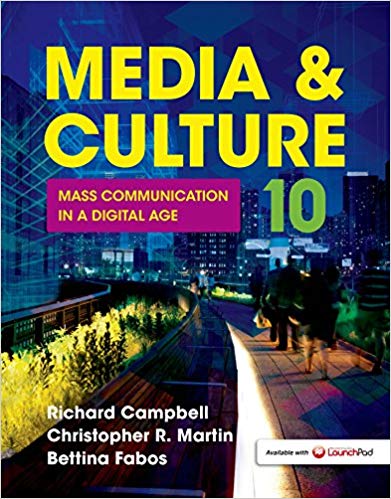
Media and Culture Mass Communication in a Digital Age 10th Edition by Richard Campbell - Test Bank

Media and Culture Mass Communication in a Digital Age 10th Edition by Richard Campbell - Test Bank   Instant Download - Complete Test Bank With Answers     Sample Questions Are Posted Below     1. Competition among media meant that with the arrival of television, radio became obsolete.   A) True   B) False …

$19.99

Media and Culture Mass Communication in a Digital Age 10th Edition by Richard Campbell – Test Bank


Instant Download – Complete Test Bank With Answers


Sample Questions Are Posted Below


1. Competition among media meant that with the arrival of television, radio became obsolete.
  A) True
  B) False


2. Guglielmo Marconi is credited with creating FM radio.
  A) True
  B) False


3. Guglielmo Marconi envisioned wireless telegraphy only as point-to-point communication and not as a one-to-many mass medium.
  A) True
  B) False


4. Alexander Popov was a Russian academic whose experiments in wireless communication occurred at roughly the same time as Marconi’s.
  A) True
  B) False


5. During his lifetime, Nikola Tesla received much recognition for his wireless inventions.
  A) True
  B) False


6. Inventor Lee De Forest developed a vacuum tube capable of detecting and amplifying radio signals.
  A) True
  B) False


7. The word broadcasting derives from the steel industry, in part because KDKA in Pittsburgh was one of the first stations to begin using radio as a mass medium.
  A) True
  B) False


8. In its entrepreneurial phase, radio was marketed as a ship-to-shore communication device.
  A) True
  B) False


9. The Titanic sank in 1912, resulting in the loss of about fifteen hundred lives; had it not been for radio, seven hundred additional lives would have been lost.
  A) True
  B) False


10. Congress passed the Radio Act of 1912 in response to the sinking of the British ocean liner Titanic.
  A) True
  B) False


11. The American Marconi Company had trouble developing as a business after World War I in part because the U.S. Navy did not want a foreign-controlled company wielding so much power in the field of emergent radio technologies.
  A) True
  B) False


12. Because of the role of the navy in early broadcast history, the United States today has a national broadcasting system both controlled and supervised by the government.
  A) True
  B) False


13. The Radio Corporation of America (RCA) was formed after World War I to give the United States an early worldwide monopoly over radio broadcasting.
  A) True
  B) False


14. During the 1920s, the United States was the only country that allowed commercial interests to control broadcasting.
  A) True
  B) False


15. Network radio helped modernize America by deemphasizing local in favor of national programs.
  A) True
  B) False


16. In the 1920s, CBS operated two radio networks, CBS-Red and CBS-Blue.
  A) True
  B) False


17. The aim of early radio networks such as CBS and NBC was to serve the public interest.
  A) True
  B) False


18. Under the Radio Act of 1927, broadcasters were allowed to own their radio channels.
  A) True
  B) False


19. The Radio Act of 1927 created the Radio Corporation of America.
  A) True
  B) False


20. In the 1940s, NBC willingly sold its Blue network because it was losing money.
  A) True
  B) False


21. With the Communications Act of 1934, the Federal Communications Commission officially became the Federal Radio Commission.
  A) True
  B) False


22. Radio soap operas got their name because they were a “clean” form of entertainment that lived up to the social and moral codes of the time.
  A) True
  B) False


23. Throughout radio’s early history—from the 1920s through the 1940s—advertisers exercised very little control over program content.
  A) True
  B) False


24. The program Amos ‘n’ Andy started on Chicago radio in 1945.
  A) True
  B) False


25. AM is better than FM for playing music because of its greater clarity and fidelity.
  A) True
  B) False


26. Texas Instruments marketed the first transistor radio in 1953.
  A) True
  B) False


27. By the 1960s, most radio listening was done outside the home.
  A) True
  B) False


28. RCA delayed the deployment of FM radio for many decades because it was more concerned with the development of television.
  A) True
  B) False


29. The first person to discover and develop FM radio in the 1920s and the 1930s was David Sarnoff of RCA.
  A) True
  B) False


30. Edwin H. Armstrong developed AM radio.
  A) True
  B) False


31. FM radio was an immediate commercial success and made its inventor a rich and happy man.
  A) True
  B) False


32. The Top 40 format refers to the forty most popular hits in a given week as measured by record sales.
  A) True
  B) False


33. The vast majority of the top radio talk-show hosts promote conservative viewpoints.
  A) True
  B) False


34. Country is the most popular radio format today.
  A) True
  B) False


35. By law, nonprofit broadcasters are allocated 25 percent of all the broadcast frequencies in the United States today.
  A) True
  B) False


36. In 1948, the FCC approved 10-watt FM stations, allowing more people to participate in radio.
  A) True
  B) False


37. Politicians have threatened to cut government funding for public broadcasting.
  A) True
  B) False


38. Contemporary public (noncommercial) radio mostly follows a variety rather than a specified format.
  A) True
  B) False


39. HD radio is a digital technology that enables broadcasters to multicast within an analog frequency.
  A) True
  B) False


40. Internet radio stations are those that either stream or simulcast a version of their on-air signal over the Web, or create a station exclusive to the Internet.
  A) True
  B) False


41. Podcasting and Internet radio aren’t very portable because you need a computer to use them.
  A) True
  B) False


42. Payola is the practice of record promoters paying deejays to play certain songs on the air.
  A) True
  B) False


43. The Telecommunications Act of 1996 set off an unprecedented consolidation in radio station ownership.
  A) True
  B) False


44. The Telecommunications Act of 1996 decreased the number of broadcast stations a single person or corporation can own.
  A) True
  B) False


45. Radio generates its largest profits by selling big national ads.
  A) True
  B) False


46. In the late 1990s, hundreds of radio stations shifted from individual to chain ownership.
  A) True
  B) False


47. iHeartMedia radio stations can be heard throughout most of the United States.
  A) True
  B) False


48. Telephone giant AT&T owns the nation’s largest radio network.
  A) True
  B) False


49. The nation’s largest broadcast group owns more than eight hundred radio stations.
  A) True
  B) False


50. The rise of pirate micropower radio stations in the United States in the 1990s led the federal government to approve a new class of noncommercial low-power FM radio stations in 2000.
  A) True
  B) False


51. The telegraph was useless as a means of communicating between ships at sea or between ships and the shore because ______.
  A) its signal was too weak to travel across bodies of water
  B) the telegraph signal was distorted by the electromagnetic spectrum
  C) telegraph equipment was too cumbersome to be used aboard ship
  D) the telegraph required a wire cable connecting the sending and receiving stations
  E) All of the options are correct.


52. The very earliest uses of Marconi’s wireless radio were for ______.
  A) military and commercial shipping
  B) gossip and shipping
  C) advertising and the military
  D) entertainment and ads
  E) playing rock-and-roll records


53. The ______ was important to radio technology because it allowed radio signals to be amplified.
  A) Hertz
  B) Audion vacuum tube
  C) cathode ray tube
  D) telephony
  E) electromagnetic wave


54. Which statement best indicates how inventors and government offices were able to establish who was responsible for early developments in radio technology?
  A) Patents clearly indicate who invented what piece of technology first.
  B) Only Italians and Americans were interested in early broadcasting.
  C) Inventors respected other inventors out of a sense of professional courtesy.
  D) The early days of radio were heavily regulated, and therefore clearly documented, by government officials.
  E) Simultaneous and independent discoveries, along with competing claims for patents, often had inventors going to court over their inventions.


55. Reginald Fessenden is credited with making the first ______, on Christmas Eve in 1906.
  A) wireless telegraph
  B) distress call from a sinking ocean liner
  C) on-air paid advertisement
  D) voice broadcast
  E) use of Morse code


56. The term broadcasting was originally used in ______.
  A) farming
  B) construction
  C) commercial fishing
  D) carpentry
  E) manufacturing


57. Which event led to the Radio Act of 1912, which required most large ships to carry wireless technology?
  A) Fessenden’s 1906 Christmas Eve transmission
  B) The sinking of the Titanic
  C) David Sarnoff’s wedding
  D) Lee De Forest’s Eiffel Tower broadcast
  E) Marconi’s founding of American Marconi


58. The Radio Corporation of America bought which of the following companies?
  A) British Marconi
  B) American Marconi
  C) AT&T
  D) Westinghouse
  E) WNBC


59. Why were AT&T and GE able to undercut Marconi’s influence with the U.S. Navy, even though Marconi was the best company?
  A) The U.S. Navy wanted to use government-owned companies over private companies.
  B) The U.S. Navy was concerned about a foreign-controlled company having so much power over their communications.
  C) The U.S. Navy wished to promote international relations by using foreign companies.
  D) The U.S. Navy was dissatisfied with the way American Marconi was being run.
  E) None of the above options is correct.


60. What three companies controlled most of RCA when it was first a government-approved commercial monopoly in the early 1920s?
  A) NBC, GE, United Fruit
  B) AT&T, GE, Westinghouse
  C) GE, AT&T, American Marconi
  D) ABC, NBC, CBS
  E) AT&T, Clear Channel, CBS


61. Who set up a crude radio station above his Pittsburgh garage in 1916?
  A) Edwin H. Armstrong
  B) David Sarnoff
  C) Ethan Zuckerman
  D) Rush Limbaugh
  E) Frank Conrad


62. Which company became the first to sell ads on the radio?
  A) American Marconi
  B) AT&T
  C) NBC
  D) RCA
  E) Westinghouse


63. In the late 1920s, which of the following was not a part owner of the National Broadcasting Company?
  A) RCA
  B) General Electric
  C) Westinghouse
  D) CBS
  E) All of the companies were owners of the National Broadcasting Company.


64. As a new network, CBS was able to compete with NBC by ______.
  A) charging affiliates less for its programs
  B) paying affiliates to broadcast its programs
  C) being the first network to broadcast in high fidelity
  D) advertising its programs on billboards
  E) being the first to offer musical programs and quiz shows


65. What established the Federal Radio Commission?
  A) The Radio Act of 1912
  B) The Radio Act of 1919
  C) The Radio Act of 1927
  D) The Radio Act of 1934
  E) None of the above options is correct.


66. The act that first emphasized that broadcasters did not own their channels but were granted licenses provided they operated in the “public interest, convenience, or necessity” was the
  A) Federal Communications Act of 1934
  B) Radio Act of 1912
  C) Radio Act of 1927
  D) 1932 revocation of RCA’s monopoly status
  E) None of the above options is correct.


67. With the Federal Communications Act of 1934, the Federal Radio Commission became the ______.
  A) Wireless Communication Commission
  B) National Broadcasting Company
  C) Federal Communications Commission
  D) Radio Corporation of America
  E) None of the above options is correct.


68. What time period is considered the “golden age” of radio?
  A) 1960s
  B) Early 1900s
  C) 1920s and 1930s
  D) 1890s
  E) 1990s


69. Which radio program panicked listeners on Halloween eve in 1938?
  A) The Shadow
  B) The Green Hornet
  C) Amos ‘n’ Andy
  D) War of the Worlds
  E) None of the above options is correct.


70. Why did the public find it easy to believe that Orson Welles’s broadcast of War of the Worlds was a real event?
  A) Newspapers also printed the story as true.
  B) It was done in the style of a real news broadcast.
  C) A sizable meteor really did hit New Jersey that day.
  D) The broadcast was never identified as fiction or a dramatization.
  E) All of the options are correct.


71. Which of the following technologies did not cause major changes in the radio industry?
  A) Television
  B) The Internet
  C) The transistor
  D) FM transmitters
  E) The telegraph


72. The transistor made radio receivers ______.
  A) portable
  B) expensive
  C) larger
  D) stereophonic
  E) disposable


73. Prior to the 1950s and 1960s, most radio listening occurred in the home because ______.
  A) people didn’t have televisions yet
  B) radio sets before the invention of transistors used bulky and delicate vacuum tubes
  C) automobiles weren’t really widespread yet so most people couldn’t leave home
  D) radio programs used to be longer and required people’s undivided attention
  E) None of the above options is correct.


74. Which of the following best sums up the advantages and disadvantages of FM radio versus AM?
  A) FM included less static, had better sound fidelity, but traveled for shorter distances.
  B) FM included less static, could travel longer distances, but had uneven results with pitch.
  C) FM was an older, cheaper technology but did better with stereo sound.
  D) FM was much better suited to the spoken voice because music sounded clearer on AM.
  E) None of the above options is correct.


75. When the radio industry was forced to reorganize in the 1950s, which of the following was not among the changes made?
  A) A turn to format-driven radio
  B) A greater dependence on recorded music
  C) Featuring top deejays during prime driving periods
  D) A move to reach national audiences
  E) The repeated playing of top songs


76. Which statement indicates why radio typically has its biggest audiences between 6 and 9 A.M. and between 4 and 7 P.M.?
  A) Many people listen to the radio as they drive to and from work.
  B) The funniest shows are on at those times.
  C) The lucrative teenage audience listens most during those times.
  D) Radio stations want it to be that way.
  E) None of the above options is correct.


77. Which of the following indicates how radio listeners today are different from radio listeners in the 1930s?
  A) Listeners today are loyal to specific stations or formats rather than to specific shows.
  B) Listeners today tune in at a specific time to hear their favorite radio programs, rather than cruising through stations.
  C) Peak listening occurs in the evening hours today, rather than during drive time.
  D) Today, people listen to their radio at home more than people did in the 1930s.
  E) None of these options is correct.


78. Radio formats usually target specific audiences according to ______.
  A) age
  B) gender
  C) race or ethnicity
  D) income
  E) All of the options are correct.


79. One of the driving forces behind the adoption of format radio was that ______.
  A) radio stations could charge an advertising premium for target audiences
  B) paperwork became easier for program directors
  C) disc jockeys had a chance to play a wider variety of music
  D) it made it easier for record companies to promote new artists
  E) radio stations could fulfill their public service requirements


80. Which of the following statements about the news/talk/information radio format is true?
  A) From 1987 until 2014, the number of stations with this format rose from just under 200 to more than 2,000.
  B) It is more expensive to produce than a music format.
  C) It appeals to advertisers looking to target working- and middle-class adult consumers.
  D) It tends to appeal to listeners over thirty-five years old.
  E) All of the options are correct.


81. The most popular music format on U.S. radio today is ______.
  A) country
  B) contemporary hit radio
  C) urban contemporary
  D) top 40
  E) adult contemporary


82. Nonprofit radio today is ______.
  A) accepting liquor advertising
  B) prospering
  C) buying up commercial radio stations
  D) converting to analog equipment to save money
  E) struggling to survive government funding cuts


83. Which of the following statements about National Public Radio is true?
  A) It is fully funded by the U.S. government with reliable support from the Republican Party.
  B) It has fewer than two million listeners nationwide each week.
  C) It is completely free of sponsorship from private businesses and corporations.
  D) Morning Edition and All Things Considered are two of its popular programs.
  E) None of the above options is correct.


84. Satellite radio ______.
  A) relies on transmitters and towers on the ground to reach consumers
  B) is now provided by only one company in the United States
  C) is mostly used by ham radio operators for secure signals, not by the general public
  D) is free to consumers once they buy the equipment that receives the satellite signal
  E) is splintered into dozens of competing satellite radio providers


85. Which of the following is true about HD radio?
  A) It allows a radio station to broadcast several different formats simultaneously on the same frequency it already uses.
  B) It is the same thing as satellite radio.
  C) It has been exploding in popularity, and consumer demand is outstripping the ability of radio stations to keep up.
  D) HD radio is an analog technology.
  E) It was developed in the 1950s but kept from the public for decades by business owners.


86. Which of the following statements about the relationship between the radio industry and the concept of media convergence is false?
  A) The convergence between radio and the recording industry was just the earliest instance of radio overlapping with another form of mass media.
  B) Radio has heavily converged with the Internet with things like podcasts and streaming audio.
  C) Internet stations are able to negotiate royalty rates directly with the music industry.
  D) Internet radio harkens back to the early days of radio, with its large variety of stations, and to the transistors of the fifties, with its portability.
  E) Internet radio only includes existing stations that simulcast over the Web.


87. Podcasting is ______.
  A) an agricultural term that refers to spreading pods over a large area
  B) a radio industry practice of sending a bundle, or pod, of programming to affiliates
  C) the practice of making a program available online that can be played on computers or portable MP3 players
  D) a reference to the small booths, or pods, that disc jockeys work in
  E) None of the above options is correct.


88. Despite new technologies like personal MP3 players and music online, traditional radio continues to see billions of dollars in advertising money because ______.
  A) advertisers are accustomed to using radio and are slow to change
  B) advertisers like the music played on a particular radio station
  C) over 90 percent of American teenagers and adults listen to the radio in a given week
  D) advertisers are required by law to place a percentage of their ads on the radio waves
  E) None of the above options is correct.


89. The top three radio companies in the United States are ______.
  A) CBS, Salem, and Univision
  B) iHeartMedia, Cumulus, and Townsquare
  C) Cox, Cumulus, and CBS
  D) Cumulus, Cox, and CBS
  E) iHeartMedia, CBS, and Lotus


90. Univision is the top ______ broadcaster in the United States.
  A) nonprofit
  B) European
  C) alternative
  D) Spanish-language
  E) None of the above options is correct.


91. What has been the defining feature of public debate regarding radio as a natural resource?
  A) Broadcasting companies are eager for questions on their financial arrangements.
  B) Public debate is vigorous and intense over the role of radio.
  C) There is little public debate over the issue.
  D) Record companies want to encourage debate in order to create the best environment for artists to grow on the airwaves.
  E) All of the options are correct.


92. Invented in the 1840s, the _________________________ was the precursor of radio technology.


93. American inventor Samuel _________________________ developed the system of sending electrical impulses from a transmitter through a cable to a reception point.


94. In the mid-1860s, James Maxwell theorized that _________________________ waves existed.


95. Lee De Forest claimed as his biggest breakthrough the development of the _________________________, or triode, vacuum tube.


96. Now a media term, _________________________ was once an agricultural term that referred to casting seeds over a large area.


97. Westinghouse established a station with the call letters _________________________, which aired national returns from the Cox-Harding presidential election on November 2, 1920.


98. The government-approved commercial company that allowed the United States to gain world leadership in broadcasting was named _________________________.


99. The Radio Act of _____________________ established the Federal Radio Commission.


100. The Communications Act of _________________________ established the Federal Communications Commission.


101. A type of radio and sound transmission that stresses the volume or height of radio waves is called _________________________.


102. _________________________, originally called Top 40 radio, encompasses everything from hip-hop to pop punk.


103. The _________________________ is a private, nonprofit corporation created by Congress in 1967.


104. _________________________ is a noncommercial radio network established in 1967 by the U.S. Congress to provide an alternative to commercial broadcasting.


105. _________________________ is a digital technology that enables AM and FM radio broadcasters to multicast two or three additional compressed signals within their traditional analog frequency.


106. _________________________ could refer to an online simulcast of a traditional radio station or to a service designed especially for this use.


107. _________________________ is the practice of making audio files available for download over the Internet.


108. The practice of record promoters paying deejays or programmers to play particular songs is called _________________________.


109. _________________________ is the company that owns the largest number of radio stations in the United States.


Use the following to answer questions 110-114:


Matching

Selecting from the following list of names, match them with the corresponding items below.

A. Lee De Forest
B. David Sarnoff
C. Guglielmo Marconi
D. Reginald Fessenden
E. Edwin H. Armstrong


110. Developed FM radio


111. Former head of NBC


112. Developed wireless telegraphy


113. First to send voice through the airwaves


114. Developed Audion, or triode, vacuum tube


115. Why was the development of the telegraph important in media history?


116. Marconi is widely considered the father of radio, yet he never did any broadcasting, nor was he part of the media. Explain.


117. What were De Forest’s and Fessenden’s contributions to radio?


118. Why was the RCA monopoly formed?


119. WEAF in New York was the first “toll broadcasting” station. What does that mean?


120. How and why did radio networks develop?


121. By the late 1920s, radio had grown from a dispersed and local medium into a national, commercial mass medium. Describe two important consequences of that growth for programming.


122. How did broadcasting come to be federally regulated?


123. Explain how radio survived the coming of television.


124. Define format radio, and give examples.


125. Will Internet radio mean the end of traditional radio? Why or why not? How are traditional radio stations and networks responding to this latest round of technological change?


126. Since the 1950s, in what ways could the radio industry be said to have experienced convergence with other media?


127. What kind of radio consumer are you? Describe the ways you use radio—regular broadcasts, podcasts, HD radio, satellite radio, or Internet radio. Do you actively listen to the radio or is it just “in the background”?


Answer Key


1. B
2. B
3. A
4. A
5. B
6. A
7. B
8. A
9. A
10. A
11. A
12. B
13. A
14. A
15. A
16. B
17. B
18. B
19. B
20. B
21. B
22. B
23. B
24. B
25. B
26. A
27. A
28. A
29. B
30. B
31. B
32. A
33. A
34. A
35. B
36. A
37. A
38. A
39. A
40. A
41. B
42. A
43. A
44. B
45. B
46. A
47. A
48. B
49. A
50. A
51. D
52. A
53. B
54. E
55. D
56. A
57. B
58. B
59. B
60. B
61. E
62. B
63. D
64. B
65. C
66. C
67. C
68. C
69. D
70. B
71. E
72. A
73. B
74. A
75. D
76. A
77. A
78. E
79. A
80. E
81. A
82. E
83. D
84. B
85. A
86. E
87. C
88. C
89. B
90. D
91. C
92. telegraph
93. Morse
94. electromagnetic
95. Audion
96. broadcasting
97. KDKA
98. RCA
99. 1927
100. 1934
101. AM or amplitude modulation
102. Contemporary hit radio
103. Corporation for Public Broadcasting
104. NPR or National Public Radio
105. HD radio
106. Internet radio
107. Podcasting
108. payola
109. iHeartMedia
110. E
111. B
112. C
113. D
114. A
115.  
116.  
117.  
118.  
119.  
120.  
121.  
122.  
123.  
124.  
125.  
126.  
127.  


Additional information

Add Review

Your email address will not be published. Required fields are marked *