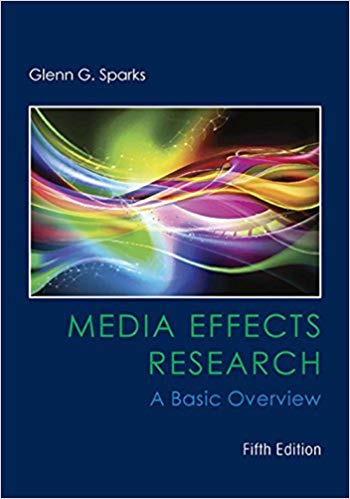
Media Effects Research A Basic Overview by Glenn G. Sparks - Test Bank

Media Effects Research A Basic Overview by Glenn G. Sparks - Test Bank   Instant Download - Complete Test Bank With Answers     Sample Questions Are Posted Below   © 2016 Cengage Learning®. May not be scanned, copied or duplicated, or posted to a publicly accessible website, in whole or in part. Potential Exam …

$19.99

Media Effects Research A Basic Overview by Glenn G. Sparks – Test Bank


Instant Download – Complete Test Bank With Answers


Sample Questions Are Posted Below


© 2016 Cengage Learning®. May not be scanned, copied or duplicated, or posted to a publicly accessible website, in whole or in
part.
Potential Exam Questions for Media Effects Research: A Basic Overview (5th Edition) by Glenn
G. Sparks
NOTE: Correct answers are underlined.
Chapter 5
1. According to the text, the fact that people can react to the very same media content in a
number of different ways is consistent with which of the following important principles?
a. the principle of limited effects of mass communication
b. the principle that media content does not equal effect
c. the principle that correlations do not necessarily imply causality
d. the principle of television addiction
e. the principle of symbolic catharsis
2. According to the text, what were the major findings in the study conducted by Robert
Hornik that analyzed the effects of a $1 billion anti-drug campaign sponsored by the
National Youth Anti-Drug Media Campaign?
a. The youth who were exposed to the messages of the campaign were more likely
to express intentions to avoid drug use in the future compared to those who were
not exposed.
b. On average, very few youth were even exposed to the messages of the campaign
so there were no effects one way or the other.
c. The youth who were exposed to the messages of the campaign were less likely to
express intentions to avoid drug use in the future compared to those who were not
exposed.
d. There were no statistical differences found between any groups that were
compared in this study.
e. None of the above statements are accurate regarding Hornik’s research.
3. According to the text, what did Andrew Weaver’s content analysis of YouTube videos
reveal?
a. Overall, the videos are equally violent as prime-time TV content.
b. Overall, the videos are far LESS violent than prime-time TV content.
c. Overall, the videos are far MORE violent than prime-time TV content.
d. Women are featured MORE frequently on YouTube than on prime-time TV.
e. Women are featured LESS frequently on YouTube than on prime-time TV.
4. According to the text, which part of George Gerbner’s Cultural Indicators Paradigm is
concerned with why media producers produce the content that they do?
© 2016 Cengage Learning®. May not be scanned, copied or duplicated, or posted to a publicly accessible website, in whole or in
part.
a. institutional process analysis
b. message system analysis
c. cultivation analysis
d. uses and gratifications
e. the forbidden fruit effect
5. According to the text, in attempting to interpret the size of the effect that emerged from
the longitudinal research of Eron and Huesmann, one way to think about it was to think
about 10 children who collectively committed 20 acts of aggression. In order to match the
statistical size of the effect that emerged from the research, how many of these acts of
aggression should be attributed to watching media violence?
a. 1
b. 2
c. 5
d. 10
e. 18
6. According to the text, which of the following statements is TRUE regarding the social
learning effect that was demonstrated by Bandura when he studied imitation of
aggressive behavior?
a. The effect was quite general—it worked with videos made by the experimenters
as well as with old Batman and Superman cartoons.
b. The effect was quite specific—it worked with the real Batman and Superman TV
shows, but not with Batman and Superman cartoons.
c. The effect was quite specific—it tended to work with females but not with males.
d. The effect was quite general—it worked equally for males and females.
e. The effect was quite specific—it worked with prosocial behaviors but not with
aggressive behaviors.
7. According to the text, which of the following was given as a reason for why people resist
the conclusion that media violence is causally related to an increase in aggressive
behavior?
a. Most people are not scientists.
b. The news media are even less likely than in years past to report stories on the
negative effects of media.
c. The wisdom of the many is correct—people have an intuitive understanding that
the scientists are, in fact, wrong about their conclusion that media violence causes
aggressive behavior.
© 2016 Cengage Learning®. May not be scanned, copied or duplicated, or posted to a publicly accessible website, in whole or in
part.
d. People don’t want the truth to be discovered because of the fear of government
censorship over the media.
e. None of the above reasons were given in the text.
8. According to the text, the research of Brandon Centerwall was an important piece of the
puzzle in the study of media violence because it showed:
a. a relationship between media violence and aggressive behavior in the world
outside the laboratory.
b. a causal relationship between exposure to media violence and aggressive behavior
in the laboratory.
c. evidence for symbolic catharsis theory.
d. evidence for the theory of excitation transfer.
e. that the suicide rate increased in the United States, Canada, and South Africa after
TV was introduced to those countries.
9. According to the text, Jeffrey Goldstein devoted an entire book to the question of the
appeal of media violence. According to Goldstein, which of the following is TRUE?
a. Violent entertainment is the preferred form of entertainment of most of the
viewing audience, most of the time.
b. Violent entertainment is not preferred by any segment of the media audience.
c. Most viewers appear to prefer comedies and sitcoms to violent entertainment.
d. No one really knows why anyone would prefer to watch violent entertainment.
e. The theory with the best overall level of empirical support in the literature is the
theory of symbolic catharsis.
10. According to the text, “priming” is most consistent with which of the following?
a. desensitization
b. symbolic catharsis theory
c. disinhibition of aggressive behavior after watching media violence
d. enjoyment of media violence
e. facilitation of aggressive behavior after watching media violence


Additional information

Add Review

Your email address will not be published. Required fields are marked *