Subtotal: $620.00

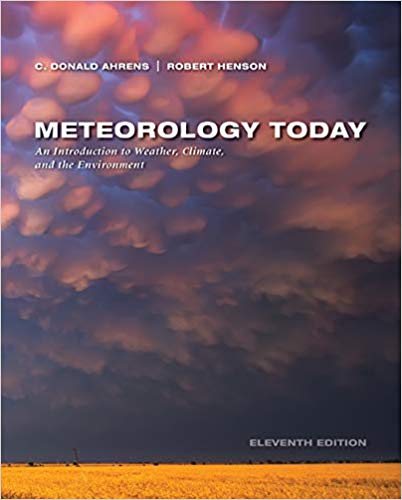
Meteorology Today 11th Edition by C. Donald Ahrens - Test Bank

Meteorology Today 11th Edition by C. Donald Ahrens - Test Bank   Instant Download - Complete Test Bank With Answers     Sample Questions Are Posted Below   True / False 1. Frost forms when the dew point temperature is at or below freezing. a. True b. False ANSWER: True REFERENCES: The Formation of Dew …

$19.99

Meteorology Today 11th Edition by C. Donald Ahrens – Test Bank


Instant Download – Complete Test Bank With Answers


Sample Questions Are Posted Below


True / False

1. Frost forms when the dew point temperature is at or below freezing.
a. True
b. False
ANSWER: True
REFERENCES: The Formation of Dew and Frost
LEARNING OBJECTIVES: METT.AHRE.16.5.1 – Differentiate among the processes and conditions that lead to the formation of dew, frozen dew, and frost.
OTHER: Bloom’s: Analyze

2. Condensation nuclei may be made up of salt from the ocean.
a. True
b. False
ANSWER: True
REFERENCES: Condensation Nuclei
LEARNING OBJECTIVES: METT.AHRE.16.5.2 – List the characteristics of the various nuclei types, including their sizes, origins, and suitability as condensation nuclei.
OTHER: Bloom’s: Remember

3. Steam fog poses a threat to humans with respiratory problems.
a. True
b. False
ANSWER: False
REFERENCES: Fog
LEARNING OBJECTIVES: METT.AHRE.16.5.4 – Distinguish among the types of fog, and illustrate the processes involved and the respective conditions needed to form each type.
OTHER: Bloom’s: Analyze

4. Fog is a major hazard to aviation.
a. True
b. False
ANSWER: True
REFERENCES: Fog
LEARNING OBJECTIVES: METT.AHRE.16.5.5 – Summarize the geographical distribution of fog and debate its impact on human systems.
OTHER: Bloom’s: Understand

5. Even at high elevations where cirrus clouds are found, liquid water still exists in the clouds.
a. True
b. False
ANSWER: True
REFERENCES: Clouds
LEARNING OBJECTIVES: METT.AHRE.16.5.7 – Label cloud types by altitude, and describe their formation processes, main characteristics, and the weather that each type indicates.
OTHER: Bloom’s: Remember

6. Contrails form due to the heating of air by aircraft engine exhaust.
a. True
b. False
ANSWER: False
REFERENCES: Clouds
LEARNING OBJECTIVES: METT.AHRE.16.5.8 – Analyze unusual cloud types and their formation mechanisms.
OTHER: Bloom’s: Analyze

7. Water vapor cannot condense onto hygroscopic nuclei particles at relative humidities less than 100 percent.
a. True
b. False
ANSWER: False
REFERENCES: Condensation Nuclei
LEARNING OBJECTIVES: METT.AHRE.16.5.2 – List the characteristics of the various nuclei types, including their sizes, origins, and suitability as condensation nuclei.
OTHER: Bloom’s: Remember

8. The sky is overcast and it is raining. The cloud above you is a cumulus humilis cloud.
a. True
b. False
ANSWER: False
REFERENCES: Clouds
LEARNING OBJECTIVES: METT.AHRE.16.5.7 – Label cloud types by altitude, and describe their formation processes, main characteristics, and the weather that each type indicates.
OTHER: Bloom’s: Remember

9. On a cold morning, it is possible to see your breath even if the air temperature is above freezing.
a. True
b. False
ANSWER: True
REFERENCES: Fog
LEARNING OBJECTIVES: METT.AHRE.16.5.4 – Distinguish among the types of fog, and illustrate the processes involved and the respective conditions needed to form each type.
OTHER: Bloom’s: Analyze

10. In hazy conditions, distant objects are usually more visible in the afternoon than in the morning, even when the concentration of particles in the air has not changed.
a. True
b. False
ANSWER: True
REFERENCES: Haze
LEARNING OBJECTIVES: METT.AHRE.16.5.3 – Outline the processes involved in the formation of haze, compare and contrast haze types, and illustrate the color effects that can be observed in hazy conditions.
OTHER: Bloom’s: Understand

11. Wet haze restricts visibility more than dry haze.
a. True
b. False
ANSWER: True
REFERENCES: Haze
LEARNING OBJECTIVES: METT.AHRE.16.5.3 – Outline the processes involved in the formation of haze, compare and contrast haze types, and illustrate the color effects that can be observed in hazy conditions.
OTHER: Bloom’s: Understand

12. The foggiest spot near sea level in the United States is Cape Cod, Massachusetts.
a. True
b. False
ANSWER: False
REFERENCES: Fog
LEARNING OBJECTIVES: METT.AHRE.16.5.5 – Summarize the geographical distribution of fog and debate its impact on human systems.
OTHER: Bloom’s: Understand

13. Because fog causes a lot of problems, such as accidents, scientists are seeking ways to disperse, or at least “thin” fog.
a. True
b. False
ANSWER: True
REFERENCES: Fog
LEARNING OBJECTIVES: METT.AHRE.16.5.5 – Summarize the geographical distribution of fog and debate its impact on human systems.
OTHER: Bloom’s: Understand

14. In Ralph Abercromby’s and Hugo Hildebrandsson’s cloud classification system, each of the four primary cloud groups is identified by the type of precipitation it produces.
a. True
b. False
ANSWER: False
REFERENCES: Clouds
LEARNING OBJECTIVES: METT.AHRE.16.5.6 – Identify factors that have contributed to the nomenclature applied in cloud classification systems, and list and describe the main types of clouds.
OTHER: Bloom’s: Remember

15. High cirriform clouds are composed almost entirely of ice crystals. In tropical regions, air temperatures low enough to freeze all liquid water usually occur only above 6000 m (about 20,000 ft). In polar regions, however, these same temperatures may be found at altitudes as low as 3000 m (about 10,000 ft). Hence, while you may observe cirrus clouds at 3600 m (about 12,000 ft) over northern Alaska, you will not see them at that elevation above southern Florida.
a. True
b. False
ANSWER: True
REFERENCES: Clouds
LEARNING OBJECTIVES: METT.AHRE.16.5.6 – Identify factors that have contributed to the nomenclature applied in cloud classification systems, and list and describe the main types of clouds.
OTHER: Bloom’s: Remember

16. All clouds form in rising air.
a. True
b. False
ANSWER: False
REFERENCES: Clouds
LEARNING OBJECTIVES: METT.AHRE.16.5.8 – Analyze unusual cloud types and their formation mechanisms.
OTHER: Bloom’s: Analyze

17. Aside from cumulonimbus clouds that sometimes penetrate into the stratosphere, all clouds are observed in the lower atmosphere.
a. True
b. False
ANSWER: False
REFERENCES: Clouds
LEARNING OBJECTIVES: METT.AHRE.16.5.8 – Analyze unusual cloud types and their formation mechanisms.
OTHER: Bloom’s: Analyze

18. The TRMM (Tropical Rainfall Measuring Mission) satellite, a joint venture between NASA and the Japan Aerospace Exploration Agency, can pick out individual cloud features as small as 2.4 km (1.5 mi) in diameter.
a. True
b. False
ANSWER: True
REFERENCES: Couds
LEARNING OBJECTIVES: METT.AHRE.16.5.9 – Compare the different satellite types utilized to collect cloud data, and explain how this type of data collection is used in understanding atmospheric processes.
OTHER: Bloom’s: Understand

Multiple Choice

19. Dew is most likely to form on
a. clear, calm nights.
b. cloudy, calm nights.
c. clear, windy nights.
d. cloudy, windy nights.
e. rainy nights.
ANSWER: a
REFERENCES: The Formation of Dew and Frost
LEARNING OBJECTIVES: METT.AHRE.16.5.1 – Differentiate among the processes and conditions that lead to the formation of dew, frozen dew, and frost.
OTHER: Bloom’s: Analyze

20. The cooling of the ground to produce dew is mainly the result of
a. conduction.
b. radiational cooling.
c. cooling due to the release of latent heat.
d. advection.
e. condensation.
ANSWER: b
REFERENCES: The Formation of Dew and Frost
LEARNING OBJECTIVES: METT.AHRE.16.5.1 – Differentiate among the processes and conditions that lead to the formation of dew, frozen dew, and frost.
OTHER: Bloom’s: Analyze

21. Particles that serve as surfaces on which water vapor may condense are called
a. hydrophobic nuclei.
b. nacreous nuclei.
c. condensation nuclei.
d. scud.
e. molecules.
ANSWER: c
REFERENCES: Condensation Nuclei
LEARNING OBJECTIVES: METT.AHRE.16.5.2 – List the characteristics of the various nuclei types, including their sizes, origins, and suitability as condensation nuclei.
OTHER: Bloom’s: Remember

22. Frost typically forms on the inside of a windowpane (rather than the outside) because
a. the inside of the pane is colder than the outside.
b. there is more water vapor touching the inside of the pane.
c. there is less water vapor touching the inside of the pane.
d. the temperature is higher on the inside.
e. there is more radiational cooling on the inside.
ANSWER: b
REFERENCES: The Formation of Dew and Frost
LEARNING OBJECTIVES: METT.AHRE.16.5.1 – Differentiate among the processes and conditions that lead to the formation of dew, frozen dew, and frost.
OTHER: Bloom’s: Analyze

23. Condensation nuclei are important in the atmosphere because
a. they provide most of the minerals found in water.
b. they make it easier for condensation to occur in the atmosphere.
c. they are the sole producers of smog.
d. they filter out sunlight.
e. they provide the only means we have of tracking wind motions.
ANSWER: b
REFERENCES: Condensation Nuclei
LEARNING OBJECTIVES: METT.AHRE.16.5.2 – List the characteristics of the various nuclei types, including their sizes, origins, and suitability as condensation nuclei.
OTHER: Bloom’s: Remember

24. When radiation fog “burns off”, the fog tends to dissipate
a. from the bottom up.
b. from the top down.
c. starting at the middle and working both upward and downward.
d. laterally.
e. in random directions.
ANSWER: a
REFERENCES: Fog
LEARNING OBJECTIVES: METT.AHRE.16.5.4 – Distinguish among the types of fog, and illustrate the processes involved and the respective conditions needed to form each type.
OTHER: Bloom’s: Analyze

25. Radiation fog forms best on a
a. clear winter night with a slight breeze.
b. cloudy winter night with a strong breeze.
c. clear summer night with a strong breeze.
d. cloudy summer night with a slight breeze.
e. cloudy winter night with a slight breeze.
ANSWER: a
REFERENCES: Fog
LEARNING OBJECTIVES: METT.AHRE.16.5.4 – Distinguish among the types of fog, and illustrate the processes involved and the respective conditions needed to form each type.
OTHER: Bloom’s: Analyze

26. On a cold, winter morning, the most likely place for radiation fog to form is
a. at the top of a hill or mountain.
b. in a valley.
c. along the side of a hill.
d. over a body of water.
e. in a city.
ANSWER: b
REFERENCES: Fog
LEARNING OBJECTIVES: METT.AHRE.16.5.5 – Summarize the geographical distribution of fog and debate its impact on human systems.
OTHER: Bloom’s: Understand

27. The fog that forms along the Pacific coastline of North America is mainly of which type?
a. radiation fog
b. upslope fog
c. frontal fog
d. advection fog
e. steam fog
ANSWER: d
REFERENCES: Fog
LEARNING OBJECTIVES: METT.AHRE.16.5.5 – Summarize the geographical distribution of fog and debate its impact on human systems.
OTHER: Bloom’s: Understand

28. If fog is forming in Denver, Colorado (located on the eastern side of the Rocky Mountains), and the wind is blowing from the east, then the fog is most likely
a. advection fog.
b. frontal fog.
c. upslope fog.
d. radiation fog.
e. downslope fog.
ANSWER: c
REFERENCES: Fog
LEARNING OBJECTIVES: METT.AHRE.16.5.5 – Summarize the geographical distribution of fog and debate its impact on human systems.
OTHER: Bloom’s: Understand

29. Fog that most often forms as warm rain falls into a cold layer of surface air is called
a. radiation fog.
b. evaporation (mixing) or frontal fog.
c. advection fog.
d. upslope fog.
e. giant fog.
ANSWER: b
REFERENCES: Fog
LEARNING OBJECTIVES: METT.AHRE.16.5.4 – Distinguish among the types of fog, and illustrate the processes involved and the respective conditions needed to form each type.
OTHER: Bloom’s: Analyze

30. Clouds are classified by their
a. appearance.
b. altitude.
c. method of formation.
d. temperature.
e. altitude and appearance.
ANSWER: e
REFERENCES: Clouds
LEARNING OBJECTIVES: METT.AHRE.16.5.6 – Identify factors that have contributed to the nomenclature applied in cloud classification systems, and list and describe the main types of clouds.
OTHER: Bloom’s: Remember

31. Which cloud type is composed of ice crystals and can cause a halo to form around the Sun or Moon?
a. altostratus
b. stratus
c. nimbostratus
d. cirrostratus
e. angelitus
ANSWER: d
REFERENCES: Clouds
LEARNING OBJECTIVES: METT.AHRE.16.5.7 – Label cloud types by altitude, and describe their formation processes, main characteristics, and the weather that each type indicates.
OTHER: Bloom’s: Remember

32. Light or moderate-but-steady precipitation is most often associated with ____ clouds.
a. nimbostratus
b. cirrostratus
c. cirrocumulus
d. cumulonimbus
e. altocumulus
ANSWER: a
REFERENCES: Clouds
LEARNING OBJECTIVES: METT.AHRE.16.5.7 – Label cloud types by altitude, and describe their formation processes, main characteristics, and the weather that each type indicates.
OTHER: Bloom’s: Remember

33. These types of clouds make the Sun appear as a dimly visible round disk.
a. altocumulus
b. cirrostratus
c. altostratus
d. cirrocumulus
e. cirrus
ANSWER: c
REFERENCES: Clouds
LEARNING OBJECTIVES: METT.AHRE.16.5.7 – Label cloud types by altitude, and describe their formation processes, main characteristics, and the weather that each type indicates.
OTHER: Bloom’s: Remember

34. When viewed from the surface, these clouds may be viewed as individual cloud elements (puffs) or as rows of ripples that resemble the scales of a fish.
a. stratocumulus
b. cumulus
c. cirrocumulus
d. altocumulus
e. cumulonimbus
ANSWER: c
REFERENCES: Clouds
LEARNING OBJECTIVES: METT.AHRE.16.5.7 – Label cloud types by altitude, and describe their formation processes, main characteristics, and the weather that each type indicates.
OTHER: Bloom’s: Remember

35. Cirrus clouds are composed primarily of
a. water droplets.
b. water vapor.
c. ice particles.
d. salt aerosols.
e. dust particles.
ANSWER: c
REFERENCES: Clouds
LEARNING OBJECTIVES: METT.AHRE.16.5.7 – Label cloud types by altitude, and describe their formation processes, main characteristics, and the weather that each type indicates.
OTHER: Bloom’s: Remember

36. Detached clouds of delicate and fibrous appearance, without shading, usually white in color and sometimes of a silky appearance are
a. stratus clouds.
b. cirrocumulus clouds.
c. altostratus clouds.
d. cirrus clouds.
e. cirrostratus clouds.
ANSWER: d
REFERENCES: Clouds
LEARNING OBJECTIVES: METT.AHRE.16.5.7 – Label cloud types by altitude, and describe their formation processes, main characteristics, and the weather that each type indicates.
OTHER: Bloom’s: Remember

37. Thick clouds of this type can be used to predict rain or snow within 12 to 24 hours because the often appear ahead of an advancing cyclonic storm.
a. stratus
b. nimbostratus
c. cirrostratus
d. stratocumulus
e. altocumulus
ANSWER: c
REFERENCES: Clouds
LEARNING OBJECTIVES: METT.AHRE.16.5.7 – Label cloud types by altitude, and describe their formation processes, main characteristics, and the weather that each type indicates.
OTHER: Bloom’s: Remember

38. A dim, “watery” Sun visible through a gray sheet-like cloud layer is often a good indication of ____ clouds.
a. stratocumulus
b. cirrostratus
c. cumulonimbus
d. altostratus
e. nimbostratus
ANSWER: d
REFERENCES: Clouds
LEARNING OBJECTIVES: METT.AHRE.16.5.7 – Label cloud types by altitude, and describe their formation processes, main characteristics, and the weather that each type indicates.
OTHER: Bloom’s: Remember

39. An anvil-shaped top is most often associated with
a. cumulonimbus.
b. cumulus congestus.
c. altocumulus.
d. cumulus humilis.
e. stratus.
ANSWER: a
REFERENCES: Clouds
LEARNING OBJECTIVES: METT.AHRE.16.5.7 – Label cloud types by altitude, and describe their formation processes, main characteristics, and the weather that each type indicates.
OTHER: Bloom’s: Remember

40. A low, lumpy cloud layer that appears in rows, patches, or rounded masses would be classified as
a. nimbostratus.
b. stratus.
c. altocumulus.
d. stratocumulus.
e. cirrostratus.
ANSWER: d
REFERENCES: Clouds
LEARNING OBJECTIVES: METT.AHRE.16.5.7 – Label cloud types by altitude, and describe their formation processes, main characteristics, and the weather that each type indicates.
OTHER: Bloom’s: Remember

41. Hail is usually associated with ____ clouds.
a. stratus
b. cumulus
c. stratocumulus
d. altocumulus
e. cumulonimbus
ANSWER: e
REFERENCES: Clouds
LEARNING OBJECTIVES: METT.AHRE.16.5.7 – Label cloud types by altitude, and describe their formation processes, main characteristics, and the weather that each type indicates.
OTHER: Bloom’s: Remember

42. The cloud with the greatest vertical growth is
a. cumulus congestus.
b. cumulus humilis.
c. cumulonimbus.
d. cirrocumulus.
e. altocumulus.
ANSWER: c
REFERENCES: Clouds
LEARNING OBJECTIVES: METT.AHRE.16.5.7 – Label cloud types by altitude, and describe their formation processes, main characteristics, and the weather that each type indicates.
OTHER: Bloom’s: Remember

43. As Apollo 12 ascended into the atmosphere, the height of the surrounding clouds was noted to be 42,000 feet. A lightning strike was seen within these clouds, indicating that they must have been
a. cumulus congestus.
b. cumulonimbus.
c. cirrus.
d. cirrocumulus.
e. lenticular.
ANSWER: b
REFERENCES: Clouds
LEARNING OBJECTIVES: METT.AHRE.16.5.7 – Label cloud types by altitude, and describe their formation processes, main characteristics, and the weather that each type indicates.
OTHER: Bloom’s: Remember

44. Which cloud forms in descending air?
a. cumulus fractus
b. cumulonimbus
c. mammatus
d. pileus
e. cirrus
ANSWER: c
REFERENCES: Clouds
LEARNING OBJECTIVES: METT.AHRE.16.5.8 – Analyze unusual cloud types and their formation mechanisms.
OTHER: Bloom’s: Analyze

45. Satellite images taken of clouds at night use
a. reflected visible radiation.
b. reflected infrared radiation.
c. emitted infrared radiation.
d. microwave radiation.
e. emitted ultraviolet radiation.
ANSWER: c
REFERENCES: Clouds
LEARNING OBJECTIVES: METT.AHRE.16.5.9 – Compare the different satellite types utilized to collect cloud data, and explain how this type of data collection is used in understanding atmospheric processes.
OTHER: Bloom’s: Understand

46. When temperatures are below freezing, the temperature to which air must be cooled in order for a phase change (from liquid to ice) to occur is called the
a. wet bulb.
b. dew point.
c. frost point.
d. heat index.
e. frost index.
ANSWER: c
REFERENCES: The Formation of Dew and Frost
LEARNING OBJECTIVES: METT.AHRE.16.5.1 – Differentiate among the processes and conditions that lead to the formation of dew, frozen dew, and frost.
OTHER: Bloom’s: Analyze

47. Radiation fog typically forms on
a. clear, calm days.
b. clear, windy days.
c. clear, calm nights.
d. clear, windy nights.
e. any day and in any conditions.
ANSWER: c
REFERENCES: Fog
LEARNING OBJECTIVES: METT.AHRE.16.5.4 – Distinguish among the types of fog, and illustrate the processes involved and the respective conditions needed to form each type.
OTHER: Bloom’s: Analyze

48. Advection fog is often observed along the Pacific coast during summer, as westerly winds carry moist air toward the shore. The fog forms because the surface water near the coast is ____ the surface water farther offshore.
a. much colder than
b. much warmer than
c. the same temperature as
d. richer in nutrients than
e. richer in wildlife than
ANSWER: a
REFERENCES: Fog
LEARNING OBJECTIVES: METT.AHRE.16.5.5 – Summarize the geographical distribution of fog and debate its impact on human systems.
OTHER: Bloom’s: Understand

49. Suppose two ocean currents with different temperatures are flowing next to one another. If the wind blows perpendicular to the currents, we would expect to find
a. radiation fog.
b. steam fog.
c. lenticular clouds.
d. advection fog.
e. haze.
ANSWER: d
REFERENCES: Fog
LEARNING OBJECTIVES: METT.AHRE.16.5.4 – Distinguish among the types of fog, and illustrate the processes involved and the respective conditions needed to form each type.
OTHER: Bloom’s: Analyze

50. Upslope fog forms because air ____ as it flows up a hill or mountain range.
a. warms adiabatically
b. warms radiatively
c. cools adiabatically
d. cools radiatively
e. remains at the same temperature
ANSWER: c
REFERENCES: Fog
LEARNING OBJECTIVES: METT.AHRE.16.5.4 – Distinguish among the types of fog, and illustrate the processes involved and the respective conditions needed to form each type.
OTHER: Bloom’s: Analyze

51. Which two clouds can produce precipitation?
a. cumulonimbus and stratocumulus
b. nimbostratus and altostratus
c. nimbostratus and cirrus
d. cumulonimbus and nimbostratus
e. cirrus and stratocumulus
ANSWER: d
REFERENCES: Clouds
LEARNING OBJECTIVES: METT.AHRE.16.5.7 – Label cloud types by altitude, and describe their formation processes, main characteristics, and the weather that each type indicates.
OTHER: Bloom’s: Remember

52. Fog that forms in industrial areas is usually quite thick because the pollution particles provide large numbers of ____ nuclei on which water droplets can form.
a. hydrophobic
b. giant
c. salt crystal
d. haze
e. hygroscopic
ANSWER: e
REFERENCES: Fog
LEARNING OBJECTIVES: METT.AHRE.16.5.4 – Distinguish among the types of fog, and illustrate the processes involved and the respective conditions needed to form each type.
OTHER: Bloom’s: Analyze

53. Near the shore of an extremely large lake, steam fog is more likely to form during the ____ and advection fog in early ____.
a. spring; summer
b. summer; winter
c. winter; summer
d. winter; autumn
e. autumn; spring
ANSWER: e
REFERENCES: Fog
LEARNING OBJECTIVES: METT.AHRE.16.5.4 – Distinguish among the types of fog, and illustrate the processes involved and the respective conditions needed to form each type.
OTHER: Bloom’s: Analyze

54. The dew point is the temperature at which
a. water starts to boil.
b. fog changes into haze.
c. high clouds form.
d. freezing occurs.
e. saturation occurs.
ANSWER: e
REFERENCES: The Formation of Dew and Frost
LEARNING OBJECTIVES: METT.AHRE.16.5.1 – Differentiate among the processes and conditions that lead to the formation of dew, frozen dew, and frost.
OTHER: Bloom’s: Analyze

55. On an ordinary day, a volume of air about the size of your index finger contains between ____ and ____ particles.
a. 1; 150
b. 10; 1,500
c. 100; 15,000
d. 1,000; 150,000
e. 10,000; 1,500,000
ANSWER: d
REFERENCES: Condensation Nuclei
LEARNING OBJECTIVES: METT.AHRE.16.5.2 – List the characteristics of the various nuclei types, including their sizes, origins, and suitability as condensation nuclei.
OTHER: Bloom’s: Remember

56. Nuclei with a radius of less than 0.1 µm are referred to as ____ nuclei.
a. Aitken
b. condensation
c. hygroscopic
d. giant
e. hydophobic
ANSWER: a
REFERENCES: Condensation Nuclei
LEARNING OBJECTIVES: METT.AHRE.16.5.2 – List the characteristics of the various nuclei types, including their sizes, origins, and suitability as condensation nuclei.
OTHER: Bloom’s: Remember

57. The scattering effect of dry haze produces a ____ color when viewed against a dark background and a ____ tint when viewed against a light-colored background.
a. yellowish; bluish
b. bluish; yellowish
c. reddish; yellowish
d. yellowish; reddish
e. whitish; silvery
ANSWER: b
REFERENCES: Haze
LEARNING OBJECTIVES: METT.AHRE.16.5.3 – Outline the processes involved in the formation of haze, compare and contrast haze types, and illustrate the color effects that can be observed in hazy conditions.
OTHER: Bloom’s: Understand

58. In 1803, Luke Howard, an English naturalist, developed a cloud classification system that employed ____ words to describe clouds as they appear to a ground observer.
a. German
b. Greek
c. Spanish
d. English
e. Latin
ANSWER: e
REFERENCES: Clouds
LEARNING OBJECTIVES: METT.AHRE.16.5.6 – Identify factors that have contributed to the nomenclature applied in cloud classification systems, and list and describe the main types of clouds.
OTHER: Bloom’s: Remember

59. In Howard’s cloud classification system sheetlike clouds were named ____ (“layer”); a puffy cloud ____ (“heap”); a wispy cloud ____ (“curl of hair”); and a rain cloud ____ (“violent rain”).
a. cirrus; cumulus; stratus; nimbus
b. cirrus; nimbus; stratus; cumulus
c. stratus; cumulus; cirrus; nimbus
d. stratus; nimbus; cirrus; cumulus
e. cumulus; cirrus; stratus; nimbus
ANSWER: c
REFERENCES: Clouds
LEARNING OBJECTIVES: METT.AHRE.16.5.6 – Identify factors that have contributed to the nomenclature applied in cloud classification systems, and list and describe the main types of clouds.
OTHER: Bloom’s: Remember

60. In 1887, Ralph Abercromby and Hugo Hildebrandsson expanded Howard’s original cloud classification system and published a classification system that, with only slight modification, is still in use today. In their system, ____ principal cloud forms are divided into ____ primary cloud groups.
a. eight; two
b. nine; three
c. ten; four
d. eleven; five
e. twelve; six
ANSWER: c
REFERENCES: Clouds
LEARNING OBJECTIVES: METT.AHRE.16.5.6 – Identify factors that have contributed to the nomenclature applied in cloud classification systems, and list and describe the main types of clouds.
OTHER: Bloom’s: Remember

61. When a cloud forms over and extends downwind of an isolated mountain peak, it is called a ____ cloud.
a. lenticular
b. banner
c. cap
d. pileus
e. mammatus
ANSWER: b
REFERENCES: Clouds
LEARNING OBJECTIVES: METT.AHRE.16.5.8 – Analyze unusual cloud types and their formation mechanisms.
OTHER: Bloom’s: Analyze

62. Mammatus clouds most frequently form on the underside of ____ clouds.
a. cumuloaltus
b. stratus
c. cirrus
d. nimbostratus
e. cumulonimbus
ANSWER: e
REFERENCES: Clouds
LEARNING OBJECTIVES: METT.AHRE.16.5.8 – Analyze unusual cloud types and their formation mechanisms.
OTHER: Bloom’s: Analyze

63. Nacreous clouds form in the ____.
a. troposphere
b. stratosphere
c. ionosphere
d. mesosphere
e. thermosphere
ANSWER: b
REFERENCES: Clouds
LEARNING OBJECTIVES: METT.AHRE.16.5.8 – Analyze unusual cloud types and their formation mechanisms.
OTHER: Bloom’s: Analyze

64. Noctilucent clouds, meaning “luminous night clouds” are best seen at ____, during the ____ at latitudes poleward of 50 degrees.
a. sunset; winter
b. sunrise; fall
c. sunrise; spring
d. twilight; winter
e. twilight; summer
ANSWER: e
REFERENCES: Clouds
LEARNING OBJECTIVES: METT.AHRE.16.5.8 – Analyze unusual cloud types and their formation mechanisms.
OTHER: Bloom’s: Analyze

65. To a weather forecaster a clear sky is one where no clouds are present. When there are between ____ and ____ clouds covering the sky, there are a few clouds present.
a. one-eighth; two-eighth
b. two-eighth; three-eighth
c. three-eighth; four-eighth
d. four-eighth; five-eighth
e. five-eighth; six-eighth
ANSWER: a
REFERENCES: Clouds
LEARNING OBJECTIVES: METT.AHRE.16.5.8 – Analyze unusual cloud types and their formation mechanisms.
OTHER: Bloom’s: Analyze

66. It is difficult to directly identify significant cloud and surface features on an infrared image when ____ differences are small.
a. relative humidity
b. air pressure
c. wind
d. precipitation
e. temperature
ANSWER: e
REFERENCES: Clouds
LEARNING OBJECTIVES: METT.AHRE.16.5.9 – Compare the different satellite types utilized to collect cloud data, and explain how this type of data collection is used in understanding atmospheric processes.
OTHER: Bloom’s: Understand

67. In infrared-enhanced images, clouds with the coldest (highest) tops are typically assigned the colors ____ or ____.
a. black; dark grey
b. orange; yellow
c. light green; dark green
d. dark blue; red
e. light grey; white
ANSWER: d
REFERENCES: Clouds
LEARNING OBJECTIVES: METT.AHRE.16.5.9 – Compare the different satellite types utilized to collect cloud data, and explain how this type of data collection is used in understanding atmospheric processes.
OTHER: Bloom’s: Understand

68. In regions where there are no clouds, it is difficult to observe the movement of air using satellite imaging. To help with this situation, geostationary satellites are equipped with ____ that can profile the distribution of atmospheric water vapor in the middle and upper troposphere.
a. special radiometers
b. water-vapor sensors
c. ultraviolet imaging sensors
d. computer enhancement software
e. reflected light imaging capabilities
ANSWER: b
REFERENCES: Clouds
LEARNING OBJECTIVES: METT.AHRE.16.5.9 – Compare the different satellite types utilized to collect cloud data, and explain how this type of data collection is used in understanding atmospheric processes.
OTHER: Bloom’s: Understand

Completion

69. You are sitting inside your house on a sunny afternoon. The shades are drawn and you look at the window and notice the Sun disappears for about 10 seconds. The alternate light and dark period lasts for nearly 30 minutes. The clouds passing in front of the Sun are ____________________ clouds.
ANSWER: cumulus
REFERENCES: Clouds
LEARNING OBJECTIVES: METT.AHRE.16.5.7 – Label cloud types by altitude, and describe their formation processes, main characteristics, and the weather that each type indicates.
OTHER: Bloom’s: Remember

70. Suppose it is raining lightly from a deck of nimbostratus clouds. Beneath the clouds are small, ragged, puffy clouds that are moving rapidly with the wind. These clouds would be called ____________________.
ANSWER: cumulus fractus
stratus fractus
scud
REFERENCES: Clouds
LEARNING OBJECTIVES: METT.AHRE.16.5.7 – Label cloud types by altitude, and describe their formation processes, main characteristics, and the weather that each type indicates.
OTHER: Bloom’s: Remember

71. ____________________ fog forms when two unsaturated bodies of air mix and the resulting mixture is saturated.
ANSWER: Evaporation (mixing)
Evaporation
Mixing
REFERENCES: Fog
LEARNING OBJECTIVES: METT.AHRE.16.5.4 – Distinguish among the types of fog, and illustrate the processes involved and the respective conditions needed to form each type.
OTHER: Bloom’s: Analyze

72. ____________________ fog is rare over tropical water.
ANSWER: Advection
REFERENCES: Fog
LEARNING OBJECTIVES: METT.AHRE.16.5.4 – Distinguish among the types of fog, and illustrate the processes involved and the respective conditions needed to form each type.
OTHER: Bloom’s: Analyze

73. As the air cools during the night, the relative humidity increases. When the relative humidity reaches about 75 percent, condensation may begin on the most active hygroscopic nuclei, producing a ____________________ haze.
ANSWER: wet
REFERENCES: Haze
LEARNING OBJECTIVES: METT.AHRE.16.5.3 – Outline the processes involved in the formation of haze, compare and contrast haze types, and illustrate the color effects that can be observed in hazy conditions.
OTHER: Bloom’s: Understand

74. When surfaces such as twigs, leaves, and blades of grass cool below the saturation temperature, water vapor begins to condense upon them, forming tiny visible specks of water called ____________________. If the air temperature should drop to freezing or below, the ____________________ will freeze, becoming tiny beads of ice called ____________________.

ANSWER: dew; dew; frozen dew
REFERENCES: The Formation of Dew and Frost
LEARNING OBJECTIVES: METT.AHRE.16.5.1 – Differentiate among the processes and conditions that lead to the formation of dew, frozen dew, and frost.
OTHER: Bloom’s: Analyze

75. The process of water vapor changing directly to ice without becoming a liquid first is called ____________________.
ANSWER: deposition
REFERENCES: The Formation of Dew and Frost
LEARNING OBJECTIVES: METT.AHRE.16.5.1 – Differentiate among the processes and conditions that lead to the formation of dew, frozen dew, and frost.
OTHER: Bloom’s: Analyze

76. The condensation nuclei most favorable for producing clouds (called cloud condensation nuclei) have radii of ____________________ µm or more.
ANSWER: 0.1
.1
REFERENCES: Condensation Nuclei
LEARNING OBJECTIVES: METT.AHRE.16.5.2 – List the characteristics of the various nuclei types, including their sizes, origins, and suitability as condensation nuclei.
OTHER: Bloom’s: Remember

77. Oils, gasoline, and paraffins are examples of ____________________ nuclei.
ANSWER: hydrophobic
REFERENCES: Condensation Nuclei
LEARNING OBJECTIVES: METT.AHRE.16.5.2 – List the characteristics of the various nuclei types, including their sizes, origins, and suitability as condensation nuclei.
OTHER: Bloom’s: Remember

78. A layer of dust or salt particles suspended above a region is called ____________________.
ANSWER: haze
REFERENCES: Haze
LEARNING OBJECTIVES: METT.AHRE.16.5.3 – Outline the processes involved in the formation of haze, compare and contrast haze types, and illustrate the color effects that can be observed in hazy conditions.
OTHER: Bloom’s: Understand

79. One positive aspect of foggy weather is a process required by fruit and nut trees that have finished growing during the summer and fall. This process, called ____________________, is the number of hours with air temperature below 7oC (45oF) before trees will begin to grow again.
ANSWER: winter chilling
REFERENCES: Fog
LEARNING OBJECTIVES: METT.AHRE.16.5.5 – Summarize the geographical distribution of fog and debate its impact on human systems.
OTHER: Bloom’s: Understand

80. In 1802, the French naturalist ____________________ proposed the first system for classifying clouds.
ANSWER: Jean-Baptiste Lamarck
Lamarck
REFERENCES: Clouds
LEARNING OBJECTIVES: METT.AHRE.16.5.6 – Identify factors that have contributed to the nomenclature applied in cloud classification systems, and list and describe the main types of clouds.
OTHER: Bloom’s: Remember

81. Abercromby’s and Hildebrandsson’s cloud classification system divides cloud forms into four primary cloud groups – ____________________ clouds, ____________________ clouds, and ____________________ clouds; the fourth group contains clouds showing more vertical than horizontal development.
ANSWER: high; middle; low
high; low; middle
low; middle; high
low; high; middle
middle; low; high
middle; high; low
REFERENCES: Clouds
LEARNING OBJECTIVES: METT.AHRE.16.5.6 – Identify factors that have contributed to the nomenclature applied in cloud classification systems, and list and describe the main types of clouds.
OTHER: Bloom’s: Remember

82. Jet aircraft flying at high altitudes often produce a cirrus-like trail of condensed vapor called a condensation trail or ____________________.
ANSWER: contrail
REFERENCES: Clouds
LEARNING OBJECTIVES: METT.AHRE.16.5.8 – Analyze unusual cloud types and their formation mechanisms.
OTHER: Bloom’s: Analyze

83. Nacreous clouds are commonly described as ____________________ clouds.
ANSWER: mother-of-pearl
mother of pearl
polar stratospheric
REFERENCES: Clouds
LEARNING OBJECTIVES: METT.AHRE.16.5.8 – Analyze unusual cloud types and their formation mechanisms.
OTHER: Bloom’s: Analyze

84. In modern satellites, a special type of advanced radiometer (called a(n) ____________________) provides satellite images with much better resolution than was available in the past.
ANSWER: imager
REFERENCES: Clouds
LEARNING OBJECTIVES: METT.AHRE.16.5.9 – Compare the different satellite types utilized to collect cloud data, and explain how this type of data collection is used in understanding atmospheric processes.
OTHER: Bloom’s: Understand

85. Satellite images provide detailed information on cloud ____________________ and ____________________.
ANSWER: thickness; height
height; thickness
REFERENCES: Clouds
LEARNING OBJECTIVES: METT.AHRE.16.5.9 – Compare the different satellite types utilized to collect cloud data, and explain how this type of data collection is used in understanding atmospheric processes.
OTHER: Bloom’s: Understand

Essay

86. List the main types of fog, and then briefly explain how each one forms. Where might you expect each of these different types of fog to form?
ANSWER: The different main fog types are radiation fog, advection fog, upslope fog, and evaporation (mixing) fog.

Fog produced by Earth’s radiational cooling is called radiation fog, or ground fog. It forms best on clear nights when a shallow layer of moist air near the ground is overlain by drier air. Since the moist layer is shallow, it does not absorb much of Earth’s outgoing infrared radiation. The ground, therefore, cools rapidly as does the air directly above it, forming a surface inversion with cooler air at the surface and warmer air above. The moist lower layer (chilled rapidly by the cold ground) quickly becomes saturated, and fog forms.

Advection fog forms when warm moist air moves over a cold surface and cools surface air to its saturation point. The surface must be sufficiently cooler than the air above so the transfer of heat from air to surface will cool the air to its dew point and produce fog. Advection fogs also prevail where two ocean currents with different temperatures flow next to one another. Such is the case in the Atlantic Ocean off the coast of Newfoundland, where the cold southward-flowing Labrador Current lies almost parallel to the warm northward-flowing Gulf Stream. Warm southerly air moving over the cold water produces fog in this region so frequently that fog occurs on about two out of three days during summer. Advection fog also forms over land. In winter, warm moist air from the Gulf of Mexico moves northward over progressively colder and slightly elevated land. As the air cools to its saturation point, a fog forms in the southern or central United States.
Because cold ground is often the result of radiational cooling, fog that forms in this manner is sometimes referred to as advection-radiation fog.

Fog that forms as moist air flows up along an elevated plain, hill, or mountain is called upslope fog. Typically, upslope fog forms during the winter and spring on the eastern side of the Rockies, where the eastward-sloping plains are nearly a kilometer higher than the land farther east. Occasionally, cold air moves from the lower eastern plains westward. The air gradually rises, expands, becomes cooler, and—if sufficiently moist—a fog forms. Upslope fogs that form over an extensive area may last for days.

Evaporation (mixing) fog forms when moist, warm air meets cold air and mixes with it. The air becomes saturated and fog forms.
REFERENCES: Fog
LEARNING OBJECTIVES: METT.AHRE.16.5.4 – Distinguish among the types of fog, and illustrate the processes involved and the respective conditions needed to form each type.
OTHER: Bloom’s: Analyze

87. List one or more key identifying features for each of the ten basic cloud types. Which cloud types might have fairly similar appearances and thus be difficult to identify?
ANSWER: Cirrus – Cirrus clouds are thin, wispy clouds blown by high winds into long streamers called mares’ tails.
They can look like a white, feathery patch with a faint wisp of a tail at one end.

Cirrocumulus – Cirrocumulus clouds are less common than cirrus clouds and appear as small, rounded, white puffs that may occur individually or in long rows. When in rows, the cirrocumulus cloud has a rippling appearance that distinguishes it from the silky look of cirrus and sheetlike cirrostratus. Cirrocumulus clouds seldom cover more than a small portion of the sky. The dappled cloud elements that reflect the red or yellow light of a setting Sun make this one of the most beautiful of all clouds. The small ripples in the cirrocumulus strongly resemble the scales of a fish; hence, the expression “mackerel sky” commonly describes a sky full of cirrocumulus clouds.

Cirrostratus – Cirrostratus clouds are thin, sheetlike, high clouds that often cover the entire sky. They are so thin that the Sun and Moon can clearly be seen through them. The ice crystals in these clouds bend the light passing through them and will often produce a halo—a ring of light that encircles the Sun or Moon. In fact, the veil of cirrostratus may be so thin that a halo is the only clue to its presence. Thick cirrostratus clouds give the sky a glary white appearance.

Altocumulus – Altocumulus clouds are middle clouds that are composed mostly of water droplets and are rarely more than 1 km (about 3,300 ft) thick. They appear as gray, puffy masses, sometimes rolled out in parallel waves or bands. Usually, one part of each cloud element is darker than another, which helps to separate it from the higher cirrocumulus. Also, individual puffs of the altocumulus appear larger than those of the cirrocumulus. Altocumulus clouds that look like “little castles” (castellanus) in the sky indicate the presence of rising air at cloud level.

Altostratus – Altostratus clouds are gray or blue-gray clouds composed of ice crystals and water droplets. Altostratus clouds often cover the entire sky across an area that extends over many hundreds of square kilometers. In the thinner section of the cloud, the Sun (or Moon) may be dimly visible as a round disk, as if the Sun were shining through ground glass. This appearance is sometimes referred to as a “watery sun”.

Nimbostratus – Nimbostratus clouds are dark-gray, “wet”-looking cloud layers associated with more or less continuously falling rain or snow. The intensity of this precipitation is usually light or moderate—it is never of the heavy, showery variety unless well-developed cumulus clouds are embedded within the nimbostratus cloud. Precipitation often makes the base of the nimbostratus cloud impossible to identify clearly. The distance from the cloud’s base to its top may be over 3 km (10,000 ft). Nimbostratus is easily confused with altostratus. Thin nimbostratus is usually darker gray than thick altostratus, and you normally cannot see the Sun or Moon through a layer of nimbostratus. Visibility below a nimbostratus cloud deck is usually quite poor because rain will evaporate and mix with the air in this region. If this air becomes saturated a lower layer of clouds or fog may form beneath the original cloud base. Since these lower clouds drift rapidly with the wind, they form irregular shreds with a ragged appearance that are called stratus fractus, or scud.

Stratocumulus – Stratocumulus clouds are low, lumpy clouds that appear in rows, in patches, or as rounded masses with blue sky visible between individual cloud elements. Often they appear near sunset as the spreading remains of a much larger cumulus cloud. Occasionally, the Sun will shine through the cloud breaks producing bands of light (called crepuscular rays) that appear to reach down to the ground. The color of stratocumulus ranges from light to dark gray. It differs from altocumulus in that it has a lower base and larger individual cloud elements. To distinguish between the two, hold your hand at arm’s length and point toward one of these clouds. Altocumulus cloud elements will generally be about the size of your thumbnail, whereas stratocumulus will usually be about the size of your fist.

Stratus – Stratus clouds are uniform grayish clouds that often cover the entire sky. They resemble fog that does not reach the ground. Actually, when a thick fog lifts the resulting cloud is a deck of low stratus. Normally, no precipitation falls from stratus clouds, but sometimes it is accompanied by a light mist or drizzle. This cloud commonly occurs over Pacific and Atlantic coastal waters in summer. A thick layer of stratus clouds might be confused with nimbostratus, but the distinction between them can be made by observing the low base of the stratus cloud and remembering that light-to-moderate precipitation occurs with nimbostratus. Moreover, stratus clouds often have a more uniform base than do nimbostratus clouds. Also, a deck of stratus clouds may be confused with a layer of altostratus clouds. However, if you remember that stratus clouds are lower and darker gray and that the Sun normally appears “watery” through altostratus clouds, the distinction can be made.

Cumulus – Cumulus clouds take on a variety of shapes but most often they look like pieces of floating cotton with sharp outlines and flat bases. The base appears white to light gray, and, on a humid day, may be only 1000 m (3300 ft) above the ground and a kilometer or so wide. The top of the cloud—often in the form of rounded towers—denotes the limit of rising air and is usually not very high. Cumulus clouds are detached (usually with a great deal of blue sky between each cloud), and have dome- or tower-shaped tops. Cumulus clouds that show only slight vertical growth are called cumulus humilis and are associated with fair weather; therefore, we call these clouds “fair-weather cumulus”. Ragged-edge cumulus clouds that are smaller than cumulus humilis and scattered across the sky are called cumulus fractus. When growing cumulus resembles a head of cauliflower, it becomes a cumulus congestus or towering cumulus. Most often, it is a single large cloud, but, occasionally, several grow into each other, forming a line of towering clouds.

Cumulunimbus – If a cumulus congestus continues to grow vertically, it develops into a giant cumulonimbus—a thunderstorm cloud. While its dark base may be no more than 600 m (2000 ft) above Earth’s surface, its top may extend upward to the tropopause, over 12,000 m (39,000 ft) higher. A cumulonimbus can occur as an isolated cloud or as part of a line or “wall” of clouds. Swift winds at the top part of the cloud can reshape the top of the cloud into a huge flattened anvil (cumulonimbus incus). These great thunderheads may contain all forms of precipitation—large raindrops, snowflakes, snow pellets, and sometimes hailstones—all of which can fall to Earth in the form of heavy showers. Lightning, thunder, and even tornadoes are associated with cumulonimbus clouds. Cumulus congestus and cumulonimbus frequently look alike, making it difficult to distinguish between them. However, you can usually distinguish them by looking at the top of the cloud. If the sprouting upper part of the cloud is sharply defined and not fibrous, it is usually a cumulus congestus; conversely, if the top of the cloud loses its sharpness and becomes fibrous in texture, it is usually a cumulonimbus.
REFERENCES: Clouds
LEARNING OBJECTIVES: METT.AHRE.16.5.7 – Label cloud types by altitude, and describe their formation processes, main characteristics, and the weather that each type indicates.
OTHER: Bloom’s: Remember

88. With which cloud type would each of the following phenomena be associated?

lightning hail tornadoes
brief heavy rain steady rain watery sun
halo mackerel sky
ANSWER: lightning – cumulonimbus
brief heavy rain – cumulonimbus
halo – cirrostratus
hail – cumulonimbus
steady rain – nimbostratus
mackerel sky – cirrocumulus
tornadoes – cumulonimbus
watery sun – altostratus
REFERENCES: Clouds
LEARNING OBJECTIVES: METT.AHRE.16.5.7 – Label cloud types by altitude, and describe their formation processes, main characteristics, and the weather that each type indicates.
OTHER: Bloom’s: Remember

89. Suppose the sky is covered with stratus clouds. How might you determine whether middle or high clouds are also present?
ANSWER: Information on cloud thickness and height can be deduced from satellite images. Visible images show sunlight reflected from a cloud’s upper surface. Because thick clouds have a higher albedo (reflectivity) than thin clouds, they appear brighter on a visible satellite image. Since middle and low clouds have just about the same albedo, which makes it difficult to distinguish among them simply by viewing them in visible light, infrared cloud images are used. Such pictures produce a better image of the actual radiating surface because they do not show the strong visible reflected light. Since warm objects radiate more energy than cold objects, high temperature regions can be artificially made to appear darker on an infrared image. Because the tops of low clouds are warmer than those of high clouds, cloud observations made in the infrared can distinguish between warm low clouds (dark) and cold high clouds (light). Cloud temperatures can then be converted by a computer into a three-dimensional image of the cloud.

Another specialized satellite also provides enhanced detail on clouds and precipitation. Launched in 2006, the satellite CloudSat circles Earth in an orbit about 700 km above the surface. Onboard CloudSat, a very sensitive radar (called Cloud Profiling Radar, or CPR) uses microwave radiation to peer into a cloud and unveil its very fine structures, including the altitude of the cloud’s top and base, its thickness, optical properties, the the abundance of liquid and ice particles, along with the intensity of precipitation inside the cloud.
REFERENCES: Clouds
LEARNING OBJECTIVES: METT.AHRE.16.5.9 – Compare the different satellite types utilized to collect cloud data, and explain how this type of data collection is used in understanding atmospheric processes.
OTHER: Bloom’s: Understand

90. List the major height categories of clouds. What differences might you expect to find in clouds that form at these different levels?
ANSWER: High clouds in middle and low latitudes generally form above 5000 m (16,000 ft). Because the air at these elevations is quite cold and dry, high clouds are composed almost exclusively of ice crystals and are also rather thin. High clouds usually appear white, except near sunrise and sunset, when the unscattered (red, orange, and yellow) components of sunlight are reflected from the underside of the clouds.

Middle clouds have bases between 2000 and 7000 m (6500 to 23,000 ft) in the middle latitudes. These clouds are composed of water droplets and when the temperature becomes low enough some ice crystals. Precipitation can form in middle clouds if they become thick enough.

Low clouds, with their bases lying below 2000 m (6500 ft), are almost always composed of water droplets; however, in cold weather, they may contain ice particles.
REFERENCES: Clouds
LEARNING OBJECTIVES: METT.AHRE.16.5.7 – Label cloud types by altitude, and describe their formation processes, main characteristics, and the weather that each type indicates.
OTHER: Bloom’s: Remember

91. Fog is often described as a cloud that forms at ground level. In what ways are the formation of fog and clouds similar and different?
ANSWER: Fog and clouds form in the same way, either by: (1) cooling—air is cooled below its saturation point (dew point) or (2) evaporation and mixing—water vapor is added to the air by evaporation and moist air mixes with relatively dry air. Once fog forms it is maintained by new fog droplets, which constantly form on available nuclei. In other words, the air must maintain its degree of saturation either by continual cooling or by evaporation and mixing of vapor into the air. The differences between fog and clouds are that fog is a very local event and is found near the surface, whereas clouds form at considerable elevation and can be widespread.
REFERENCES: Fog
LEARNING OBJECTIVES: METT.AHRE.16.5.4 – Distinguish among the types of fog, and illustrate the processes involved and the respective conditions needed to form each type.
OTHER: Bloom’s: Analyze

92. Explain why clouds form in rising air.
ANSWER: Clouds form either by: (1) cooling—air is cooled below its saturation point (dew point) or (2) evaporation and mixing—water vapor is added to the air by evaporation and moist air mixes with relatively dry air. In general, air temperature within the troposphere decreases with altitude, hence it is expected to have clouds forming as air rises. However, for cloud formation to occur condensation nuclei must be present in the atmosphere. The condensation nuclei most favorable for producing clouds (called cloud condensation nuclei) have radii of 0.1 µm or more. Usually, between 100 and 1000 nuclei of this size exist in a cubic centimeter of air. These particles enter the atmosphere in a variety of ways: dust, volcanoes, factory smoke, forest fires, salt from ocean spray, and even sulfate particles emitted by phytoplankton in the oceans. In fact, studies show that sulfates provide the major source of cloud condensation nuclei in the marine atmosphere. Because most particles are released into the atmosphere near the ground, the largest concentrations of nuclei are observed in the lower atmosphere near Earth’s surface. Condensation nuclei are extremely light (many have a mass less than one-trillionth of a gram), so can remain suspended in the air for many days.
REFERENCES: Condensation Nuclei
LEARNING OBJECTIVES: METT.AHRE.16.5.2 – List the characteristics of the various nuclei types, including their sizes, origins, and suitability as condensation nuclei.
OTHER: Bloom’s: Remember

93. Describe, with the aid of a figure, the orbital paths followed by geostationary and polar-orbiting satellites and explain their advantages and uses.
ANSWER: Student answers may vary slightly but the figure needs to demonstrate that geostationary satellites (or geosynchronous satellites) orbit the equator at the same rate Earth spins and, hence, remain above a fixed spot on Earth’s surface, at an altitude of nearly 36,000 km (22,300 mi). This positioning allows continuous monitoring of a specific region. Geostationary satellites are also important because they use a “real time” data system meaning that satellites transmit images to the receiving system on the ground as soon as the image is taken. Successive cloud images from these satellites can be put into a time-lapse movie sequence to show the cloud movement, dissipation, or development associated with weather fronts and storms. This information is a great help in forecasting the progress of large weather systems. Wind directions and speeds at various levels may also be approximated by monitoring cloud movement with the geostationary satellite.

Polar-orbiting satellites closely parallel Earth’s meridian lines. These satellites pass over the north and south polar regions on each revolution. As Earth rotates to the east beneath the satellite, each pass monitors an area to the west of the previous pass. Eventually, the satellite covers the entire Earth. Polar-orbiting satellites have the advantage of scanning clouds directly beneath them as they move. They can gather sharp images from polar regions where images from a geostationary satellite are distorted because of the low angle at which the satellite “sees” this region. Polar orbiters circle Earth at a much lower altitude (about 850 km) than geostationary satellites, which allows them to provide more detailed images of clouds and storms.
REFERENCES: Clouds
LEARNING OBJECTIVES: METT.AHRE.16.5.9 – Compare the different satellite types utilized to collect cloud data, and explain how this type of data collection is used in understanding atmospheric processes.
OTHER: Bloom’s: Understand

94. What kinds of information about clouds could you hope to determine using infrared and visible satellite photographs?
ANSWER: Visible and infrared images are used to deduce information on cloud thickness and height. Visible images show the sunlight reflected from a cloud’s upper surface. Because thick clouds have a higher albedo (reflectivity) than thin clouds, they appear brighter on a visible satellite image. However, middle and low clouds have just about the same albedo, so it is difficult to distinguish among them simply by viewing them in visible light. To make this distinction, infrared cloud images are used. Such pictures produce a better image of the actual radiating surface because they do not show the strong visible reflected light. Since warm objects radiate more energy than cold objects, high temperature regions can be artificially made to appear darker on an infrared image. Because the tops of low clouds are warmer than those of high clouds, cloud observations made in the infrared can distinguish between warm low clouds (dark) and cold high clouds (light). Moreover, cloud temperatures can be converted by a computer into a three-dimensional image of the cloud.
REFERENCES: Clouds
LEARNING OBJECTIVES: METT.AHRE.16.5.9 – Compare the different satellite types utilized to collect cloud data, and explain how this type of data collection is used in understanding atmospheric processes.
OTHER: Bloom’s: Understand

95. Under what conditions can a cloud form when air is sinking?
ANSWER: Most clouds form in rising air, but the mammatus forms in sinking air. Mammatus clouds derive their name from their appearance—baglike sacs that hang beneath the cloud and resemble a cow’s udder. Although mammatus most frequently form on the underside of cumulonimbus, they may develop beneath cirrocumulus, altostratus, altocumulus, and stratocumulus. For mammatus to form, the sinking air must be cooler than the air around it and have a high liquid water or ice content. As saturated air sinks, it warms, but the warming is retarded because of the heat taken from the air to evaporate the liquid or melt ice particles. If the sinking air remains saturated and cooler than the air around it, the sinking air can extend below the cloud base, appearing as rounded masses we call mammatus clouds.
REFERENCES: Clouds
LEARNING OBJECTIVES: METT.AHRE.16.5.8 – Analyze unusual cloud types and their formation mechanisms.
OTHER: Bloom’s: Analyze

96. How can you visually distinguish between cumulus, altocumulus, and cirrocumulus clouds?
ANSWER: Cirrocumulus clouds appear as small, rounded, white puffs that may occur individually or in long rows. When in rows, the cirrocumulus cloud has a rippling appearance that distinguishes it from the silky look of cirrus and sheetlike cirrostratus. Cirrocumulus seldom cover more than a small portion of the sky. The dappled cloud elements that reflect the red or yellow light of a setting Sun make this one of the most beautiful of all clouds. The small ripples in the cirrocumulus strongly resemble the scales of a fish; hence, the expression mackerel sky commonly describes a sky full of cirrocumulus clouds.

Altocumulus clouds are middle clouds that are composed mostly of water droplets and are rarely more than 1 km (about 3300 ft) thick. They appear as gray, puffy masses, sometimes rolled out in parallel waves or bands. Usually, one part of each cloud element is darker than another, which helps to separate it from the higher cirrocumulus. Also, the individual puffs of the altocumulus appear larger than those of the cirrocumulus.

Cumulus clouds take on a variety of shapes, but they most often look like pieces of floating cotton with sharp outlines and flat bases. The base appears white to light gray, and, on a humid day, may be only 1000 m (3300 ft) above the ground and a kilometer or so wide. The top of the cloud—often in the form of rounded towers—denotes the limit of rising air and is usually not very high. These clouds can be distinguished from stratocumulus by the fact that cumulus clouds are detached (usually with a great deal of blue sky between each cloud), while stratocumulus usually occur in groups or patches. Also, cumulus clouds have a dome- or tower-shaped top as opposed to the general flat tops of stratocumulus clouds.
REFERENCES: Clouds
LEARNING OBJECTIVES: METT.AHRE.16.5.7 – Label cloud types by altitude, and describe their formation processes, main characteristics, and the weather that each type indicates.
OTHER: Bloom’s Analyze

97. Distinguish among dry haze, wet haze, and fog.
ANSWER: Dry haze: forms when the relative humidity of the air is below the point where water vapor begins to condense on active hygroscopic nuclei. The floating particles remain small—usually no larger than about one-tenth of a micrometer. Wet haze: when the relative humidity reaches about 75 percent condensation may begin on the most active hygroscopic nuclei. As water collects on the nuclei, their size increases and haze particles, although still small, become large. Fog: as the relative humidity gradually approaches 100 percent haze particles grow larger and condensation begins on less-active nuclei.
REFERENCES: Haze
LEARNING OBJECTIVES: METT.AHRE.16.5.3 – Outline the processes involved in the formation of haze, compare and contrast haze types, and illustrate the color effects that can be observed in hazy conditions.
OTHER: Bloom’s: Understand

98. Explain how dew, frozen dew, and visible frost form.
ANSWER: Dew forms when the air cools to the dew point, the temperature at which saturation occurs. Frozen dew forms if the air temperature drops to freezing or below. The dew will freeze, becoming tiny beads of ice. Visible frost forms on cold, clear, calm mornings when the dew-point temperature is at or below freezing. When the air temperature cools to the dew point (now called the frost point) and further cooling occurs, water vapor can change directly to ice without becoming a liquid first—a process called deposition.
REFERENCES: The Formation of Dew and Frost
LEARNING OBJECTIVES: METT.AHRE.16.5.1 – Differentiate among the processes and conditions that lead to the formation of dew, frozen dew, and frost.
OTHER: Bloom’s: Analyze

99. Explain why altocumulus clouds might be observed at 6400 m (21,000 ft) above the surface in Mexico City, Mexico, but never at that altitude above Fairbanks, Alaska.
ANSWER: Air temperatures aloft are much lower above polar latitudes than above subtropical latitudes. Altocumulus clouds usually contain liquid water. Over polar latitudes at 6400 m (21,000 feet), temperatures are generally low enough to freeze all liquid water. Therefore, the very cold air will produce a thin, ice crystal (cirriform) cloud. At 21,000 feet above the tropics and subtropics temperatures are not low enough to freeze all liquid water; consequently, thicker middle clouds may form at that altitude.
REFERENCES: Clouds
LEARNING OBJECTIVES: METT.AHRE.16.5.7 – Label cloud types by altitude, and describe their formation processes, main characteristics, and the weather that each type indicates.
OTHER: Bloom’s: Remember

100. Outline the historic development of the cloud classification system used today.
ANSWER: Clouds were first formally identified and classified early in the nineteenth century. The French naturalist Jean-Baptiste Lamarck (1744–1829) proposed the first system for classifying clouds in 1802; however, his work did not receive wide acclaim. One year later, Luke Howard, an English naturalist, developed a cloud classification system that found general acceptance. In essence, Howard’s innovative system employed Latin words to describe clouds as they appear to a ground observer. He named a sheetlike cloud stratus (Latin for “layer”); a puffy cloud cumulus (“heap”); a wispy cloud cirrus (“curl of hair”); and a rain cloud nimbus (“violent rain”). In Howard’s system, these were the four basic cloud forms. Other clouds could be described by combining the basic types. For example, nimbostratus is a rain cloud that shows layering, whereas cumulonimbus is a rain cloud having pronounced vertical development. In 1887, Ralph Abercromby and Hugo Hildebrandsson expanded Howard’s original system and published a classification system that, with only slight modification, is still in use today. Ten principal cloud forms are divided into four primary cloud groups. Each group is identified by the height of the cloud’s base above the surface: high clouds, middle clouds, and low clouds. The fourth group contains clouds showing more vertical than horizontal development. Within each group, cloud types are identified by their appearance.
REFERENCES: Clouds
LEARNING OBJECTIVES: METT.AHRE.16.5.6 – Identify factors that have contributed to the nomenclature applied in cloud classification systems, and list and describe the main types of clouds.
OTHER: Bloom’s: Remember

Additional information

Add Review

Your email address will not be published. Required fields are marked *