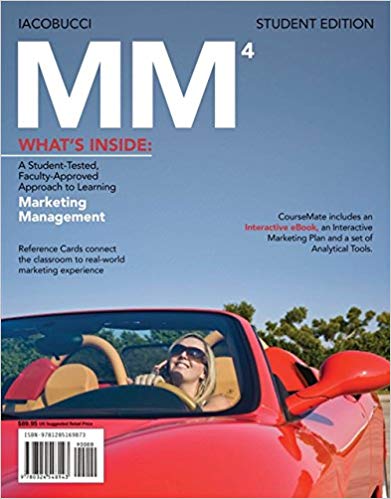
MM 4Th Edition By Dawn Iacobucci - Test Bank

MM 4Th Edition By Dawn Iacobucci - Test Bank   Instant Download - Complete Test Bank With Answers     Sample Questions Are Posted Below   Chapter 5 - Positioning   TRUE/FALSE   Positioning has more physical elements than perceptual ones.   ANS:   F                      DIF:    Moderate        REF:    Page 53 NAT:   BUSPROG Analytic                          LOC:   DISC: Marketing …

$19.99

MM 4Th Edition By Dawn Iacobucci – Test Bank


Instant Download – Complete Test Bank With Answers


Sample Questions Are Posted Below


Chapter 5 – Positioning


TRUE/FALSE


  1. Positioning has more physical elements than perceptual ones.


ANS:   F                      DIF:    Moderate        REF:    Page 53

NAT:   BUSPROG Analytic                          LOC:   DISC: Marketing Plan

TOP:    What is Positioning and Why is it Probably the Most Important Aspect of Marketing?       KEY:            Bloom’s: Knowledge

MSC:   MBA: Knowledge of General Business Functions


  1. Perception is one of the 4 Ps.


ANS:   F                      DIF:    Easy                REF:    Page 52

NAT:   BUSPROG Analytic                          LOC:   DISC: Marketing Plan

TOP:    What is Positioning and Why is it Probably the Most Important Aspect of Marketing?       KEY:            Bloom’s: Knowledge

MSC:   MBA: Knowledge of General Business Functions


  1. Positioning is about identity (i.e., who you are in the marketplace vis-à-vis the competition).


ANS:   T                      DIF:    Easy                REF:    Page 53

NAT:   BUSPROG Analytic                          LOC:   DISC: Marketing Plan

TOP:    What is Positioning and Why is it Probably the Most Important Aspect of Marketing?       KEY:            Bloom’s: Comprehension

MSC:   MBA: Knowledge of human behavior & society


  1. Communication is one of the 5 Cs.


ANS:   F                      DIF:    Easy                REF:    Page 52

NAT:   BUSPROG Analytic                          LOC:   DISC: Marketing Plan

TOP:    What is Positioning and Why is it Probably the Most Important Aspect of Marketing?       KEY:            Bloom’s: Knowledge

MSC:   MBA: Knowledge of General Business Functions


  1. Positioning is about designing a product to have benefits that the target segment will value.


ANS:   T                      DIF:    Easy                REF:    Page 53

NAT:   BUSPROG Analytic                          LOC:   DISC: Marketing Plan

TOP:    What is Positioning and Why is it Probably the Most Important Aspect of Marketing?       KEY:            Bloom’s: Knowledge

MSC:   MBA: Knowledge of General Business Functions


  1. Alexis is in charge of designing a new product for her company.  The research data she collected suggests the benefits to her target segment will be minimal.  Based on this information, Alexis will have a difficult time positioning this new product.


ANS:   T                      DIF:    Easy                REF:    Page 53

NAT:   BUSPROG Analytic                          LOC:   DISC: Marketing Plan

TOP:    What is Positioning and Why is it Probably the Most Important Aspect of Marketing?       KEY:            Bloom’s: Application

MSC:   MBA: Knowledge of General Business Functions


  1. Positioning involves two of the marketing mix variables.


ANS:   F                      DIF:    Moderate        REF:    Page 53

NAT:   BUSPROG Analytic                          LOC:   DISC: Marketing Plan

TOP:    What is Positioning and Why is it Probably the Most Important Aspect of Marketing?       KEY:            Bloom’s: Knowledge

MSC:   MBA: Knowledge of General Business Functions


  1. Perceptual maps allow managers to see graphical depictions of where their brands are, and where their competitors are, in the minds of their customers.


ANS:   T                      DIF:    Easy                REF:    Page 53

NAT:   BUSPROG Analytic                          LOC:   DISC: Marketing Plan

TOP:    Positioning via Perceptual Maps        KEY:   Bloom’s: Knowledge

MSC:   MBA: Knowledge of General Business Functions


  1. Holes in perceptual maps identify areas of fierce competition among an industry’s firms.


ANS:   F                      DIF:    Moderate        REF:    Page 53

NAT:   BUSPROG Analytic                          LOC:   DISC: Marketing Plan

TOP:    Positioning via Perceptual Maps        KEY:   Bloom’s: Comprehension

MSC:   MBA: Knowledge of General Business Functions


  1. Customer segments shown on perceptual maps offer marketing managers information about what’s going on in the marketplace.


ANS:   T                      DIF:    Easy                REF:    Page 53

NAT:   BUSPROG Analytic                          LOC:   DISC: Customer

TOP:    Positioning via Perceptual Maps        KEY:   Bloom’s: Knowledge

MSC:   MBA: Knowledge of General Business Functions


  1. On a perceptual map, brands depicted as points in the map close together are those perceived as similar.


ANS:   T                      DIF:    Easy                REF:    Page 53

NAT:   BUSPROG Analytic                          LOC:   DISC: Marketing Plan

TOP:    Positioning via Perceptual Maps        KEY:   Bloom’s: Comprehension

MSC:   MBA: Knowledge of General Business Functions


  1. One question always on the minds of marketers is, “Is my intended position the one that customers perceive?”


ANS:   T                      DIF:    Easy                REF:    Page 54

NAT:   BUSPROG Analytic                          LOC:   DISC: Marketing Plan

TOP:    Positioning via Perceptual Maps        KEY:   Bloom’s: Knowledge

MSC:   MBA: Knowledge of human behavior & society


  1. Positioning typically involves modifying all the 4P elements.


ANS:   T                      DIF:    Moderate        REF:    Page 53

NAT:   BUSPROG Analytic                          LOC:   DISC: Marketing Plan

TOP:    The Positioning Matrix                      KEY:   Bloom’s: Comprehension

MSC:   MBA: Knowledge of General Business Functions


  1. Some perceptual maps contain descriptors for a single service provider.


ANS:   T                      DIF:    Easy                REF:    Page 54

NAT:   BUSPROG Analytic                          LOC:   DISC: Marketing Plan

TOP:    Positioning via Perceptual Maps        KEY:   Bloom’s: Knowledge

MSC:   MBA: Knowledge of General Business Functions


  1. With time, it’s hard for a company to resist raising prices, or letting quality settle a little lower due to cost cutting measures.


ANS:   T                      DIF:    Easy                REF:    Page 56

NAT:   BUSPROG Analytic                          LOC:   DISC: Pricing

TOP:    Positioning via Perceptual Maps        KEY:   Bloom’s: Comprehension

MSC:   MBA: Knowledge of General Business Functions


  1. Just as consumers are demanding, wanting the very best of everything, companies can be equally irrational.


ANS:   T                      DIF:    Easy                REF:    Page 56

NAT:   BUSPROG Analytic                          LOC:   DISC: Marketing Plan

TOP:    The Positioning Matrix                      KEY:   Bloom’s: Knowledge

MSC:   MBA: Knowledge of human behavior & society


  1. Simultaneously being the “coolest” brand and offering the best value is a reasonable positioning objective.


ANS:   F                      DIF:    Moderate        REF:    Page 56

NAT:   BUSPROG Analytic                          LOC:   DISC: Strategy

TOP:    The Positioning Matrix                      KEY:   Bloom’s: Evaluation

MSC:   MBA: Knowledge of General Business Functions


  1. Brands occasionally come along that are priced high but offer low quality.


ANS:   T                      DIF:    Easy                REF:    Page 56

NAT:   BUSPROG Analytic                          LOC:   DISC: Pricing

TOP:    The Positioning Matrix                      KEY:   Bloom’s: Knowledge

MSC:   MBA: Knowledge of General Business Functions


  1. Low prices always result in low profitability.


ANS:   F                      DIF:    Challenging    REF:    Page 57

NAT:   BUSPROG Analytic                          LOC:   DISC: Pricing

TOP:    The Positioning Matrix                      KEY:   Bloom’s: Knowledge

MSC:   MBA: Knowledge of General Business Functions


  1. Three basic corporate strategies to creating value and achieving market stature are operational excellence, product leadership, and customer intimacy.


ANS:   T                      DIF:    Moderate        REF:    Page 60

NAT:   BUSPROG Analytic                          LOC:   DISC: Strategy

TOP:    The Positioning Matrix                      KEY:   Bloom’s: Knowledge

MSC:   MBA: Knowledge of General Business Functions


  1. Joe’s company prides itself on efficient production and delivery of products, in addition to offering low prices and convenience to its customers.  The strategy most likely being employed by Joe’s company is Product Leadership.


ANS:   F                      DIF:    Challenging    REF:    Page 60

NAT:   BUSPROG Analytic                          LOC:   DISC: Strategy

TOP:    The Positioning Matrix                      KEY:   Bloom’s: Application

MSC:   MBA: Managing Strategy & Innovation


  1. Madison serves as Vice President of Customer Experience at Company X, a large international hospitality firm with hotels and resorts around the globe.  Madison’s role involves catering to the specific needs and preferences of Company X’s most valuable guests.  Company X is most likely engaged in a Customer Intimacy strategy to create value among its guests.


ANS:   T                      DIF:    Moderate        REF:    Page 62

NAT:   BUSPROG Analytic                          LOC:   DISC: Strategy

TOP:    The Positioning Matrix                      KEY:   Bloom’s: Application

MSC:   MBA: Managing Strategy & Innovation


  1. Niche positioning is a matter of exclusivity and size.


ANS:   T                      DIF:    Moderate        REF:    Page 62

NAT:   BUSPROG Analytic                          LOC:   DISC: Marketing Plan

TOP:    The Positioning Matrix                      KEY:   Bloom’s: Comprehension

MSC:   MBA: Managing Strategy & Innovation


  1. If a brand has an exclusive image and distribution chain, it needs to promote it as much as possible.


ANS:   F                      DIF:    Easy                REF:    Page 56

NAT:   BUSPROG Analytic                          LOC:   DISC: Promotion

TOP:    The Positioning Matrix                      KEY:   Bloom’s: Analysis

MSC:   MBA: Managing Strategy & Innovation


  1. The three basic corporate strategies to creating value and achieving market stature were originally described by Michael Treacy and Fred Wiersema in The Discipline of Market Leaders.


ANS:   T                      DIF:    Challenging    REF:    Page 60

NAT:   BUSPROG Analytic                          LOC:   DISC: Marketing Plan

TOP:    The Positioning Matrix                      KEY:   Bloom’s: Knowledge

MSC:   MBA: Managing Strategy & Innovation


  1. Southwest Airlines uses an operational excellence strategy.


ANS:   T                      DIF:    Challenging    REF:    Page 60

NAT:   BUSPROG Analytic                          LOC:   DISC: Strategy

TOP:    The Positioning Matrix                      KEY:   Bloom’s: Comprehension

MSC:   MBA: Managing Strategy & Innovation


  1. Sony uses a product leadership strategy.


ANS:   T                      DIF:    Challenging    REF:    Page 62

NAT:   BUSPROG Analytic                          LOC:   DISC: Strategy

TOP:    The Positioning Matrix                      KEY:   Bloom’s: Comprehension

MSC:   MBA: Managing Strategy & Innovation


  1. Johnson & Johnson uses a customer intimacy strategy.


ANS:   F                      DIF:    Challenging    REF:    Page 62

NAT:   BUSPROG Analytic                          LOC:   DISC: Strategy

TOP:    The Positioning Matrix                      KEY:   Bloom’s: Comprehension

MSC:   MBA: Managing Strategy & Innovation


  1. A positioning statement includes the specification of the target segment(s).


ANS:   T                      DIF:    Moderate        REF:    Page 62

NAT:   BUSPROG Analytic                          LOC:   DISC: Marketing Plan

TOP:    Writing a Positioning Statement        KEY:   Bloom’s: Knowledge

MSC:   MBA: Knowledge of General Business Functions


  1. In marketing, USP stands for unique strategic position.


ANS:   F                      DIF:    Moderate        REF:    Page 62

NAT:   BUSPROG Communication              LOC:   DISC: Marketing Plan

TOP:    Writing a Positioning Statement        KEY:   Bloom’s: Knowledge

MSC:   MBA: Knowledge of General Business Functions


  1. Once it has positioned itself or its brand, a company must be able to communicate succinctly the parameters of that position to a single audience.


ANS:   F                      DIF:    Moderate        REF:    Page 62

NAT:   BUSPROG Communication              LOC:   DISC: Marketing Plan

TOP:    Writing a Positioning Statement        KEY:   Bloom’s: Comprehension

MSC:   MBA: Managing Strategy & Innovation


  1. Some positioning statements are surprising in that they may NOT reflect current marketplace perceptions but rather the goals the company seeks to reach.


ANS:   T                      DIF:    Easy                REF:    Page 63

NAT:   BUSPROG Communication              LOC:   DISC: Marketing Plan

TOP:    Writing a Positioning Statement        KEY:   Bloom’s: Comprehension

MSC:   MBA: Managing Strategy & Innovation


  1. Managers should NOT use a positioning statement as an internal memorandum that keeps them aligned to it as a basic guiding principle.


ANS:   F                      DIF:    Moderate        REF:    Page 63

NAT:   BUSPROG Communication              LOC:   DISC: Marketing Plan

TOP:    Writing a Positioning Statement        KEY:   Bloom’s: Evaluation

MSC:   MBA: Managing Strategy & Innovation


  1. Positioning statements should be lengthy and very detailed in order to communicate efficiently.


ANS:   F                      DIF:    Easy                REF:    Page 63

NAT:   BUSPROG Analytic                          LOC:   DISC: Marketing Plan

TOP:    Writing a Positioning Statement        KEY:   Bloom’s: Analysis

MSC:   MBA: Managing Strategy & Innovation


  1. Mark needs to write the positioning statement for Company X.  One of Mark’s colleagues advises him that the positioning statement needs to be clearly understood by the company’s employees, shareholders, and customers – but NOT by the general public since this group will not be interacting with the company.  Mark’s colleague has offered good advice.


ANS:   F                      DIF:    Easy                REF:    Page 63

NAT:   BUSPROG Communication              LOC:   DISC: Marketing Plan

TOP:    Writing a Positioning Statement        KEY:   Bloom’s: Evaluation

MSC:   MBA: Managing Strategy & Innovation


  1. To write a good positioning statement, you need to know who you are trying to persuade.


ANS:   T                      DIF:    Easy                REF:    Page 63

NAT:   BUSPROG Communication              LOC:   DISC: Marketing Plan

TOP:    Writing a Positioning Statement        KEY:   Bloom’s: Analysis

MSC:   MBA: Managing Strategy & Innovation


  1. To write a good positioning statement, you do not need to know who you are competing with. It’s irrelevant.


ANS:   F                      DIF:    Easy                REF:    Page 63

NAT:   BUSPROG Communication              LOC:   DISC: Marketing Plan

TOP:    Writing a Positioning Statement        KEY:   Bloom’s: Analysis

MSC:   MBA: Managing Strategy & Innovation


  1. An element of the positioning statement may be only implied.


ANS:   T                      DIF:    Moderate        REF:    Page 63

NAT:   BUSPROG Analytic                          LOC:   DISC: Marketing Plan

TOP:    Writing a Positioning Statement        KEY:   Bloom’s: Comprehension

MSC:   MBA: Managing Strategy & Innovation


  1. Positioning statements should not be used as advertising taglines.


ANS:   F                      DIF:    Easy                REF:    Page 63

NAT:   BUSPROG Communication              LOC:   DISC: Marketing Plan

TOP:    Writing a Positioning Statement        KEY:   Bloom’s: Analysis

MSC:   MBA: Managing Strategy & Innovation


  1. FedEx has a very straightforward positioning statement: “Dependable Solutions for Your Shipping Needs.”


ANS:   T                      DIF:    Moderate        REF:    Page 63

NAT:   BUSPROG Communication              LOC:   DISC: Marketing Plan

TOP:    Writing a Positioning Statement        KEY:   Bloom’s: Knowledge

MSC:   MBA: Managing Strategy & Innovation


MULTIPLE CHOICE


  1. Which of the following is NOT one of the 5 Cs?
a. customer
b. company
c. comprehension
d. context


ANS:   C                     DIF:    Moderate        REF:    Page 52

NAT:   BUSPROG Analytic                          LOC:   DISC: Marketing Plan

TOP:    What is Positioning and Why is it Probably the Most Important Aspect of Marketing?       KEY:            Bloom’s: Knowledge

MSC:   MBA: Knowledge of General Business Functions


  1. Positioning is mostly about ________.
a. identity
b. physical elements
c. targeting
d. advertising


ANS:   A                     DIF:    Moderate        REF:    Page 53

NAT:   BUSPROG Analytic                          LOC:   DISC: Marketing Plan

TOP:    What is Positioning and Why is it Probably the Most Important Aspect of Marketing?       KEY:            Bloom’s: Comprehension

MSC:   MBA: Knowledge of General Business Functions


  1. Shannon is struggling to communicate who Company ABC is compared to the competition.  Shannon wants to communicate that Company ABC’s brand has the benefits that the target market will value.  Shannon is engaged in what marketing activity?
a. segmenting
b. targeting
c. positioning
d. advertising


ANS:   C                     DIF:    Moderate        REF:    Page 53

NAT:   BUSPROG Analytic                          LOC:   DISC: Marketing Plan

TOP:    What is Positioning and Why is it Probably the Most Important Aspect of Marketing?       KEY:            Bloom’s: Application

MSC:   MBA: Knowledge of General Business Functions


  1. Positioning involves which of the marketing mix variables?
a. Price, Promotion, Product, Place
b. Price, Promotion, Product
c. Price, Place
d. Promotion, Product, Place


ANS:   A                     DIF:    Moderate        REF:    Page 53

NAT:   BUSPROG Analytic                          LOC:   DISC: Marketing Plan

TOP:    What is Positioning and Why is it Probably the Most Important Aspect of Marketing?       KEY:            Bloom’s: Knowledge

MSC:   MBA: Knowledge of General Business Functions


  1. Marketers and senior managers like to see graphical depictions of where their brands are, and where their competitors are in the minds of their customers.  What are these called?
a. histograms
b. perceptual maps
c. genograms
d. opinion charts


ANS:   B                     DIF:    Easy                REF:    Page 53

NAT:   BUSPROG Analytic                          LOC:   DISC: Marketing Plan

TOP:    Positioning via Perceptual Maps        KEY:   Bloom’s: Knowledge

MSC:   MBA: Knowledge of General Business Functions


  1. Brands depicted as points in the map close together are those perceived as _______.
a. similar
b. different
c. expensive
d. high-quality


ANS:   A                     DIF:    Easy                REF:    Page 53

NAT:   BUSPROG Analytic                          LOC:   DISC: Marketing Plan

TOP:    Positioning via Perceptual Maps        KEY:   Bloom’s: Comprehension

MSC:   MBA: Knowledge of General Business Functions


  1. _________ in perceptual maps offer(s) intriguing possibilities for new market opportunities.
a. Brands
b. Holes
c. Targeting
d. Positioning


ANS:   B                     DIF:    Moderate        REF:    Page 53

NAT:   BUSPROG Analytic                          LOC:   DISC: Marketing Plan

TOP:    Positioning via Perceptual Maps        KEY:   Bloom’s: Comprehension

MSC:   MBA: Managing Strategy & Innovation


  1. In analyzing perceptual maps, one question always on the marketer’s mind is:
a. “Is my brand optimally segmented?”
b. “Is my brand experiencing holes?”
c. “Is my brand targeted correctly?”
d. “Is my brand optimally positioned?”


ANS:   D                     DIF:    Challenging    REF:    Page 54

NAT:   BUSPROG Analytic                          LOC:   DISC: Marketing Plan

TOP:    Positioning via Perceptual Maps        KEY:   Bloom’s: Comprehension

MSC:   MBA: Knowledge of human behavior & society


  1. Dom is reviewing a perceptual map that compares a number of jeans brands based on customer survey data.  Five of the eight brands are depicted as points close together on the map.  A logical conclusion Dom can draw from this perceptual map is ________.
a. three brands are well positioned as being diverse from all other brands
b. the five brands are viewed as most interchangeable by consumers
c. the five brands identify a “hole” in the perceptual map
d. consumers will most likely purchase more of the three brands not clustered together


ANS:   B                     DIF:    Moderate        REF:    Page 54

NAT:   BUSPROG Analytic                          LOC:   DISC: Marketing Plan

TOP:    Positioning via Perceptual Maps        KEY:   Bloom’s: Application

MSC:   MBA: Knowledge of General Business Functions


  1. Which of the following is NOT true according to this perceptual map?
a. Customers view Lexus and Lincoln as most interchangeable of the brands.
b. The Tesla and Prius are not competing with each other.
c. People in segment 1 prefer Tesla or Prius to Lincoln or Lexus.
d. People is segment 2 seek nice luxury at inexpensive prices.


ANS:   C                     DIF:    Challenging    REF:    Page 54

NAT:   BUSPROG Analytic                          LOC:   DISC: Marketing Plan

TOP:    Positioning via Perceptual Maps        KEY:   Bloom’s: Application

MSC:   MBA: Knowledge of human behavior & society


  1. Which of the following is NOT true based on this perceptual map?
a. Paris and Rome are seen as places where there is lots to see and do, but they’re relatively expensive.
b. Nassau and Tampa are perceived as beach trips that are relatively affordable.
c. The first customer segment is very well-served.
d. The second customer segment is seeking more to do on their holiday and is not concerned about price.


ANS:   D                     DIF:    Challenging    REF:    Page 54

NAT:   BUSPROG Analytic                          LOC:   DISC: Marketing Plan

TOP:    Positioning via Perceptual Maps        KEY:   Bloom’s: Application

MSC:   MBA: Knowledge of human behavior & society


  1. If a company promotes broadly and heavily, they are probably looking to ______.
a. create a niche market
b. offer low prices
c. move a lot of merchandise
d. distribute through selective channels


ANS:   C                     DIF:    Moderate        REF:    Page 56

NAT:   BUSPROG Analytic                          LOC:   DISC: Promotion

TOP:    The Positioning Matrix                      KEY:   Bloom’s: Analysis

MSC:   MBA: Managing Strategy & Innovation


  1. Which of the following combinations doesn’t make very much sense?
a. low price and low quality
b. high price and high quality
c. heavy promotion and low (exclusive) availability
d. heavy promotion and high availability


ANS:   C                     DIF:    Moderate        REF:    Page 56

NAT:   BUSPROG Analytic                          LOC:   DISC: Marketing Plan

TOP:    The Positioning Matrix                      KEY:   Bloom’s: Analysis

MSC:   MBA: Managing Strategy & Innovation


  1. If a brand has an exclusive image, it would make good sense NOT to ________.
a. over-promote it
b. charge a premium price
c. engage in light promotion
d. distribute through selective channels


ANS:   A                     DIF:    Moderate        REF:    Page 56

NAT:   BUSPROG Analytic                          LOC:   DISC: Marketing Plan

TOP:    The Positioning Matrix                      KEY:   Bloom’s: Analysis

MSC:   MBA: Managing Strategy & Innovation


  1. A CEO is considering how he wants his company to be positioned. He has thought of it as “the coolest brand” and also the one with the best value. Which of the following is true about his predicament?
a. He should definitely try to have the coolest brand.
b. He should definitely try to have the brand with the best value.
c. He can probably achieve either of these goals, but not both.
d. He can achieve both of these goals.


ANS:   C                     DIF:    Moderate        REF:    Page 56

NAT:   BUSPROG Analytic                          LOC:   DISC: Marketing Plan

TOP:    The Positioning Matrix                      KEY:   Bloom’s: Evaluation

MSC:   MBA: Managing Strategy & Innovation


  1. Which of the following positioning combinations makes the most sense?
a. low price, low quality, exclusive availability, heavy promotions
b. high price, low quality, exclusive availability, heavy promotions
c. low price, high quality, exclusive availability, light promotions
d. low price, low quality, widely available, heavy promotions


ANS:   D                     DIF:    Challenging    REF:    Page 56

NAT:   BUSPROG Analytic                          LOC:   DISC: Marketing Plan

TOP:    The Positioning Matrix                      KEY:   Bloom’s: Evaluation

MSC:   MBA: Managing Strategy & Innovation


  1. Which of the following is NOT one of three basic corporate strategies for creating value and achieving market stature?
a. operational excellence
b. product leadership
c. quality placement
d. customer intimacy


ANS:   C                     DIF:    Easy                REF:    Page 60

NAT:   BUSPROG Analytic                          LOC:   DISC: Strategy

TOP:    The Positioning Matrix                      KEY:   Bloom’s: Knowledge

MSC:   MBA: Knowledge of General Business Functions


  1. Operational excellence refers to companies that ________.
a. are good at production, delivery, price, and convenience
b. pride themselves on quality and innovation
c. are willing to tailor their products to particular customer needs
d. are expensive but is expected to pay off in long-term loyalty and enhanced customer lifetime value


ANS:   A                     DIF:    Moderate        REF:    Page 60

NAT:   BUSPROG Analytic                          LOC:   DISC: Marketing Plan

TOP:    The Positioning Matrix                      KEY:   Bloom’s: Comprehension

MSC:   MBA: Managing Strategy & Innovation


  1. Product leadership refers to companies that ______.
a. are good at production and delivery, and price and convenience
b. are expensive but is expected to pay off in long-term loyalty and enhanced customer lifetime value
c. pride themselves on quality and innovation
d. are willing to tailor their products to particular customer needs


ANS:   C                     DIF:    Moderate        REF:    Page 62

NAT:   BUSPROG Analytic                          LOC:   DISC: Strategy

TOP:    The Positioning Matrix                      KEY:   Bloom’s: Comprehension

MSC:   MBA: Managing Strategy & Innovation


  1. Customer intimacy refers to companies that ______.
a. pride themselves on quality and innovation
b. are willing to tailor their products to particular customer needs
c. target and position themselves high in the market
d. are good at production and delivery, and price and convenience


ANS:   B                     DIF:    Moderate        REF:    Page 62

NAT:   BUSPROG Analytic                          LOC:   DISC: Strategy

TOP:    The Positioning Matrix                      KEY:   Bloom’s: Comprehension

MSC:   MBA: Managing Strategy & Innovation


  1. Who originally described the three basic corporate strategies to creating value and achieving market stature?
a. Treacy and Wiersema
b. Tracy and Wiseman
c. Thompson and Walters
d. Tisdale and Winters


ANS:   A                     DIF:    Challenging    REF:    Page 62

NAT:   BUSPROG Analytic                          LOC:   DISC: Strategy

TOP:    The Positioning Matrix                      KEY:   Bloom’s: Knowledge

MSC:   MBA: Managing Strategy & Innovation


  1. Which of these companies uses a strategy of operational excellence?
a. Johnson & Johnson
b. Costco
c. Sony
d. Home Depot


ANS:   B                     DIF:    Challenging    REF:    Page 60

NAT:   BUSPROG Analytic                          LOC:   DISC: Strategy

TOP:    The Positioning Matrix                      KEY:   Bloom’s: Comprehension

MSC:   MBA: Managing Strategy & Innovation


  1. Which of these companies uses a strategy of customer intimacy?
a. Dell
b. Sony
c. Costco
d. Home Depot


ANS:   D                     DIF:    Challenging    REF:    Page 62

NAT:   BUSPROG Analytic                          LOC:   DISC: Strategy

TOP:    The Positioning Matrix                      KEY:   Bloom’s: Comprehension

MSC:   MBA: Managing Strategy & Innovation


  1. Which of these companies uses a product leadership strategy?
a. Johnson & Johnson
b. Walmart
c. Southwest Airlines
d. Nordstrom


ANS:   A                     DIF:    Challenging    REF:    Page 62

NAT:   BUSPROG Analytic                          LOC:   DISC: Strategy

TOP:    The Positioning Matrix                      KEY:   Bloom’s: Comprehension

MSC:   MBA: Managing Strategy & Innovation


  1. Nordstrom uses which of the following strategies?
a. customer intimacy
b. product leadership
c. operational excellence
d. quality placement


ANS:   A                     DIF:    Moderate        REF:    Page 62

NAT:   BUSPROG Analytic                          LOC:   DISC: Strategy

TOP:    The Positioning Matrix                      KEY:   Bloom’s: Knowledge

MSC:   MBA: Managing Strategy & Innovation


  1. Dell uses which of the following strategies?
a. customer intimacy
b. product leadership
c. operational excellence
d. quality placement


ANS:   C                     DIF:    Moderate        REF:    Page 60

NAT:   BUSPROG Analytic                          LOC:   DISC: Strategy

TOP:    The Positioning Matrix                      KEY:   Bloom’s: Comprehension

MSC:   MBA: Managing Strategy & Innovation


  1. In his books on Competitive Strategy, ________ discusses generic strategies driven by keeping costs down and prices competitive, leading by differentiation (e.g., excellence in quality or innovation), or when appropriate, niche positioning.
a. Mark Patton
b. Mitchell Paul
c. Matthew Pilsner
d. Michael Porter


ANS:   D                     DIF:    Challenging    REF:    Page 62

NAT:   BUSPROG Analytic                          LOC:   DISC: Strategy

TOP:    The Positioning Matrix                      KEY:   Bloom’s: Knowledge

MSC:   MBA: Managing Strategy & Innovation


  1. What do the letters of USP represent?
a. ultimate selling proposition
b. unique selling proposition
c. unique selling product
d. universal selling point


ANS:   B                     DIF:    Moderate        REF:    Page 62

NAT:   BUSPROG Communication              LOC:   DISC: Marketing Plan

TOP:    Writing a Positioning Statement        KEY:   Bloom’s: Knowledge

MSC:   MBA: Knowledge of General Business Functions


  1. The USP concept captures two things. One is how does your market offering dominate these other providers. What is the other?
a. what is the product category
b. what is the target segment
c. where is the product positioned
d. none of these


ANS:   A                     DIF:    Moderate        REF:    Page 62

NAT:   BUSPROG Communication              LOC:   DISC: Marketing Plan

TOP:    Writing a Positioning Statement        KEY:   Bloom’s: Comprehension

MSC:   MBA: Managing Strategy & Innovation


  1. Jen is developing the positioning statement for a new line of sunglasses.  In a meeting, the marketing team tells Jen that she has succinctly and clearly expressed the competitive advantage of the new sunglasses brand.  The team approves of the way Jen wants to express the brand’s competitive advantage, and tells her to continue her work on fully developing the positioning statement.  Which element of crafting the positioning statement has Jen’s team just approved?
a. positioning
b. target marketing
c. target segmenting
d. unique selling proposition


ANS:   D                     DIF:    Moderate        REF:    Page 62

NAT:   BUSPROG Communication              LOC:   DISC: Marketing Plan

TOP:    Writing a Positioning Statement        KEY:   Bloom’s: Application

MSC:   MBA: Managing Strategy & Innovation


  1. “Broadcast Yourself” is what website’s positioning statement?
a. Facebook
b. Myspace
c. Vimeo
d. YouTube


ANS:   D                     DIF:    Moderate        REF:    Page 63

NAT:   BUSPROG Communication              LOC:   DISC: Marketing Plan

TOP:    Writing a Positioning Statement        KEY:   Bloom’s: Knowledge

MSC:   MBA: Managing Strategy & Innovation


  1. Once a company has decided upon its positioning, either for the corporation as a whole, or for one of its brands, it must be able to communicate _______ the parameters of that position to ______.
a. succinctly, a number of audiences
b. verbosely, a number of audiences
c. succinctly, one audience
d. verbosely, one audience


ANS:   A                     DIF:    Moderate        REF:    Page 62

NAT:   BUSPROG Communication              LOC:   DISC: Marketing Plan

TOP:    Writing a Positioning Statement        KEY:   Bloom’s: Comprehension

MSC:   MBA: Knowledge of General Business Functions


  1. A positioning statement should address your target segment.  Anything else you’ll say in the positioning statement will have _______ meaning to customers who are not in that segment.
a. a lot of
b. no
c. very significant
d. confusing


ANS:   B                     DIF:    Moderate        REF:    Page 62

NAT:   BUSPROG Analytic                          LOC:   DISC: Marketing Plan

TOP:    Writing a Positioning Statement        KEY:   Bloom’s: Comprehension

MSC:   MBA: Knowledge of General Business Functions


  1. When you are writing a positioning statement, if you don’t have real differences and cannot see a way to create them, then you can create a difference based on ________.
a. image
b. the future
c. opinion
d. data


ANS:   A                     DIF:    Moderate        REF:    Page 62

NAT:   BUSPROG Analytic                          LOC:   DISC: Marketing Plan

TOP:    Writing a Positioning Statement        KEY:   Bloom’s: Comprehension

MSC:   MBA: Managing Strategy & Innovation


  1. When writing a positioning statement, it is a good idea to abstract from the level of the brand’s attributes to the _______ benefits to the customer.
a. concrete
b. impractical
c. intangible
d. money-related


ANS:   C                     DIF:    Moderate        REF:    Page 63

NAT:   BUSPROG Analytic                          LOC:   DISC: Marketing Plan

TOP:    Writing a Positioning Statement        KEY:   Bloom’s: Comprehension

MSC:   MBA: Managing Strategy & Innovation


  1. To write a positioning statement, you should answer all of the following questions EXCEPT:
a. Who are you trying to persuade?
b. Who are you competing with?
c. How are you better?
d. What are your weaknesses?


ANS:   D                     DIF:    Moderate        REF:    Page 63

NAT:   BUSPROG Communication              LOC:   DISC: Marketing Plan

TOP:    Writing a Positioning Statement        KEY:   Bloom’s: Analysis

MSC:   MBA: Knowledge of General Business Functions


  1. Volvo is most known for which of the following?
a. safety
b. extravagance
c. value
d. femininity


ANS:   A                     DIF:    Moderate        REF:    Page 63

NAT:   BUSPROG Analytic                          LOC:   DISC: Marketing Plan

TOP:    Writing a Positioning Statement        KEY:   Bloom’s: Knowledge

MSC:   MBA: Knowledge of human behavior & society


  1. “Where happiness means the world,” is the positioning statement for which of the following?
a. Honda
b. Club Med
c. Disney
d. Apple


ANS:   B                     DIF:    Challenging    REF:    Page 63

NAT:   BUSPROG Communication              LOC:   DISC: Marketing Plan

TOP:    Writing a Positioning Statement        KEY:   Bloom’s: Knowledge

MSC:   MBA: Knowledge of human behavior & society


  1. Which of the following is Volkswagen’s long-running advertising tagline?
a. Drivers Wanted
b. The Power of Dreams
c. Think Different
d. Our clients’ interests always come first.


ANS:   A                     DIF:    Moderate        REF:    Page 63

NAT:   BUSPROG Communication              LOC:   DISC: Marketing Plan

TOP:    Writing a Positioning Statement        KEY:   Bloom’s: Knowledge

MSC:   MBA: Knowledge of human behavior & society


  1. The positioning statement can serve as an internal memorandum keeping all managers aligned as a basic guiding principle in all their collective decisions, so as to enhance the likelihood of ______ in the results of those decisions.
a. innovation
b. consistencies
c. boredom
d. excitement


ANS:   B                     DIF:    Moderate        REF:    Page 63

NAT:   BUSPROG Communication              LOC:   DISC: Marketing Plan

TOP:    Writing a Positioning Statement        KEY:   Bloom’s: Comprehension

MSC:   MBA: Knowledge of human behavior & society


ESSAY


  1. What is positioning and why is it probably the most important aspect of marketing?


ANS:

Positioning has many physical elements, and even more perceptual ones. Positioning is about identity—who you are in the marketplace vis-à-vis the competition. Once you see who you are, you can determine who you want to be.  Positioning comprises much of a marketer’s responsibilities. It is about designing a product to have benefits that the target segment will value (How do you want your customers to think about your brand?), pricing it to be profitable yet valuable to the target segment (How high a price can you command for your brand?), building distributor relationships to make the market offering available (Where do customers go to find your brand?), and communicating all of this to the customer via promotional activities (What do you say about your brand?). Positioning involves all of the marketing mix variables.


DIF:    Challenging     REF:    Page 53           NAT:   BUSPROG Communication

LOC:   DISC: Marketing Plan

TOP:    What is Positioning and Why is it Probably the Most Important Aspect of Marketing?       KEY:            Bloom’s: Synthesis

MSC:   MBA: Knowledge of General Business Functions


  1. Explain the concept of perceptual maps and why marketers find this tool valuable.


ANS:

Marketing managers like to see graphical depictions of where their brands are, and where their competitors are, in the minds of their customers. These pictures help them envision how customers think about their brand and others and give them preliminary answers to many questions; e.g., in their customers’ minds, what are their strengths and weaknesses? What are the strengths and weaknesses of their competitors? Although they think of certain companies and brands as their competition, who do customers see as their competitors—who do they think are their closest substitutes for the benefits they seek when they’re buying in this product category? Perceptual maps provide these pictures.


DIF:    Challenging     REF:    Pages 53-55    NAT:   BUSPROG Communication

LOC:   DISC: Marketing Plan                       TOP:    Positioning via Perceptual Maps

KEY:   Bloom’s: Synthesis                             MSC:   MBA: Managing Strategy & Innovation


  1. Explain this perceptual map.


ANS:

This perceptual map tells us about the positioning of these cities, vis-à-vis the dimensions of expense and activity.  Paris and Rome are seen as places where there is lots to see and do, but they’re relatively expensive.  Nassau and Tampa are perceived as beach trips that are relatively affordable. The customer segments on the perceptual map offer another diagnostic to the company about what’s going on in the marketplace.  The first customer segment is very well-served—they are looking for beaches and cheap trips, and the company has hotels in both Nassau and Tampa to cater to those tourists.  The second customer segment, however, is seeking more to do on their holiday, yet still hoping for reasonable rates.  The company has less to offer them, although perhaps they can play up Washington, D.C.


DIF:    Challenging     REF:    Pages 53-55    NAT:   BUSPROG Communication

LOC:   DISC: Marketing Plan                       TOP:    Positioning via Perceptual Maps

KEY:   Bloom’s: Synthesis

MSC:   MBA: Knowledge of human behavior & society


  1. Identify and describe the three basic corporate strategies for creating value and achieving market stature.


ANS:

The three basic strategies are operational excellence, product leadership, and customer intimacy.  Operationally excellent companies are good at production and delivery, and price and convenience (e.g., Dell, Southwest Airlines, Walmart, Costco).  Companies exhibiting product leadership pride themselves on quality and innovation (e.g., Johnson & Johnson and Sony).  Companies focusing on customer intimacy are willing to tailor their products to particular customer needs, which can be expensive but is expected to pay off in long-term loyalty and enhanced customer lifetime value (e.g., Nordstrom, Home Depot, Amazon,  Saturn).


DIF:    Challenging     REF:    Pages 60-62    NAT:   BUSPROG Communication

LOC:   DISC: Model Strategy                       TOP:    The Positioning Matrix

KEY:   Bloom’s: Synthesis                             MSC:   MBA: Managing Strategy & Innovation


  1. Consider price, quality, availability, and promotions. Which combinations of these make the most sense? Why?


ANS:

The most appropriate combinations are (1) low price, low quality, widely available, heavy promotions, and (2) high price, high quality, exclusivity, light promotions.


We can either position our brand as low price, low quality, or we want to achieve high quality and charge high prices, etc.  If we have reason to modify one of the Ps, go with low price, low quality, widely available, but we want to lighten up on promotions, then that is our strategic and tactical choice.  But these two extremes clarify the goals of a brand’s position in the marketplace and can help us align the many decisions that need to be made, all the way from product design to channel choice for deliver to the marketplace.


Some brands appear in all the other suboptimal combinations though.  We might question how long a company or brand can sustain in a suboptimal position, but at any given point in time, there could be market offerings spanning the matrix.


DIF:    Challenging     REF:    Pages 57-60    NAT:   BUSPROG Communication

LOC:   DISC: Marketing Plan                       TOP:    The Positioning Matrix

KEY:   Bloom’s: Synthesis                             MSC:   MBA: Managing Strategy & Innovation


  1. In terms of the positioning matrix, what types of companies tend not to make it?


ANS:

Occasionally brands come along that offer high quality at low prices, and we would refer to these as good values, but with time, it’s hard for a company to resist raising prices, or letting quality settle a little lower due to cost cutting measures.  And conversely, occasionally brands come along that are priced high but are kind of junky.  Customers are not fools, and these kinds of brands don’t last—the company either needs to adjust the price downward to be more competitive, or improve the quality to be in synch with the price charged, or even more frequently, just leave the marketplace.


DIF:    Challenging     REF:    Page 56           NAT:   BUSPROG Communication

LOC:   DISC: Marketing Plan                       TOP:    The Positioning Matrix

KEY:   Bloom’s: Evaluation                           MSC:   MBA: Managing Strategy & Innovation


  1. What are the three questions that must be answered in order to write a positioning statement?


ANS:

A marketing manager should answer the following three questions in order to compose a positioning statement:

1. Who are you trying to persuade? (Who is your target segment?)
2. With whom are you competing? (Who are your competitors, what is your major product category, what frames of reference will customers use in making choices?)
3. How are you better? (What is your uniqueness, your competitive advantage, your point of difference, and do you have attributes or benefits that dominate competitors?)


Putting these three answers together leads to a marketing manager’s positioning statement, for example: “For customers who want… [segment], our brand is the best at… [unique selling proposition—competitors and competitive advantage].”


DIF:    Challenging     REF:    Page 63           NAT:   BUSPROG Communication

LOC:   DISC: Marketing Plan                       TOP:    Writing a Positioning Statement

KEY:   Bloom’s: Synthesis                             MSC:   MBA: Managing Strategy & Innovation


  1. Positioning statements vary widely. They can be straightforward or surprising. Give some examples of different types of positioning statements from the real world.


ANS:

Some positioning statements are a bit surprising.  For example, Volvo is known for safety, yet at Volvo.com you’ll see: “We offer transport solutions to demanding customers around the world.”  Perhaps Volvo’s dominance on safety is so well-known, that the benefit doesn’t need stating.


Some positioning statements are straightforward, such as FedEx’s “Dependable Solutions for Your Shipping Needs,” YouTube’s “Broadcast Yourself,” and Club Med’s “Where Happiness Means the World.”  Others are abstract and inspiring, such as Honda’s, “The Power of Dreams,” Apple’s “Think Different(ly),” and Goldman Sachs’s “Our clients’ interests always come first.”


An element of the positioning statement may be only implied.  For example, Volkswagen’s, long-running advertising tagline, “Drivers Wanted” states the target segment clearly, and reflects their position by implying the competitive frame and its superior position within the category.


DIF:    Challenging     REF:    Page 63           NAT:   BUSPROG Communication

LOC:   DISC: Marketing Plan                       TOP:    Writing a Positioning Statement

KEY:   Bloom’s: Synthesis

MSC:   MBA: Knowledge of human behavior & society


  1. Explain what a USP is and how it is used.


ANS:

The unique selling proposition (USP) is an element of a positioning statement.  The idea is to express your brand’s competitive advantage clearly and succinctly.  The USP concept captures two things—first, what is the product category (the SP), and second, how does your market offering dominate these other providers (the U).  Why should a customer buy from you and not one of your competitors?  How is it that you’re better?


If you cannot answer this question, much less put it into a positioning statement, either your position is not clear, or your product has little differentiation.  There is no excuse for this situation, given that your position can be based on “real” attribute differences or “perceived” differences based on images you’ve built.  If you don’t have real differences and cannot see a way to create them, then create an image-based difference.


DIF:    Challenging     REF:    Page 62           NAT:   BUSPROG Communication

LOC:   DISC: Marketing Plan                       TOP:    Writing a Positioning Statement

KEY:   Bloom’s: Synthesis                             MSC:   MBA: Managing Strategy & Innovation


  1. Why should positioning statements be succinct? How can this be achieved?


ANS:

A simple statement facilitates communication and an understanding in the marketplace. While you might think your has strong attributes, try to think of a word that captures all their essence and use that word.  Or, make a list of your brand’s benefits and prioritize them, and take the most important, most compelling difference, and make that the difference you insert into the positioning statement.  You can cycle through some of the other qualities in some of your communications, but they should all be consistent with the basic message in the positioning statement itself.  This goal is more easily achieved if we can abstract from the level of the brand’s attributes to the more general intangible benefits to the customer—all we have to do is ask why would a customer care?


DIF:    Challenging     REF:    Page 63           NAT:   BUSPROG Communication

LOC:   DISC: Marketing Plan                       TOP:    Writing a Positioning Statement

KEY:   Bloom’s: Synthesis                             MSC:   MBA: Managing Strategy & Innovation

Additional information

Add Review

Your email address will not be published. Required fields are marked *