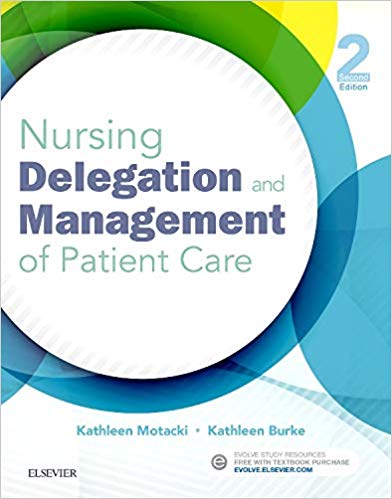
Nursing Delegation And Management of Patient Care 2nd Edition By Motacki RN MSN - Test Bank

Nursing Delegation And Management of Patient Care 2nd Edition By Motacki RN MSN - Test Bank   Instant Download - Complete Test Bank With Answers     Sample Questions Are Posted Below   Chapter 05: Healthcare Regulatory and Certifying Agencies Motacki: Nursing Delegation and Management of Patient Care, 2nd Edition   MULTIPLE CHOICE   The …

$19.99

Nursing Delegation And Management of Patient Care 2nd Edition By Motacki RN MSN – Test Bank


Instant Download – Complete Test Bank With Answers


Sample Questions Are Posted Below


Chapter 05: Healthcare Regulatory and Certifying Agencies

Motacki: Nursing Delegation and Management of Patient Care, 2nd Edition


MULTIPLE CHOICE


  1. The Joint Commission (TJC) is a voluntary accrediting agency that is nationally recognized for its performance standards. A hospital accredited by the agency will most likely experience which outcome?
a. Improved patient outcomes
b. Dedicated staff
c. Higher salaries
d. Loss of practicing physicians


ANS:  A

Adherence to the performance standards set by TJC should lead to better patient outcomes. Options B and C may result from accreditation but there are no data to support this. Option D is incorrect because accreditation should have the opposite effect.


DIF:    Cognitive Level: Application           REF:   page 58


  1. In which situation should the SBAR (Situation-Background-Assessment-Recommendation) tool most appropriately be used?
a. To reduce the risk of nosocomial infections
b. To improve response to changes in patient condition
c. In hand-off communication
d. For accuracy of patient identification


ANS:  C

SBAR is supported by TJC as a tool to improve communication between care givers. The other options are goals of TJC but is not related to the use of SBAR.


DIF:    Cognitive Level: Application           REF:   page 91


  1. Federal and state departments of health regulatory agencies have been established to ensure optimal standards and delivery of care. Which action is the jurisdiction of these agencies?
a. Investigation of medication errors
b. Investigation of patient- or family-reported complaints
c. Investigation of patient falls
d. Investigation of staffing shortages


ANS:  B

These agencies investigate and make judgments on complaints brought by consumers of the services and the public. The other actions would be investigated internally.


DIF:    Cognitive Level: Application           REF:   page 57


  1. The state regulatory agency may impose a fine on a hospital for which patient safety infraction?
a. Inconsistent adherence to isolation protocol
b. Medication administration error resulting in no harm to the patient
c. Wrong patient sent for chest radiograph
d. Repetitive staffing shortage due to staff discontent


ANS:  A

Hospitals may be cited and fined by the state regulatory agency because of nonadherence to isolation protocol. The other infractions would be managed internally.


DIF:    Cognitive Level: Analysis                REF:   page 57


  1. The state regulatory agency may impose a fine on a hospital for which patient safety infraction?
a. A UAP ambulating a patient
b. A UAP checking a blood glucose level
c. Allowing only RN staff in the medication room
d. Leaving the medication room unlocked


ANS:  D

The door to the medication room must be locked at all times to prevent unapproved people from accessing medications, syringes, needles, etc. Options A and B are not regulated by state regulatory agencies. Option C is incorrect because other employees may need access for various reasons.


DIF:    Cognitive Level: Analysis                REF:   page 60


  1. The state regulatory agency may impose a fine on a hospital for which patient safety infraction?
a. Not reporting a patient’s change in condition
b. Physical abuse to patient by staff
c. Not documenting pain management
d. Not feeding a confused patient


ANS:  B

Physical abuse of a patient would be investigated by a state regulatory agency. The other infractions do not require state investigation.


DIF:    Cognitive Level: Analysis                REF:   page 62


  1. The National League of Nursing Accrediting Committee (NLNAC) is an example of an accrediting body for nursing programs. Besides the nursing school, for what other agencies are they responsible to ensure compliance to their standards?
a. Hospitals where students provide care to patients
b. Medical schools
c. Nursing homes in the area
d. Other similar hospital settings


ANS:  A

Hospitals must be in compliance with the standards of the regulating bodies for nursing school programs and will receive a visit when the schools that use those facilities are being accredited. The others are sites that are not visited during the accreditation of nursing schools.


DIF:    Cognitive Level: Application           REF:   pages 57-58


  1. During a convention at a large hotel, several attendees become very ill with respiratory symptoms for which they are diagnosed with Legionnaires’ disease. Which regulatory agency is responsible for investigation of an outbreak of Legionnaires’ disease?
a. Occupational Safety and Health Administration (OSHA)
b. The Joint Commission (TJC)
c. Centers for Disease Control and Prevention (CDC)
d. National League of Nursing Accrediting Committee (NLNAC)


ANS:  C

The CDC is the government body responsible for preventing and controlling diseases. The other regulatory agencies do not investigate the outbreak of diseases.


DIF:    Cognitive Level: Application           REF:   page 61


  1. The people of the United States depend on many agencies working under the leadership of the U.S. Department of Health and Human Services (HHS) for assistance, research, and protection. Which service would be expected under the HHS leadership?
a. Restricting the cost of prescriptions
b. Limiting accessibility to family planning
c. Ensuring food and drug safety
d. Providing day care for low-income families


ANS:  C

One of the departments within HHS is the Food and Drug Administration, which is responsible for ensuring the safety of our food and drugs. The other services are not provided by HHS.


DIF:    Cognitive Level: Application           REF:   page 62


  1. The Centers for Disease Control and Prevention (CDC) is a department headed by the Secretary of the U.S. Department of Health and Human Services (HHS). Which of the following situations would be expected to be investigated by this department?
a. Inaccessibility of the influenza shot
b. Toxic spill near a school
c. Outbreak of Salmonella
d. Rubella exposure of a pregnant woman


ANS:  C

An outbreak of Salmonella is most likely from a contaminated food source and the source needs to be identified to prevent more injuries and deaths. The other situations are not within the auspices of the CDC.


DIF:    Cognitive Level: Analysis                REF:   page 62


  1. The National Institutes of Health (NIH) is a department headed by the Secretary of the U.S. Department of Health and Human Services (HHS). Which action would be expected from this department?
a. Research of health care issues
b. Statement regarding stem cell research
c. Recommendation for all people to stop smoking
d. Recommendation for use of Nicorette to stop smoking


ANS:  A

The NIH is a health research department of the HHS. The other actions are not those that the NIH would take.


DIF:    Cognitive Level: Analysis                REF:   page 62


  1. The Food and Drug Administration (FDA) is a department headed by the Secretary of the U.S. Department of Health and Human Services (HHS). Which function would be expected of this department?
a. Regulation of herbal drugs
b. Control of the price of medications
c. Regulation of the safety and efficacy of medications
d. Licensing of nurses


ANS:  C

The FDA regulates medications. The other functions are not the responsibility of the FDA.


DIF:    Cognitive Level: Analysis                REF:   page 61


  1. The most common impact on the nurse of The Joint Commission standards is through the management of the pain standard. Which action is necessary to comply with the standard?
a. Documentation of the relief of pain
b. Providing for alternative pain medications
c. Prescribing the correct dosage of pain medication
d. Documentation of the frequency of medication administration


ANS:  A

Documentation of pain relief is included as one of the measurements for compliance with the pain management goal. The other actions are not included in the measurements for pain management.


DIF:    Cognitive Level: Application           REF:   page 60


  1. The Joint Commission (TJC) measures the management of infections within the institution. By which method will TJC be able to measure the performance of the institution to manage infections?
a. Employment of an infection control nurse
b. Interviews with patients and families
c. Staff follow-up for prevention
d. Documentation of a patient’s infection


ANS:  A

TJC requires surveillance of infections to comply with the standard. An infection control nurse fulfills that role. Options B and C are not measures taken to determine compliance. Option D is important to the patient’s outcome but is not a measurement of TJC.


DIF:    Cognitive Level: Application           REF:   page 60


  1. The Joint Commission (TJC) goals include the safe and accurate delivery and reconciliation of medication administration. In which way is this goal measured?
a. Charting medications on an MAR
b. Use of an admission medication list
c. Use of the six rights of medication administration
d. Documentation of pharmacy accuracy in dispensing of medications


ANS:  B

A TJC goal is the utilization of the admission medication list for reconciliation of medications ordered during admission, discharge, and transfer to an outside facility. The other options do not measure this goal.


DIF:    Cognitive Level: Analysis                REF:   pages 58-59


  1. A goal of The Joint Commission (TJC) is prevention of health care–associated pressure ulcers. In which situation would the institution fail in complying with that goal?
a. Charting of the Braden Risk Assessment Scale
b. Utilization of the Braden Risk Assessment Scale to prevent pressure ulcers from developing
c. Documentation of stages of pressure ulcers to determine appropriate action to take
d. Turning at-risk patient every 2 hours


ANS:  A

The Braden Risk Assessment Scale is considered by TJC to be an accurate tool for identifying and therefore preventing pressure sores in patients, but the scale must be used to prevent the ulcers. When the other measures are used, prevention of pressure ulcers is possible.


DIF:    Cognitive Level: Analysis                REF:   pages 58-59


MULTIPLE RESPONSE


  1. The Joint Commission (TJC) surveyors measure each institution’s compliance by which of the following? (Select all that apply.)
a. Staff education documentation
b. Interviews with patients and staff
c. Review of medical records
d. Educational materials provided to patients and families
e. Review of employee records


ANS:  B, C, D

B, C, and D are compliance standards measured by TJC. Options A and E are not compliance standard measured by TJC.


DIF:    Cognitive Level: Application           REF:   pages 58-59


  1. The ANCC (American Nurses Credentialing Center) is an organization that recognizes excellence in nursing in hospitals. Which outcome would be expected by an institution receiving Magnet Hospital status? (Select all that apply.)
a. Nurses as teachers
b. Quality nursing leadership
c. Better salaries for staff
d. Increased use of UAPs
e. Quality of care
f. Community relationships


ANS:  A, B, E, F

A, B, E, and F are characteristics developed by ANCC to accredit hospitals through their nursing care performance. C and D are not characteristics used to acquire Magnet status.


DIF:    Cognitive Level: Application           REF:   page 63


  1. The Joint Commission (TJC) has made recommendations for abbreviation use, which have been instituted in most health care facilities. Which abbreviations would the nurse expect to find on the “Do Not Use” list from TJC? (Select all that apply.)
a. Qd
b. Qod
c. Prn
d. NPO
e. STAT


ANS:  A, B

The abbreviation qd can be mistaken for other meanings and should be written as “daily.” The abbreviation qod can be mistaken for other meanings and should be written as “every other day.” The other options are an appropriate abbreviation and are approved.


DIF:    Cognitive Level: Application           REF:   pages 58-59


  1. In addition to staff interviews, The Joint Commission (TJC) surveyors measure an institution’s compliance by which action? (Select all that apply.)
a. Review of clinical records
b. Shadowing a nurse for a shift
c. Passing as a patient for the day
d. Interviews with patients
e. Reviewing policy statements of the facility


ANS:  A, D, E

TJC surveyors use these actions to measure compliance to the pain management standard. The others are not measures used by the surveyors.


DIF:    Cognitive Level: Analysis                REF:   pages 58-59

Additional information

Add Review

Your email address will not be published. Required fields are marked *