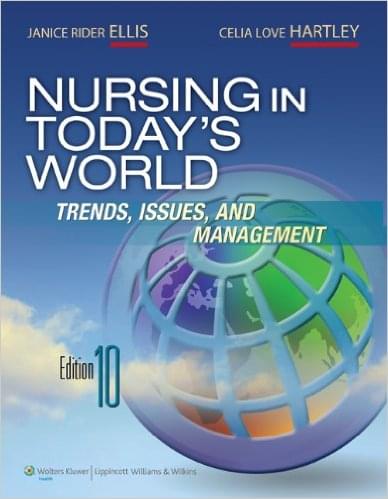
Nursing in Today's World 10th Edition by Dr. Janice Rider Ellis - Test Bank

Nursing in Today's World 10th Edition by Dr. Janice Rider Ellis - Test Bank   Instant Download - Complete Test Bank With Answers     Sample Questions Are Posted Below   suspension does not typically involve the courts.4. Which of the following is a recommendation of the Institute of Medicine report HealthProfession Education: A Bridge …

$19.99

Nursing in Today’s World 10th Edition by Dr. Janice Rider Ellis – Test Bank


Instant Download – Complete Test Bank With Answers


Sample Questions Are Posted Below


suspension does not typically involve the courts.
4. Which of the following is a recommendation of the Institute of Medicine report Health
Profession Education: A Bridge to Quality (2003)?
A) Developing separate core competencies to regulate each health profession
B) Revising the processes of accreditation bodies to require outcomes related to core
competencies
C) Allowing each profession to educate, practice, and dialogue within its own boundaries
D) Changing healthcare workforce regulations based on what is termed a “safe” focus
Ans: B
Client Needs: A-1
Cognitive Level: Comprehension
Difficulty: Difficult
Integrated Process: Nursing Process
Objective: 10
Page and Header: 117, Institute of Medicine Recommendations
Feedback: The IOM report recommended that both licensing bodies and specialty certification
bodies require health professionals to demonstrate in some way their continued competence in
the previously determined core competencies. The report does not advocate the development of
separate core competencies, the isolation of each profession, or changes to workforce
regulations.
5. A nurse administers insulin to a diabetic patient via an insulin pump. Based on the
NCLEX® examination, this action would fall under which of the categories of client needs?
A) Safe effective care environment
B) Health promotion and maintenance
C) Psychosocial integrity
D) Physiological integrity
Ans: D
Client Needs: A-1
Cognitive Level: Analysis
Difficulty: Moderate
Integrated Process: Nursing Process
Objective: 6
Page and Header: 105, Table 3.1
Feedback: The client needs category of physiological integrity encompasses nursing actions
that address a client’s physical needs and the treatment of illness. Administration of medication
is not normally considered a health promotion activity, an aspect of psychosocial integrity, or a
demonstration of safety measures.
6. A nurse who has provided care in acute settings for several years has begun the process of
gaining additional credentials. Which of the following statements best describes credentials?
A) Credentials indicate that an individual has demonstrated a continuing commitment to
competence.
B) Credentials recognize an individual’s professional superiority to his or her peers.
C) Credentials indicate that an individual has met specific criteria and standards.
D) Credentials indicate that an individual has the authority to direct practice in a particular care
setting.
Ans: C
Client Needs: A-1
Cognitive Level: Comprehension
Difficulty: Moderate
Integrated Process: Nursing Process
Objective: 1
Page and Header: 89, Introduction
Feedback: Credentials indicate that an individual (or organization) has met specific standards
that are important to fulfilling a professional mandate. This is not necessarily synonymous with
a “continued commitment,” though such a commitment may help facilitate the attainment of
credentials. Individual credentials do not necessarily indicate superiority or leadership potential.
7. After completing an associate degree in nursing and passing the NCLEX-RN®
examination, a nurse has been granted a license to practice. A license to practice provides the
nurse with
A) formal recognition of the nurse’s graduation from an accredited school of nursing.
B) legal permission to practice the nursing profession.
C) the authority to practice nursing in any state.
D) recognition of advanced learning and competence in a particular care setting.
Ans: B
Client Needs: A-1
Cognitive Level: Analysis
Difficulty: Easy
Integrated Process: Communication and Documentation
Objective: 2
Page and Header: 92, Licensure
Feedback: A license is a legal credential awarded by an individual state that grants permission
to that individual to practice a given profession. A license is normally specific to a particular
jurisdiction. It does not denote advanced learning in a specific setting. Graduation from a
school of nursing is required for licensure, but a license does not explicitly document this
education.
8. The students and faculty of a school of nursing are pleased that the school has recently been
granted a renewal of its current accreditation. Accreditation of a school of nursing is based
primarily on which of the following?
A) The proportion of graduates who pass the NCLEX-RN®
B) The academic credentials of faculty members
C) The findings of an external review committee
D) The overall contribution of the school to the body of nursing knowledge
Ans: C
Client Needs: A-1
Cognitive Level: Application
Difficulty: Moderate
Integrated Process: Communication and Documentation
Objective: 3
Page and Header: 89, Accreditation of Educational Institutions
Feedback: Accreditation of a school of nursing is primarily based on the findings of nursing
experts who visit the institution and appraise the education that is provided. Other factors may
be considered, such as the success of graduates, the credentials of instructors, or the research
that is conducted, but the findings of external reviewers are paramount.
9. A state board of nursing is legally empowered to carry out the provisions of the Nurse
Practice Act. Which of the following activities best demonstrates the mandate and jurisdiction
of a state board of nursing?
A) Advocating for nurses during labor negotiations
B) Organizing information campaigns to enhance the public perception of the nursing
profession
C) Specifying the way that nursing care is organized in public hospitals
D) Establishing the standards that nurses must meet in order to be licensed
Ans: D
Client Needs: A-1
Cognitive Level: Analysis
Difficulty: Difficult
Integrated Process: Communication and Documentation
Objective: 5
Page and Header: 103, The Role of the State Board of Nursing
Feedback: State boards of nursing perform multiple functions, including examination and
licensure of nurses. Participation in labor negotiations, advertising to increase awareness of the
profession, and specifying the way that care is provided are activities that are normally beyond
the purview of a state board of nursing.
10. A registered nurse who completed her education in the Philippines and who is in the
process of immigrating in the United States is attempting to obtain a license to practice in New
Jersey, her intended state of residence. In order to obtain a license, the nurse will primarily be
in contact with
A) the New Jersey Board of Nursing.
B) the American Nurses Association (ANA).
C) one of the accredited schools of nursing in New Jersey.
D) the National Council of State Boards of Nursing, Inc. (NCSBN).
Ans: A
Client Needs: A-1
Cognitive Level: Application
Difficulty: Easy
Integrated Process: Communication and Documentation
Objective: 5
Page and Header: 103, The Role of the State Board of Nursing
Feedback: Licensure is one of the main responsibilities of state boards of nursing, and a nurse
seeking a license to practice in a particular state must obtain a license from that state’s board of
nursing. Schools of nursing, the ANA, and the NCSBN do not directly grant licensure.
Multiple Selection
11. Amanda is a nurse who currently works in a community clinic in a city near state lines.
She is exploring employment possibilities in a neighboring state and hopes to obtain a license
through mutual recognition of licensure. Which of the following conditions must be met in
order for Amanda to obtain a nursing license in this manner? (Select all that apply.)
A) Amanda’s home state must be party to the Nurse Licensure Compact.
B) Amanda must obtain a nursing license in the intended state as well as in her home state.
C) Amanda must meet the standards for licensure in the state where she intends to practice.
D) The state in which Amanda wishes to practice must belong to the Nurse Licensure
Compact.
E) Amanda must possess an ADN or baccalaureate degree in nursing.
Ans: A, C, D
Client Needs: A-1
Cognitive Level: Analysis
Difficulty: Difficult
Integrated Process: Communication and Documentation
Objective: 8
Page and Header: 109, Mutual Recognition of Licensure
Feedback: Obtaining a license through mutual recognition of licensure requires that an
individual’s home state and the intended state of practice be party states. As well, an applicant
must qualify for licensure in the intended state. A diploma in nursing does not preclude transfer
of licensure, and an individual may not possess licenses in both states simultaneously.
Multiple Choice
12. Under the provisions of the Nurse Licensure Compact (NLC), a nurse who is licensed in
Arizona has been practicing for the past year in New Mexico. The nurse is alleged to have
become involved in an inappropriate relationship with a patient in New Mexico and grounds
for disciplinary action appear to exist. How will the discipline of this nurse most likely
proceed?
A) The New Mexico Board of Nursing may withdraw the nurse’s license if this is deemed
necessary.
B) The nurse’s discipline is referred to the American Nurses Association because two state
boards of nursing have interest in the matter.
C) The New Mexico Board of Nursing will undertake investigation, but the Arizona State
Board of Nursing will implement appropriate discipline.
D) The New Mexico Board of Nursing will be unable to change the Arizona licensure status
of the nurse.
Ans: D
Client Needs: A-1
Cognitive Level: Application
Difficulty: Difficult
Integrated Process: Communication and Documentation
Objective: 8
Page and Header: 110, Concerns Regarding Mutual Recognition of Licenses
Feedback: A major concern with mutual recognition is the disciplinary process. Although the
board of nursing can investigate nursing practices and enforce its own standards in the state, it
cannot change the licensure status of the person whose licensure originates in a different state.
The ANA does not participate in disciplinary matters, and a state would not normally undertake
discipline based on an investigation in another party state.
13. Nurse T. has been notified by her state board of nursing that a complaint has been lodged
regarding her practice. How should Nurse T. best respond to this news?
A) Retain the services of an attorney.
B) Organize a private meeting between her and the complainant.
C) Have colleagues write statements attesting to her competence.
D) Explore practice opportunities in other states.
Ans: A
Client Needs: A-1
Cognitive Level: Application
Difficulty: Moderate
Integrated Process: Communication and Documentation
Objective: 8
Page and Header: 110, Revocation of Limitation of a License
Feedback: The individual being investigated for any violation of the Nurse Practice Act should
have an attorney who is knowledgeable about professional disciplinary issues from the time of
notification of the complaint. This is an important action, whether or not there are grounds for
the accusation. A meeting with the complainant would be inappropriate, and enlisting support
from colleagues would be a secondary concern compared with hiring an attorney. It would be
premature, and likely inappropriate, to explore options out-of-state at this early stage.
14. A nurse has been working in pediatrics for 6 years since graduating from an accredited
nursing school. The nurse is now interested in pursuing American Nurses Credentialing Center
certification as a pediatric Clinical Nurse Specialist. What factor will primarily determine
whether the nurse obtains this ANCC certification?
A) Enrollment in a PhD, DNS, or DNP degree program
B) A review of the nurse’s marks from nursing school and interviews with managers and
colleagues
C) Completion of an original research project related to pediatric nursing
D) The demonstration of knowledge and skills in beyond those required for licensure as an
RN
Ans: D
Client Needs: A-1
Cognitive Level: Comprehension
Difficulty: Moderate
Integrated Process: Communication and Documentation
Objective: 9
Page and Header: 114, American Nurses Credentialing Center Certification
Feedback: ANCC certification is a method of recognizing nurses who have special expertise.
Applicants must demonstrate current practice and knowledge beyond that required for licensure
as an RN. Enrollment in a doctoral program is not necessary. Marks from nursing school, the
opinions of supervisors, and the completion of research do not form the basis for certification.
15. The Institute of Medicine (IOM) report Health Profession Education: A Bridge to Quality
(2003) came to several conclusions around the issues confronting health professions education.
Which of the following issues was addressed in the report?
A) The tendency of each health discipline to educate and practice independently of the other
disciplines
B) The lack of recognition of credentials and the credentialing process outside of the field of
nursing
C) The trend toward managed care and the inability of nursing educators to adapt to this
change
D) The historical animosity between nursing and medicine and the failure to bridge this gap
Ans: A
Client Needs: A-1
Cognitive Level: Analysis
Difficulty: Difficult
Integrated Process: Communication and Documentation
Objective: 10
Page and Header: 117, Institute of Medicine Recommendations
Feedback: The IOM noted that each health profession tends to educate, practice, and dialogue
within a “silo.” These narrowly constructed walls make it difficult for interdisciplinary
collaboration to occur. The report does not focus on the relationship between medicine and
nursing, the trend toward managed care, or the lack of recognition of credentials.

Additional information

Add Review

Your email address will not be published. Required fields are marked *