Subtotal: $1,060.00

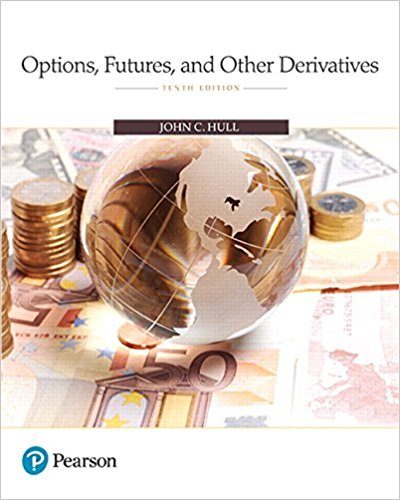
Options Futures and Other Derivatives 10th Edition By JohnC. - Test Bank

Options Futures and Other Derivatives 10th Edition By JohnC. - Test Bank   Instant Download - Complete Test Bank With Answers     Sample Questions Are Posted Below   Hull: Options, Futures and Other Derivatives, Ninth Edition Chapter 6: Interest Rate Futures Multiple Choice Test Bank: Questions and Answers   Which of following is applicable …

$19.99

Options Futures and Other Derivatives 10th Edition By JohnC. – Test Bank


Instant Download – Complete Test Bank With Answers


Sample Questions Are Posted Below


Hull: Options, Futures and Other Derivatives, Ninth Edition

Chapter 6: Interest Rate Futures

Multiple Choice Test Bank: Questions and Answers


  1. Which of following is applicable to corporate bonds in the United States?
    1. Actual/360
    2. Actual/Actual
    3. 30/360
    4. Actual/365

Answer: C


Corporate bonds in the U.S are usually quoted with a 30/360 day count. This means that there are assumed to be 30 days per month and 360 days per year when the length of an accrual period is calculated.


  1. It is May 1. The quoted price of a bond with an Actual/Actual (in period) day count and 12% per annum coupon (paid semiannually) in the United States is 105. It has a face value of 100 and pays coupons on April 1 and October 1. What is the cash price?
  2. 106.00
  3. 106.02
  4. 105.98
  5. 106.04


Answer: C


The cash price is the quoted price plus accrued interest. There are 30 actual days between April 1 and May 1 and 183 actual days between April 1 and October 1.  In this case the quoted price is 105 and the accrued interest is 0.06×100×30/183=0.98. The answer is therefore 105.98.


  1. It is May 1. The quoted price of a bond with a 30/360 day count and 12% per annum coupon in the United States is 105. It has a face value of 100 and pays coupons on April 1 and October 1. What is the cash price?\
  2. 106.00
  3. 106.02
  4. 105.98
  5. 106.04


Answer: A


The cash price is the quoted price plus accrued interest. There are 30 assumed days between April 1 and May 1 and 180 assumed days between April 1 and October 1. In this case the quoted price is 105 and the accrued interest is 0.06×100×30/180 = 1.00. The answer is therefore 106.00.


  1. The most recent settlement bond futures price is 103.5. Which of the following four bonds is cheapest to deliver?
  2. Quoted bond price = 110; conversion factor = 1.0400.
  3. Quoted bond price = 160; conversion factor = 1.5200.
  4. Quoted bond price = 131; conversion factor = 1.2500.
  5. Quoted bond price = 143; conversion factor = 1.3500.

Answer:  C


The cost of delivering a bond is the quoted bond price minus the most recent settlement price times the conversion factor. This is 2.36, 2.68, 1.625, and 3.275 for bonds in A, B, C, and D, respectively. The bond in C is therefore cheapest to deliver.


  1. Which of the following is NOT an option open to the party with a short position in the Treasury bond futures contract?
  2. The ability to deliver any of a number of different bonds
  3. The wild card play
  4. The fact that delivery can be made any time during the delivery month
  5. The interest rate used in the calculation of the conversion factor

Answer: D


A, B, and C describe options that the party with the short position has. D does not


  1. A trader enters into a long position in one Eurodollar futures contract. How much does the trader gain when the futures price quote increases by 6 basis points?
  2. $6
  3. $150
    C.    $60
  4. $600

Answer: B


The trader gains $25 for each basis point. The gain is therefore 25×6 or $150.


  1. The bonds that can be delivered in a Treasury bond futures contract are
  2. Assets that provide no income
  3. Assets that provide a known cash income
  4. Assets that provide a known yield
  5. None of the above

Answer: B

A bond is an asset that provides a known cash income (the coupons)


  1. An ultra T-bond futures contract is one where
  2. Bonds with maturities less than 3 years can be delivered
  3. Bonds with maturities less than 10 years can be delivered
  4. Bonds with maturities greater than 15 years can be delivered
  5. Bonds with maturities greater than 25 year can be delivered


Answer: D


In the ultra T-bond futures contract bonds with maturities over 25 years can be delivered.


  1. A portfolio is worth $24,000,000. The futures price for a Treasury note futures contract is 110 and each contract is for the delivery of bonds with a face value of $100,000. On the delivery date the duration of the bond that is expected to be cheapest to deliver is 6 years and the duration of the portfolio will be 5.5 years. How many contracts are necessary for hedging the portfolio?
    1. 100
    2. 200
    3. 300
    4. 400


Answer: B

The contract price is 110,000. The number of contracts is (24,000,000×5.5)/(110,000×6.0)=200


  1. Which of the following is true?
  2. The futures rates calculated from a Eurodollar futures quote are always less than the corresponding forward rate
  3. The futures rates calculated from a Eurodollar futures quote are always greater than the corresponding forward rate
  4. The futures rates calculated from a Eurodollar futures quote should equal the corresponding forward rate
  5. The futures rates calculated from a Eurodollar futures quote are sometimes greater than and sometimes less than the corresponding forward rate


Answer: B


The futures rate must be reduced by what is known as a convexity adjustment to get the forward rate.


  1. How much is a basis point?
    1. 0%
    2. 1%
    3. 01%
    4. 001%


Answer: C


A basis point is 0.01%.


  1. Which of the following day count conventions applies to a US Treasury bond?
    1. Actual/360
    2. Actual/Actual (in period)
    3. 30/360
    4. Actual/365


Answer: B


Actual/Actual (in period) is used for US Treasury bonds. This means that the interest earned during a period that lies between two coupon payment dates is calculated by dividing the actual number of days in the period by the number of days between the coupon payments and multiplying the result by the next coupon payment


  1. What is the quoted discount rate on a money market instrument?
    1. The interest rate earned as a percentage of the final face value of a bond
    2. The interest rate earned as a percentage of the initial price of a bond
    3. The interest rate earned as a percentage of the average price of a bond
    4. The risk-free rate used to calculate the present value of future cash flows from a bond


Answer: A

The quoted discount rate is the interest earned as a percentage of the final face value


  1. Which of the following is closest to the duration of a 2-year bond that pays a coupon of 8% per annum semiannually? The yield on the bond is 10% per annum with continuous compounding.
    1. 82
    2. 85
    3. 88
    4. 92

Answer: C

The duration of the bond is the weighted average of the times when cash flows are received with weights proportional to the present values of the cash flows. This is


  1. Which of the following is NOT true about duration?
    1. It equals the years-to-maturity for a zero coupon bond
    2. It equals the weighted average of payment times for a bond, where weights are proportional to the present value of payments
    3. Equals the weighted average of individual bond durations for a portfolio, where weights are proportional to the present value of bond prices
    4. The prices of two bonds with the same duration change by the same percentage amount when interest rate moves up by 100 basis points


Answer: D


D is only approximately true. A, B, and C are exactly true.


  1. The conversion factor for a bond is approximately
    1. The price it would have if all cash flows were discounted at 6% per annum
    2. The price it would have if it paid coupons at 6% per annum
    3. The price it would have if all cash flows were discounted at 8% per annum
    4. The price it would have if it paid coupons at 8% per annum


Answer: A


The calculation of the conversion factor involves discounting the cash flows on the bond at 6%.

  1. The time-to-maturity of a Eurodollar futures contract is 4 years and the time-to-maturity of the rate underlying the futures contract is 4.25 years. The standard deviation of the change in the short term interest rate, s = 0.011. What does the model in the text estimate as the difference between the futures and the forward interest rate?
  2. 0.105%
  3. 0.103%
  4. 0.098%
  5. 0.093%


Answer: B


With the notation in the text, the futures rate exceeds the forward rate by 0.5s2T1T2. In this         case s=0.011, T1=4 and T2=4.25 so the difference between the futures and forward price is        0.5×0.011×4×4.25=0.00103.


  1. A trader uses 3-month Eurodollar futures to lock in a rate on $5 million for six months. How many contracts are required?
    1. 5
    2. 10
    3. 15
    4. 20


Answer: B


Each contract locks in the rate on $1 million dollars for three months. A six month instrument is approximately twice as sensitive to rate movements as a three month instrument because it has twice the duration. 2×5 = 10 contracts are therefore required


  1. In the U.S. what is the longest maturity for 3-month Eurodollar futures contracts?

A:  2 years

B:  5 years

C:  10 years

D:  20 years


Answer: C


Eurodollar futures have maturities out to 10 years.


  1. Duration matching immunizes a portfolio against
    1. Any parallel shift in the yield curve
    2. All shifts in the yield curve
    3. Changes in the steepness of the yield curve
    4. Small parallel shifts in the yield curve

Answer: D

Duration matching only protects against small parallel shifts. It does not provide protection against large parallel shifts and non-parallel shifts.


Additional information

Add Review

Your email address will not be published. Required fields are marked *