Subtotal: $960.00

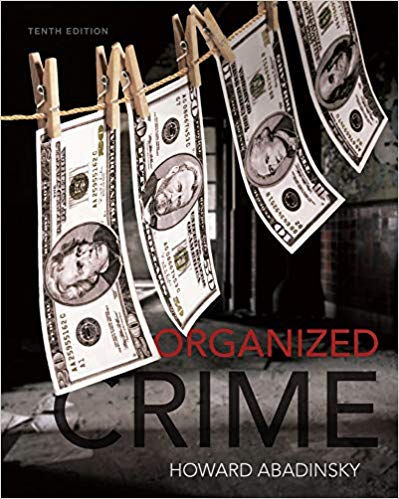
Organized Crime 10th Edition by Howard Abadinsky - Test Bank

Organized Crime 10th Edition by Howard Abadinsky - Test Bank   Instant Download - Complete Test Bank With Answers     Sample Questions Are Posted Below   CHAPTER FIVE Italian Organized Crime and the Albanian Connection Test Bank       MULTIPLE CHOICE   The southern Italians developed an ideal of: manliness omertá vendetta all …

$19.99

Organized Crime 10th Edition by Howard Abadinsky – Test Bank


Instant Download – Complete Test Bank With Answers


Sample Questions Are Posted Below


CHAPTER FIVE

Italian Organized Crime and the Albanian Connection

Test Bank


MULTIPLE CHOICE


  1. The southern Italians developed an ideal of:
  2. manliness
  3. omertá
  4. vendetta
  5. all of these


ANS: D                             LO: 1                           REF: 106


  1. Members of the Mafia refer to the organization as _____________?
  2. Omertá
  3. Vendetta
  4. Cosa Nostra
  5. Capo di Famiglia


ANS: C                             LO: 4                           REF: 113


  1. Which one of the following statements is false?
  2. Mafia is a state of mind.
  3. Mafia is a secret criminal organization.
  4. The mafia originated in Sicily.
  5. Mafia is a way of life.


ANS: B                             LO: 2                           REF: 108 | 109


  1. Every Mafioso demands what?
  2. Extortion money
  3. Rispetto
  4. Capomafioso
  5. Blood money


ANS: B                             LO: 2 | 4                      REF: 111


  1. At the end of World War II, which group emerged?
  2. The Outfit
  3. The Firm
  4. The Nuovo Mafia
  5. The Mezzogiorno


ANS: C                             LO: 4                           REF: 113 | 114 | 115

  1. Which historical figure’s rise had important implications for the Mafia and Italian-American organized crime?
  2. Stalin
  3. Hitler
  4. Pope John IX
  5. Mussolini


ANS: D                             LO: 3                           REF: 112


  1. To which crimes did the Cosa Nostra resort to accumulate the capital necessary to be a player in the heroin and cocaine marketplaces?
  2. Extortion and smuggling
  3. Murder hits and money laundering
  4. Robbery and kidnapping
  5. Prostitution and gambling


ANS: C                             LO: 4                           REF: 125


  1. According to Barzini, which level of organization within the Mafia consists of a group of several families who come together to form a cosca?
  2. The first level
  3. The second level
  4. The third level
  5. The fourth level


ANS: B                             LO: 4                           REF: 109


  1. Which of the following has become a primary alternative to traditional Balkan smuggling routes through the former Yugoslavia?
  2. The Mezzogiorno
  3. The Puglia (Apulia) region at the heel of the Italian boot
  4. Albania
  5. Sicily


ANS: C                             LO: 8                           REF: 127


  1. In Sicily, at least how many people are directly tied to the Mafia?
  2. 500,000
  3. 1 million
  4. 2 million
  5. 3 million


ANS: A                             LO: 4                           REF: 116


  1. To a mafioso, rispetto is:
  2. a demonstration of affection
  3. a show of good manners
  4. an acknowledgement of power
  5. a representation of protection


ANS: C                             LO: 2 | 4                      REF: 111


  1. What does the word cosca refer to?
  2. the globe’s heart
  3. friends of friends
  4. a broker
  5. the leaves of an artichoke


ANS: D                             LO: 4                           REF: 109


  1. The New Mafia has a membership in excess of how many members?
  2. 5,000
  3. 10,000
  4. 15,000
  5. 20,000


ANS: A                             LO: 4                           REF: 115


  1. The New Mafia is divided into about how many cosche?
  2. 18
  3. 180
  4. 1800
  5. 18,000


ANS: B                             LO: 4                           REF: 115


  1. What does the term camorra mean?
  2. “honorable thieves”

b “contestation”

  1. “secret”
  2. “brotherhood”


ANS: B                             LO: 5                           REF: 119


  1. An estimated three-quarters of what product sold in Naples originate in the black market?
  2. cigarettes
  3. guns
  4. blue jeans
  5. gasoline


ANS: A                             LO: 5                           REF: 120

  1. During the postwar era, many Sicilian Mafiosi were forced into “internal exile” to live in which of the following cities?
  2. Naples
  3. Rome
  4. Florence
  5. Venice


ANS: A                             LO: 3 | 4 | 5                 REF: 120


  1. Which of the following rules a collection of some of the most ruthless Camorra clans in Naples?
  2. a priest
  3. a Mafioso
  4. a woman
  5. the mayor of the city


ANS: B                             LO: 1                           REF: 121


  1. To the Camorra, which of the following is crucial?
  2. omertà
  3. secrecy
  4. territorial control
  5. religious ideology


ANS: C                             LO: 5                           REF: 123


  1. The principal industry of the Neapolitan Camorra was:
  2. kidnapping
  3. burglary
  4. extortion
  5. international arms smuggling


ANS: C                             LO: 5                           REF: 119


  1. Members of the ‘Ndrangheta must do what to be admitted?
  2. cut off a finger
  3. tattoo most of their bodies
  4. take a blood oath
  5. commit five murders


ANS: C                             LO: 6                           REF: 123


  1. The ‘Ndrangheta exhibits its criminal skills in all but which of the following?
  2. kidnapping
  3. vast-scale international arms trafficking
  4. extortion
  5. all of these


ANS: D                             LO: 6                           REF: 125


  1. Salvatore Riina is known by what name?
  2. “the Policeman”
  3. “the Butcher”
  4. “the Bull”
  5. “the Beast”


ANS: D                             LO: 4                           REF: 115


  1. _______ are very violent; their major source of income derives from trafficking in economic migrants, women, children, drugs, contraband, weapons, and automobiles.
  2. Italian Crime Groups
  3. Mexican Crime Groups
  4. Albanian Crime Groups
  5. American Crime Groups


ANS: C                             LO: 9                           REF: 127


  1. Which of the following is not a type of criminal organization in Italy?
  2. The Mafia
  3. The ‘Ndrangheta
  4. The Neapolitan Camorra
  5. The Outfit


ANS: D                             LO: 1                           REF: 106


  1. In 1860, Italy was freed of foreign rule and united by:
  2. Giuseppe Garibaldi
  3. Luciana Leggio
  4. Salvatore Riina
  5. Vito Genovese


ANS: C                             LO: 1 | 2                      REF: 108


  1. Which of the following means protection against the arrogance of the powerful, remedy to any damage, sturdiness of body, strength and serenity of spirit, and the best and most exquisite part of life?
  2. Omertá
  3. Mafia
  4. Cosa Nostra
  5. Capo di Famiglia


ANS: B                             LO: 1 | 2                      REF: 109


  1. Who did Mussolini send to take down the Mafia?
  2. Luiana Leggio
  3. Prefect Cesare Mori
  4. Vito Genovese
  5. Giuseppe Garibaldi


ANS: B                             LO: 3                           REF: 112


  1. Which of the following was the last of the old-style capomafiosi?
  2. Don Calò
  3. Luiana Leggio
  4. Vito Genovese
  5. Giuseppe Garibaldi


ANS: A                             LO: 4                           REF: 113


TRUE/FALSE


  1. Mussolini’s rise to power in the 1920s had important implications for the Mafia and Italian-American organized crime.


ANS: T                              LO: 3                           REF: 112


  1. The end of World War II brought a Mafia renaissance in the United States as a vacuum in local leadership was filled by former capomafiosi.


ANS: F                              LO: 3                           REF: 113


  1. While burglary and other remunerative felonies were not neglected, extortion was the Camorra’s principal industry.


ANS: T                              LO: 5                           REF: 119


  1. The Mafia has little voting strength in Sicily.


ANS: F                              LO: 4                           REF: 116

  1. The cosca’s rigid organization makes it an inflexible bureaucracy.


ANS: F                              LO: 4                           REF: 109 | 110


  1. Excesses at home, a vigorous government response, and the increasing number of informers have weakened the Mafia.


ANS: T                              LO: 4                           REF: 117 | 118


  1. As a result of the assassinations of government officials, the New Mafia has gained the support of important elements of Italian society.


ANS: F                              LO: 4                           REF: 117


  1. The New Mafia has a membership in excess of five thousand.


ANS: T                              LO: 1                           REF: 115


  1. A collection of some of the most ruthless Camorra clans in Naples is ruled by a woman.


ANS: T                              LO: 1                           REF: 121


FILL IN THE BLANK


  1. ______________ is a Sicilian-Arabic term meaning to protect and to act as guardian.


ANS: Mafia                                               LO: 2                           REF: 109


  1. ______________rise to power in the 1920s had important implications for the Mafia and Italian-American organized crime.


ANS: Mussolini’s                                      LO: 3                           REF: 112


  1. The members of the ‘Ndrangheta are governed by the concept of _____________.


ANS: omerta                                             LO: 6                           REF: 123

  1. The Nuovo Mafia emerged after ______________.


ANS: World War II                                  LO: 3 | 4                      REF: 113


  1. The New Mafia is also known as ______________.


ANS: Cosa Nostra                                    LO: 4                           REF: 113


  1. The New Mafia continues the ______________ which is the collection of protection money from large and small businesses.


ANS: pizzu                                                LO: 4                           REF: 114


  1. The traditional Mafia pursued ________________, not wealth.


ANS: power                                              LO: 1 | 2                      REF: 117


  1. The Mezzogiornio was dependent on _______________ and had a legacy of political, social, and economic repression and exploitation.


ANS: agriculture                                       LO: 1                           REF: 106


  1. ___________ play important roles in business operations in the Sacra Corona Unita.


ANS: women                                            LO: 1                           REF: 126


  1. The ___________ was deliberately structured as a criminal society.


ANS: Camorra                                          LO: 1                           REF: 119


ESSAY


  1. Explain the following statement: Mafia is a state of mind, a way of life – not a secret criminal organization.


ANS:  Mafia is shared by all Sicilians, the honest and the criminal:  “they must aid each other, side with their friends, and fight the common enemies even when the friends are wrong and the enemies are right; each must defend his dignity at all costs and never allow the smallest slight to go unavenged; they must keep secrets and beware of official authorities and laws.”


LO: 1 | 2                         REF: 109


  1. Discuss why Mussolini’s rise to power in the 1920s had important implications for the Mafia and Italian-American organized crime.


ANS:  Mussolini sought to destroy the Mafia. The campaign against the Mafia drove some important mafiosi out of Sicily. They traveled to the United States at an opportune time, during the Prohibition era, and took up important positions in a newly emerging form of organized crime.


LO: 3                              REF: 112


  1. Discuss two or three differences between the Nuovo Mafia and the “Old Mafia.”


ANS:  Agrarian reform in Italy broke up the landed estates and did away with the traditional capomafioso who lived off agricultural profits, theft of cattle, control over water supplies, and peasant labor. “The new Mafia was making deals in luxury hotels, in the offices of multinational corporations, and the well-appointed studies of politicians” (Costanzo 2007: 139). They were becoming increasingly urban–by 1987, there were eighteen cosche in Palermo (Maran 2008).


LO: 4                              REF: 114


  1. Discuss the relationship between politics and the Mafia in Sicily.


ANS:  Italy is home to three world powers: the Italian government, the Catholic Church, and the Mafia, of which the government is the feeblest. Mafia voting strength is based on the circle of family and friends that each mafioso can deliver.


LO: 4                              REF: 116


  1. How has the Nuovo Mafia contributed to the decline of the Mafia in Sicily?


ANS:  Since 1971, the Nuovo Mafia has assassinated investigative, judicial, and political officials.  This violence alienated the Catholic church and the people, and brought government forces to bear against the mafia.


LO: 4                              REF: 117


  1. What is the Albanian connection to Italian organized crime?


ANS:  Since 1992, ethnic Albanian organized crime groups have profited greatly from instability and war in the Balkans to become the fastest growing ethnic criminal presence in Europe, with operations reaching as far as Australia and the United States (LaVerle et al. 2003). Albanian influence in the Mezzogiorno dates back to the migration of Albanians driven from their country by the Ottoman invasion in the fifteenth century. Known as arbresheri, many settled in Calabria and Sicily where they quickly integrated with the existing culture of southern Italy (Bequai 1979).

Once the most isolated country in Europe, Albania became a haven for local and foreign criminal groups after the collapse of its Stalinist regime in the early 1990s.


LO: 8 | 9                         REF: 126 | 127 | 128 | 129


  1. What is the organizational structure of the ’Ndrangheta?


ANS: ‘Ndrangheta is a loose federation of mafia families.  Clans are based on blood ties, allowing for a high degree of internal cohesion which protects against informants.


LO: 6                              REF: 124


  1. What is omertá? Define the term’s meaning in southern Italy region of Mezzogiorno and briefly tell its implications for men in that region.


ANS:  Omertá is the southern Italian ideal of manliness.  It includes non-cooperation with authorities (vow of silence), self-control in the face of adversity, and the vendetta—“blood washes blood”—which dictated that any offense or slight to the famiglia (family) had to be avenged, no matter what the consequences or how long it took.


LO: 1                              REF: 106


  1. What is a famiglia in the culture of the Mezzogiorno? Who are the members of a famiglia?


ANS:  A famiglia s composed of all of one’s blood relatives; including all relatives Americans would consider very distant cousins, aunts, and uncles, an extended clan whose genealogy was traced through paternity.  The clan was supplemented through an important comparático or comparaggio (godparenthood), through which carefully selected outsiders became, to an important (but incomplete) extent, members of the family.


LO: 1                              REF: 106


  1. Why do Albanian transnational organized crime groups prefer to reside in Albania, when they could live in Italy or elsewhere around the world?


ANS: In Albania, they benefit from a weak and corrupt justice system.  “Albania is an origin and transit country.  The criminal elements can take advantage of the instability, corruption and lack of organization and resources of the Albanian law enforcement entities. Illicit funds are laundered back into Albania from abroad to purchase and develop choice properties suspiciously acquired during the privatization program.”


LO: 9                              REF: 127

Additional information

Add Review

Your email address will not be published. Required fields are marked *