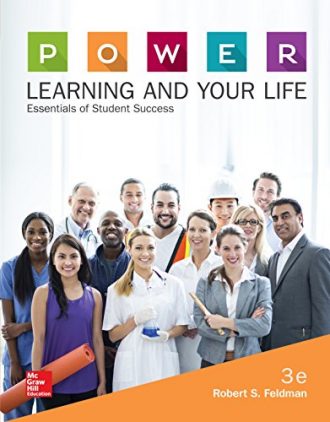
P.O.W.E.R. Learning and Your Life Essentials of Student Success 3rd Edition by Robert Feldman - Test Bank

P.O.W.E.R. Learning and Your Life Essentials of Student Success 3rd Edition by Robert Feldman - Test Bank   Instant Download - Complete Test Bank With Answers     Sample Questions Are Posted Below   Chapter 05 Reading and Remembering   Multiple Choice Questions 1. The key to good reading is A. speed.   B. using …

$19.99

P.O.W.E.R. Learning and Your Life Essentials of Student Success 3rd Edition by Robert Feldman – Test Bank


Instant Download – Complete Test Bank With Answers


Sample Questions Are Posted Below


Chapter 05

Reading and Remembering


Multiple Choice Questions

1. The key to good reading is

A. speed.


B. using a highlighter.


C. having the right tools of the trade.


D. understanding the material.


2. Understanding the material is the

A. P.O.W.E.R. Learning method.


B. pursuit of academia.


C. key to good reading.


D. tool of the trade.


3. An advance organizer is

A. a clue to the meaning and organization of new reading material that paves the way for later learning.


B. the preface, introduction, and table of contents of a book.


C. the length of time that attention is usually sustained.


D. the process of practicing and learning material.


4. Examples of advance organizers are

A. P.O.W.E.R. tools.


B. the preface, introduction, and table of contents.


C. mental distractions.


D. outlines, overviews, and objectives.


5. Front matter is

A. P.O.W.E.R. tools.


B. the preface, introduction, and table of contents.


C. mental distractions.


D. outlines, overviews, and objectives.


6. The preface, introduction, and table of contents to a book are referred to as

A. advance organizers.


B. a P.O.W.E.R. tool.


C. front matter.


D. a memory strategy.


7. The first step in building a better memory is to

A. read the outlines, overviews, and objectives.


B. focus on what is less crucial.


C. read the front matter.


D. determine what you wish to recall.


8. If you are going to use a text extensively throughout the semester, it is useful to start by reading the

A. set assignments.


B. front matter.


C. syllabus.


D. index.


9. Your attention span is

A. the time you take to prepare for a reading assignment.


B. the length of time you sustain focus.


C. the information you recall when reading.


D. the primary item you need to finish a reading assignment.


10. The length of time you can sustain focus is your

A. index.


B. front matter.


C. reading assignment.


D. attention span.


11. If you can’t remember the meaning of a word when reading in a foreign language you should

A. immediately look it up in a dictionary.


B. not stop or you will interrupt your train of thought.


C. try to figure it out using its context.


D. look it up in a dictionary after you finish reading.


12. According to your textbook, you will find it easier to concentrate on longer reading assignments if you

A. make the material yours.


B. break them into several smaller segments.


C. read them straight through.


D. read them out loud.


13. One system for reading is the principles of P.O.W.E.R., which stands for

A. prepare, organize, work, evaluate, and rethink.


B. prepare, organize, worry, evaluate, and revise.


C. promote, organize, work, elevate, and rethink.


D. promote, organize, work, evaluate, and revise.


14. In what part of the P.O.W.E.R. plan do you use advance organizers?

A. prepare


B. organize


C. work


D. evaluate


E. rethink


15. In what part of the P.O.W.E.R. plan do you gather your pens, highlighters, assignments, and a dictionary?

A. prepare


B. organize


C. work


D. evaluate


E. rethink


16. The process of practicing and learning material is referred to as

A. recite.


B. review.


C. rehearsal.


D. record.


17. Rehearsal is referred to as

A. writing in your textbook.


B. practicing and learning material.


C. describing what you’ve read.


D. reviewing your reading materials.


18. A formal techniques used to make material more readily remembered is referred to as

A. a rhyme.


B. an acrostic.


C. an acronym.


D. a mnemonic.


19. A word or phrase formed by the first letters of a series of terms is referred to as

A. a rhyme.


B. an acrostic.


C. an acronym.


D. a mnemonic.


20. A sentence in which the first letters of the words correspond to the material that is to be remembered is referred to as

A. a rhyme.


B. an acrostic.


C. an acronym.


D. a mnemonic.


21. Studying and rehearsing material past the point of initial mastery to the point at which recall becomes automatic is referred to as

A. SQ4R.


B. a mnemonic.


C. overlearning.


D. rehearsal.


22. Two particularly useful rethinking tools are rereading and

A. rephrasing.


B. highlighting.


C. questioning.


D. thinking deeply.


23. Evaluation of what you’ve read is crucial. It consists of

A. creating acronyms.


B. identifying main ideas and their value.


C. rehearsing mnemonics.


D. questioning your reading.


24. Determining what information is more crucial to the main point compared to those that aren’t as crucial is referred to as

A. being honest with yourself.


B. thinking critically about the presented arguments.


C. prioritizing the ideas.


D. determining the main theme.


25. Pretending to explain your reading material to a fellow classmate helps you to

A. improve your speaking skills.


B. recognize flaws in an argument.


C. identify weak spots in your understanding of the material.


D. prioritize the ideas in the material.


26. According to your textbook, what is the best way to remember what you have read?

A. Put it away for at least two days.


B. Rethink the material, rereading the more difficult or important parts.


C. Write a one-page summary.


D. Highlight key words.


27. A memory technique by which images are formed to help recall material is referred to as

A. acrostic.


B. chunking.


C. overlearning.


D. visualization.


28. Visualization is referred to as

A. the process by which our physical memories require the use of mnemonics.


B. the process by which the physical links between brain cells that represent memory become fixed and stable over time.


C. a memory technique by which images are formed to help recall material.


D. the process by which we begin to lose our memories and have to continually reread in order to remember.


29. Difficulties in processing information when listening, speaking, reading, or writing is characterized by a

A. memorization strategy.


B. mnemonic.


C. memory consolidation.


D. learning disability.


30. One common learning disabilities is known as

A. acronym.


B. dyslexia.


C. memory conditioning.


D. memory loss.


Check All That Apply Questions

31. What factors should be considered when determining whether you have enough time to read an assignment? Click all that apply.

____  the type of music you like to listen to while reading
____  your per-page reading speed
____  how long it will take to prepare the snack you want for your “reading break”
____  your typical attention span
____  the length of the assignment


32. What are some of the tools you should gather to help you complete a reading assignment? Click all that apply.

____  front matter
____  pens and pencils
____  advance organizers
____  access to a dictionary
____  a copy of the assignment


33. What are the benefits of taking notes while reading an assignment? Click all that apply.

____  A marked-up textbook is easier to sell at the end of the term.
____  It reminds you of key points when you begin studying the material for an exam.
____  It makes the material part of your personal knowledge base.
____  It engages an additional perceptual system that helps you learn in an active way.
____  It allows you to skip lectures since you already know the information.


34. What should you do to help comprehend what you’re reading? Click all that apply.

____  Look up the definition of unfamiliar words.
____  Rephrase key points.
____  Memorize what you’re reading
____  Underline or highlight key points.
____  Highlight every chapter title.


35. Which options below are referred to as mnemonics? Click all that apply.

____  SQ4R
____  jingles
____  acronyms
____  acrostics
____  rehearsal


36. When you feel comfortable with what you’ve learned, it’s time to evaluate whether you’ll be able to recall the materials. Which of the following strategies can you use? Click all that apply.

____  Use the SQ4R method.
____  Work with your study group.
____  Create mnemonics.
____  Test yourself.
____  Complete the in-text review questions and tests.


True / False Questions

37. Understanding the author’s point of view is not essential to active reading.

True    False


38. An important feature of advance organizers is to provide a framework for what you will be reading.

True    False


39. You should read all material with the same degree of intensity.

True    False


40. Writing is one of the most important aspects of reading.

True    False


41. Read your chapter summaries and test questions first, then read the front matter.

True    False


42. When reading, you should make as few marks in your book as possible so you will not be distracted when you go back to revise.

True    False


43. The first or last sentence of a paragraph will often present a key point.

True    False


44. When highlighting and underlining reading material, more is usually better.

True    False


45. Attention-deficit hyperactivity disorder (ADHD) poses no real challenges for college reading.

True    False


46. Learning disabilities are linked to IQ.

True    False


Short Answer Questions

47. You have been assigned a text that you will be reading from throughout the semester. Briefly explain what steps you can take to prepare yourself before reading the specific weekly assignments, so that you will understand and retain the material better.


48. List three advance organizers that are often built into textbooks, and briefly explain how you could create your own advance organizers.


49. How can you use visualization to help you understand and remember what you have read? Provide an example of a visualization.


50. According to the textbook, “Evaluation is a crucial step in reading.” What are some things you can do to evaluate how well you have understood what you have read?


Chapter 05 Reading and Remembering Answer Key

Multiple Choice Questions

1. The key to good reading is

A. speed.


B. using a highlighter.


C. having the right tools of the trade.


D. understanding the material.

Understanding the material is the most important element in reading.


Accessibility: Keyboard Navigation
Blooms: Remember
Difficulty: 1 Easy
Learning Objective: 5-1 Explain how reading style and attention span affect reading.
Topic: Preparing to Read and Remember


2. Understanding the material is the

A. P.O.W.E.R. Learning method.


B. pursuit of academia.


C. key to good reading.


D. tool of the trade.

We should try to become more efficient readers who comprehend and recall more effectively.


Accessibility: Keyboard Navigation
Blooms: Remember
Difficulty: 1 Easy
Learning Objective: 5-1 Explain how reading style and attention span affect reading.
Topic: Preparing to Read and Remember


3. An advance organizer is

A. a clue to the meaning and organization of new reading material that paves the way for later learning.


B. the preface, introduction, and table of contents of a book.


C. the length of time that attention is usually sustained.


D. the process of practicing and learning material.

Most textbooks have advance organizes built in. For example, the beginning of a chapter may include an outline and some questions at the end.


Accessibility: Keyboard Navigation
Blooms: Remember
Difficulty: 1 Easy
Learning Objective: 5-1 Explain how reading style and attention span affect reading.
Topic: Preparing to Read and Remember


4. Examples of advance organizers are

A. P.O.W.E.R. tools.


B. the preface, introduction, and table of contents.


C. mental distractions.


D. outlines, overviews, and objectives.

An advance organizer is a clue to the meaning and organization of new material you are reading.


Accessibility: Keyboard Navigation
Blooms: Remember
Difficulty: 1 Easy
Learning Objective: 5-1 Explain how reading style and attention span affect reading.
Topic: Preparing to Read and Remember


5. Front matter is

A. P.O.W.E.R. tools.


B. the preface, introduction, and table of contents.


C. mental distractions.


D. outlines, overviews, and objectives.

Your instructor may not assign front matter as part of the reading, but it can be a huge help for you to learn what the author feels is important and what you can expect as you read.


Accessibility: Keyboard Navigation
Blooms: Remember
Difficulty: 1 Easy
Learning Objective: 5-1 Explain how reading style and attention span affect reading.
Topic: Preparing to Read and Remember


6. The preface, introduction, and table of contents to a book are referred to as

A. advance organizers.


B. a P.O.W.E.R. tool.


C. front matter.


D. a memory strategy.

Begin by reading the front matter to get insight into what will be covered in the text.


Accessibility: Keyboard Navigation
Blooms: Remember
Difficulty: 1 Easy
Learning Objective: 5-1 Explain how reading style and attention span affect reading.
Topic: Preparing to Read and Remember


7. The first step in building a better memory is to

A. read the outlines, overviews, and objectives.


B. focus on what is less crucial.


C. read the front matter.


D. determine what you wish to recall.

Determine what you wish to recall by separating the important information from the less crucial information.


Accessibility: Keyboard Navigation
Blooms: Remember
Difficulty: 1 Easy
Learning Objective: 5-1 Explain how reading style and attention span affect reading.
Topic: Preparing to Read and Remember


8. If you are going to use a text extensively throughout the semester, it is useful to start by reading the

A. set assignments.


B. front matter.


C. syllabus.


D. index.

Reading the front matter (i.e., introduction, preface, table of contents) gives you insight into the author’s frame of reference, goals, and strategies in writing the book.


Accessibility: Keyboard Navigation
Blooms: Remember
Difficulty: 1 Easy
Learning Objective: 5-1 Explain how reading style and attention span affect reading.
Topic: Preparing to Read and Remember


9. Your attention span is

A. the time you take to prepare for a reading assignment.


B. the length of time you sustain focus.


C. the information you recall when reading.


D. the primary item you need to finish a reading assignment.

Everyone’s attention span is different. Knowing your attention span can help you better prepare for your reading assignments.


Accessibility: Keyboard Navigation
Blooms: Remember
Difficulty: 1 Easy
Learning Objective: 5-1 Explain how reading style and attention span affect reading.
Topic: Preparing to Read and Remember


10. The length of time you can sustain focus is your

A. index.


B. front matter.


C. reading assignment.


D. attention span.

People with a long attention span can read for regularly lengthy periods of time versus someone with a shorter attention span who may only be able to read for a short period of time.


Accessibility: Keyboard Navigation
Blooms: Remember
Difficulty: 1 Easy
Learning Objective: 5-1 Explain how reading style and attention span affect reading.
Topic: Preparing to Read and Remember


11. If you can’t remember the meaning of a word when reading in a foreign language you should

A. immediately look it up in a dictionary.


B. not stop or you will interrupt your train of thought.


C. try to figure it out using its context.


D. look it up in a dictionary after you finish reading.

You should look the word up only after you have tried to figure out the meaning from the context.


Accessibility: Keyboard Navigation
Blooms: Remember
Difficulty: 1 Easy
Learning Objective: 5-2 Identify how to improve concentration and read and remember more effectively.
Topic: Reading Strategies


12. According to your textbook, you will find it easier to concentrate on longer reading assignments if you

A. make the material yours.


B. break them into several smaller segments.


C. read them straight through.


D. read them out loud.

Reading in small bites makes concentration more manageable.


Accessibility: Keyboard Navigation
Blooms: Remember
Difficulty: 1 Easy
Learning Objective: 5-2 Identify how to improve concentration and read and remember more effectively.
Topic: Reading Strategies


13. One system for reading is the principles of P.O.W.E.R., which stands for

A. prepare, organize, work, evaluate, and rethink.


B. prepare, organize, worry, evaluate, and revise.


C. promote, organize, work, elevate, and rethink.


D. promote, organize, work, evaluate, and revise.

P.O.W.E.R. Learning will help you become a better reader with a more complete memory of what you read.


Accessibility: Keyboard Navigation
Blooms: Remember
Difficulty: 1 Easy
Learning Objective: 5-1 Explain how reading style and attention span affect reading.
Topic: Preparing to Read and Remember


14. In what part of the P.O.W.E.R. plan do you use advance organizers?

A. prepare


B. organize


C. work


D. evaluate


E. rethink

Prepare yourself by becoming familiar with advance organizers—the outlines, overviews, and section objectives in the material you’re reading.


Accessibility: Keyboard Navigation
Blooms: Remember
Difficulty: 1 Easy
Learning Objective: 5-1 Explain how reading style and attention span affect reading.
Topic: Preparing to Read and Remember


15. In what part of the P.O.W.E.R. plan do you gather your pens, highlighters, assignments, and a dictionary?

A. prepare


B. organize


C. work


D. evaluate


E. rethink

These essential tools will get you prepared and ready to begin your reading assignment. You won’t have to stop what you’re doing to get, for example, a highlighter.


Accessibility: Keyboard Navigation
Blooms: Remember
Difficulty: 1 Easy
Learning Objective: 5-1 Explain how reading style and attention span affect reading.
Topic: Preparing to Read and Remember


16. The process of practicing and learning material is referred to as

A. recite.


B. review.


C. rehearsal.


D. record.

Rehearsal helps transfer material you’ve encountered into your memory.


Accessibility: Keyboard Navigation
Blooms: Remember
Difficulty: 1 Easy
Learning Objective: 5-2 Identify how to improve concentration and read and remember more effectively.
Topic: Memory Strategies


17. Rehearsal is referred to as

A. writing in your textbook.


B. practicing and learning material.


C. describing what you’ve read.


D. reviewing your reading materials.

If you don’t rehearse what you’ve learned, you’re at risk of losing it from your memory.


Accessibility: Keyboard Navigation
Blooms: Remember
Difficulty: 1 Easy
Learning Objective: 5-2 Identify how to improve concentration and read and remember more effectively.
Topic: Memory Strategies


18. A formal techniques used to make material more readily remembered is referred to as

A. a rhyme.


B. an acrostic.


C. an acronym.


D. a mnemonic.

Mnemonics are tricks that professionals use to store information in their memory.


Accessibility: Keyboard Navigation
Blooms: Remember
Difficulty: 1 Easy
Learning Objective: 5-2 Identify how to improve concentration and read and remember more effectively.
Topic: Memory Strategies


19. A word or phrase formed by the first letters of a series of terms is referred to as

A. a rhyme.


B. an acrostic.


C. an acronym.


D. a mnemonic.

One example of an acronym is the word laser. It stands for light amplification by stimulated emissions of radiation.


Accessibility: Keyboard Navigation
Blooms: Remember
Difficulty: 1 Easy
Learning Objective: 5-2 Identify how to improve concentration and read and remember more effectively.
Topic: Memory Strategies


20. A sentence in which the first letters of the words correspond to the material that is to be remembered is referred to as

A. a rhyme.


B. an acrostic.


C. an acronym.


D. a mnemonic.

Acrostics are similar to acronyms except they use entire sentences instead of single words to create the memory hint.


Accessibility: Keyboard Navigation
Blooms: Remember
Difficulty: 1 Easy
Learning Objective: 5-2 Identify how to improve concentration and read and remember more effectively.
Topic: Memory Strategies


21. Studying and rehearsing material past the point of initial mastery to the point at which recall becomes automatic is referred to as

A. SQ4R.


B. a mnemonic.


C. overlearning.


D. rehearsal.

Once you have overlearned, recall becomes automatic and you no longer have to search for the answers.


Accessibility: Keyboard Navigation
Blooms: Remember
Difficulty: 1 Easy
Learning Objective: 5-2 Identify how to improve concentration and read and remember more effectively.
Topic: Memory Strategies


22. Two particularly useful rethinking tools are rereading and

A. rephrasing.


B. highlighting.


C. questioning.


D. thinking deeply.

Think deeply about the material you’re rereading and consider the take-home message. Make sure you understand it completely and that you can answer any questions you had earlier about the material.


Accessibility: Keyboard Navigation
Blooms: Remember
Difficulty: 1 Easy
Learning Objective: 5-3 Discuss how best to retain what you have read.
Topic: Evaluating and Rethinking Your Reading


23. Evaluation of what you’ve read is crucial. It consists of

A. creating acronyms.


B. identifying main ideas and their value.


C. rehearsing mnemonics.


D. questioning your reading.

Determine what the take-home message is from what you read and what it means to you on a personal level.


Accessibility: Keyboard Navigation
Blooms: Remember
Difficulty: 1 Easy
Learning Objective: 5-3 Discuss how best to retain what you have read.
Topic: Evaluating and Rethinking Your Reading


24. Determining what information is more crucial to the main point compared to those that aren’t as crucial is referred to as

A. being honest with yourself.


B. thinking critically about the presented arguments.


C. prioritizing the ideas.


D. determining the main theme.

Make a list of the main topics and try to rank them in order of importance.


Accessibility: Keyboard Navigation
Blooms: Remember
Difficulty: 1 Easy
Learning Objective: 5-3 Discuss how best to retain what you have read.
Topic: Evaluating and Rethinking Your Reading


25. Pretending to explain your reading material to a fellow classmate helps you to

A. improve your speaking skills.


B. recognize flaws in an argument.


C. identify weak spots in your understanding of the material.


D. prioritize the ideas in the material.

In addition to helping you remember the information better, pretending to explain the material to a classmate can help identify weak spots in your understanding.


Accessibility: Keyboard Navigation
Blooms: Remember
Difficulty: 1 Easy
Learning Objective: 5-3 Discuss how best to retain what you have read.
Topic: Evaluating and Rethinking Your Reading


26. According to your textbook, what is the best way to remember what you have read?

A. Put it away for at least two days.


B. Rethink the material, rereading the more difficult or important parts.


C. Write a one-page summary.


D. Highlight key words.

Rethinking the material will help transfer the material from your short-term to long-term memory and solidify the information so that it will be remembered for the long haul.


Accessibility: Keyboard Navigation
Blooms: Remember
Difficulty: 1 Easy
Learning Objective: 5-3 Discuss how best to retain what you have read.
Topic: Evaluating and Rethinking Your Reading


27. A memory technique by which images are formed to help recall material is referred to as

A. acrostic.


B. chunking.


C. overlearning.


D. visualization.

Memory requires three basic steps: the initial recording of information, the storage of that information, and the retrieval of the information. Associate images with these steps and you’ll be able to remember them better.


Accessibility: Keyboard Navigation
Blooms: Remember
Difficulty: 1 Easy
Learning Objective: 5-2 Identify how to improve concentration and read and remember more effectively.
Topic: Memory Strategies


28. Visualization is referred to as

A. the process by which our physical memories require the use of mnemonics.


B. the process by which the physical links between brain cells that represent memory become fixed and stable over time.


C. a memory technique by which images are formed to help recall material.


D. the process by which we begin to lose our memories and have to continually reread in order to remember.

Associating images to information you learn will help you recall the information much easier later.


Accessibility: Keyboard Navigation
Blooms: Remember
Difficulty: 1 Easy
Learning Objective: 5-2 Identify how to improve concentration and read and remember more effectively.
Topic: Memory Strategies


29. Difficulties in processing information when listening, speaking, reading, or writing is characterized by a

A. memorization strategy.


B. mnemonic.


C. memory consolidation.


D. learning disability.

Learning disabilities are often diagnosed when there is a discrepancy between learning potential and actual academic achievement.


Accessibility: Keyboard Navigation
Blooms: Remember
Difficulty: 1 Easy
Learning Objective: 5-3 Discuss how best to retain what you have read.
Topic: Learning Disabilities


30. One common learning disabilities is known as

A. acronym.


B. dyslexia.


C. memory conditioning.


D. memory loss.

Dyslexia is a reading disability that produces the misperception of letters during reading and writing, unusual difficulty in sounding out letters, and even confusion between right and left.


Accessibility: Keyboard Navigation
Blooms: Remember
Difficulty: 1 Easy
Learning Objective: 5-3 Discuss how best to retain what you have read.
Topic: Learning Disabilities


Check All That Apply Questions

31. What factors should be considered when determining whether you have enough time to read an assignment? Click all that apply.

__ the type of music you like to listen to while reading
X your per-page reading speed
__ how long it will take to prepare the snack you want for your “reading break”
X your typical attention span
X the length of the assignment

To determine how long a given reading assignment will take, you can multiply the number of pages by your per-page reading speed. You should factor in breaks if this number exceeds your attention span.


Blooms: Remember
Difficulty: 1 Easy
Learning Objective: 5-1 Explain how reading style and attention span affect reading.
Topic: Preparing to Read and Remember


32. What are some of the tools you should gather to help you complete a reading assignment? Click all that apply.

__ front matter
X pens and pencils
__ advance organizers
X access to a dictionary
X a copy of the assignment

Gather a copy of the assignment, paper or index cards, pencils or pens, and access to the dictionary so you are able to thoroughly read your assignment and take notes as necessary.


Blooms: Remember
Difficulty: 1 Easy
Learning Objective: 5-1 Explain how reading style and attention span affect reading.
Topic: Preparing to Read and Remember


33. What are the benefits of taking notes while reading an assignment? Click all that apply.

__ A marked-up textbook is easier to sell at the end of the term.
X It reminds you of key points when you begin studying the material for an exam.
X It makes the material part of your personal knowledge base.
X It engages an additional perceptual system that helps you learn in an active way.
__ It allows you to skip lectures since you already know the information.

Taking notes on the key points has many important benefits.


Blooms: Remember
Difficulty: 1 Easy
Learning Objective: 5-2 Identify how to improve concentration and read and remember more effectively.
Topic: Reading Strategies


34. What should you do to help comprehend what you’re reading? Click all that apply.

X Look up the definition of unfamiliar words.
X Rephrase key points.
__ Memorize what you’re reading
X Underline or highlight key points.
__ Highlight every chapter title.

Above all, create a reading system that works for you.


Blooms: Remember
Difficulty: 1 Easy
Learning Objective: 5-1 Explain how reading style and attention span affect reading.
Topic: Preparing to Read and Remember


35. Which options below are referred to as mnemonics? Click all that apply.

__ SQ4R
X jingles
X acronyms
X acrostics
__ rehearsal

A mnemonic is a formal technique used to make material easier to remember. Acronyms, acrostics, jingles, and rhymes are tools you can use.


Blooms: Remember
Difficulty: 1 Easy
Learning Objective: 5-2 Identify how to improve concentration and read and remember more effectively.
Topic: Memory Strategies


36. When you feel comfortable with what you’ve learned, it’s time to evaluate whether you’ll be able to recall the materials. Which of the following strategies can you use? Click all that apply.

__ Use the SQ4R method.
X Work with your study group.
__ Create mnemonics.
X Test yourself.
X Complete the in-text review questions and tests.

The questions from your text indicate what the writer thought was important for you to learn and memorize. They also provide a great opportunity for you to test your memory.


Blooms: Remember
Difficulty: 1 Easy
Learning Objective: 5-3 Discuss how best to retain what you have read.
Topic: Evaluating and Rethinking Your Reading


True / False Questions

37. Understanding the author’s point of view is not essential to active reading.

FALSE

Knowing the author’s purpose can help you a great deal as you read.


Accessibility: Keyboard Navigation
Blooms: Remember
Difficulty: 1 Easy
Learning Objective: 5-1 Explain how reading style and attention span affect reading.
Topic: Preparing to Read and Remember


38. An important feature of advance organizers is to provide a framework for what you will be reading.

TRUE

Advance organizers, such as outlines, overviews, section objectives, and so on, provide a framework and context for the material.


Accessibility: Keyboard Navigation
Blooms: Remember
Difficulty: 1 Easy
Learning Objective: 5-1 Explain how reading style and attention span affect reading.
Topic: Preparing to Read and Remember


39. You should read all material with the same degree of intensity.

FALSE

The purpose of the reading assignment, as well as the type of material, will determine how deeply you need to read.


Accessibility: Keyboard Navigation
Blooms: Remember
Difficulty: 1 Easy
Learning Objective: 5-1 Explain how reading style and attention span affect reading.
Topic: Preparing to Read and Remember


40. Writing is one of the most important aspects of reading.

TRUE

Writing helps to facilitate active reading. Underlining, taking notes, drawing diagrams, and marking in your book are strategies for successful reading.


Accessibility: Keyboard Navigation
Blooms: Remember
Difficulty: 1 Easy
Learning Objective: 5-2 Identify how to improve concentration and read and remember more effectively.
Topic: Reading Strategies


41. Read your chapter summaries and test questions first, then read the front matter.

FALSE

Begin with the front matter, which is the textbook’s preface, introduction, and table of contents. Your instructor may not assign this to you, however it’ll provide you information as to what the author considers important.


Accessibility: Keyboard Navigation
Blooms: Remember
Difficulty: 1 Easy
Learning Objective: 5-1 Explain how reading style and attention span affect reading.
Topic: Preparing to Read and Remember


42. When reading, you should make as few marks in your book as possible so you will not be distracted when you go back to revise.

FALSE

Underlining, taking notes, drawing diagrams, and marking in your book are strategies for successful reading.


Accessibility: Keyboard Navigation
Blooms: Remember
Difficulty: 1 Easy
Learning Objective: 5-2 Identify how to improve concentration and read and remember more effectively.
Topic: Reading Strategies


43. The first or last sentence of a paragraph will often present a key point.

TRUE

Writers usually use topic sentences and summary remarks to present a key point.


Accessibility: Keyboard Navigation
Blooms: Remember
Difficulty: 1 Easy
Learning Objective: 5-2 Identify how to improve concentration and read and remember more effectively.
Topic: Reading Strategies


44. When highlighting and underlining reading material, more is usually better.

FALSE

It is best to highlight only the key information. As a general rule, you should highlight no more than 10 percent of the material.


Accessibility: Keyboard Navigation
Blooms: Remember
Difficulty: 1 Easy
Learning Objective: 5-2 Identify how to improve concentration and read and remember more effectively.
Topic: Reading Strategies


45. Attention-deficit hyperactivity disorder (ADHD) poses no real challenges for college reading.

FALSE

For the 1 to 3 percent of college students with ADHD, planning, staying on task, and maintaining interest while reading pose some real challenges.


Accessibility: Keyboard Navigation
Blooms: Remember
Difficulty: 1 Easy
Learning Objective: 5-3 Discuss how best to retain what you have read.
Topic: Learning Disabilities


46. Learning disabilities are linked to IQ.

FALSE

There is no relationship between learning disabilities and I.Q.


Accessibility: Keyboard Navigation
Blooms: Remember
Difficulty: 1 Easy
Learning Objective: 5-3 Discuss how best to retain what you have read.
Topic: Learning Disabilities


Short Answer Questions

47. You have been assigned a text that you will be reading from throughout the semester. Briefly explain what steps you can take to prepare yourself before reading the specific weekly assignments, so that you will understand and retain the material better.

Peruse the front matter of the book, including the table of contents, introduction, preface, author notes, etc. This can help put the information into context, give you clues as the author’s intent or biases, and help personalize the author and material.


Blooms: Understand
Difficulty: 2 Medium
Learning Objective: 5-1 Explain how reading style and attention span affect reading.
Topic: Preparing to Read and Remember


48. List three advance organizers that are often built into textbooks, and briefly explain how you could create your own advance organizers.

Advance organizers, which include the end-of-chapter summaries, chapter outlines, overviews, and section objectives, are clues to the meaning and organization of the material. To create advance organizers, you could skim the material and sketch out a general outline on your own. Try It! 4 walks students through the process of creating advance organizers.


Blooms: Understand
Difficulty: 2 Medium
Learning Objective: 5-1 Explain how reading style and attention span affect reading.
Topic: Preparing to Read and Remember


49. How can you use visualization to help you understand and remember what you have read? Provide an example of a visualization.

Using images associated with what you’re reading/learning helps you recall materials later. For example, if you visualize a computer with its keyboard, flash drive, and monitor, you can associate each with information. The keyboard represents the initial recording of information, the flash drive represents the storage of information, and the monitor represents the display of information that has been retrieved from memory.


Blooms: Understand
Difficulty: 2 Medium
Learning Objective: 5-2 Identify how to improve concentration and read and remember more effectively.
Topic: Memory Strategies


50. According to the textbook, “Evaluation is a crucial step in reading.” What are some things you can do to evaluate how well you have understood what you have read?

Identify the main ideas and themes, prioritize the ideas, think critically about the arguments presented, pretend to explain the material to others, and reread passages that were not clear or ones that you did not concentrate fully on the first time.


Blooms: Remember
Difficulty: 1 Easy
Learning Objective: 5-3 Discuss how best to retain what you have read.
Topic: Evaluating and Rethinking Your Reading


Additional information

Add Review

Your email address will not be published. Required fields are marked *