Subtotal: $1,740.00

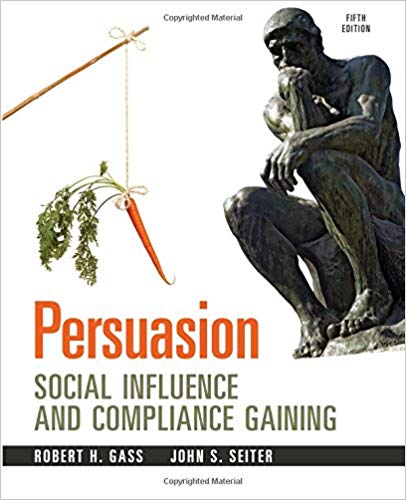
Persuasion Social Influence and Compliance Gaining 5th Edition by Robert H Gass - Test Bank

Persuasion Social Influence and Compliance Gaining 5th Edition by Robert H Gass - Test Bank   Instant Download - Complete Test Bank With Answers     Sample Questions Are Posted Below   Chapter 1: Why Study Persuasion?   Key Terms and Concepts   persuasion as an art and science pervasiveness of persuasion word of mouth …

$19.99

Persuasion Social Influence and Compliance Gaining 5th Edition by Robert H Gass – Test Bank


Instant Download – Complete Test Bank With Answers


Sample Questions Are Posted Below


Chapter 1: Why Study Persuasion?


Key Terms and Concepts


persuasion as an art and science

pervasiveness of persuasion

word of mouth (WOM)

buzz marketing

tipping points

“the law of the few”

mavens

connectors

salespeople

context

stickiness

scalability

effortless transfer

gamification

instrumental function

communication competence

knowledge function

habitual persuasion

defensive function

third person effect

debunking function

counter-intuitive finding

manipulation

“tool” analogy of persuasion

meta-analysis

propaganda

indoctrination


Chapter Summary

  1. Persuasion is everywhere; it is ubiquitous.
  2. Persuasion can be thought of as both an art and a science.
  3. While much is known about processes of social influence, the scientific study of persuasion is still in its infancy.
  4. Persuasion isn’t evil or manipulative. It is an essential, indispensable feature of human interaction.

III. Persuasion is worth studying because it is pervasive; it is inevitable and unavoidable.

  1. It is part and parcel of the “people professions.”
  2. The average person is exposed to hundreds, if not thousands, of ads per day.
  3. Buzz marketing, also known as word of mouth (WOM) has gained favor because it is cheap, self-perpetuating, and effective.

1) Social media are increasingly important channels for persuasion.

2) Sentiment tracking relies on social media to identify topics, brands, and threads that are trending.

  1. Support for an idea, a brand, or a phenomenon by the influential “law of the few” creates momentum that ultimately becomes the tipping point, or a self-perpetuating persuasive message.

1) Malcolm Gladwell (2000) suggests that certain people act as mavens, connectors, and salespeople.

2) Context, stickiness, scalability, and effortless transfer are essential for reaching a tipping point

3) There are no guarantees that viral marketing will succeed, just as there are no guarantees that any persuasive campaign will succeed.

  1. Gamification is designed to increase consumer engagement via active participation.
  2. Persuasion is found in not-so-obvious places like the natural sciences, the arts, and a variety of other communication contexts.
  3. Weird persuasion is often aimed at generating controversy or buzz and, hence, free publicity.
  4. The interpersonal arena is where influence attempts are most prevalent and have their greatest impact.
  5. Learning about persuasion serves four basic functions:
  6. Learning about persuasion performs an instrumental function by enhancing the student’s ability to use persuasion effectively and appropriately.
  7. Learning about persuasion fulfills a knowledge function by increasing the student’s understanding of how persuasion works.

1) People are often unaware of their own habitual patterns of persuasion.

  1. Learning about persuasion serves a defensive function by making the student a more discriminating consumer of persuasive messages.

1) People tend to underestimate the influence of advertising on themselves and overestimate its effects on others, a phenomenon known as the third-person effect.

  1. Learning about persuasion performs a debunking function by alerting the student to false or outdated notions of how persuasion works.

1) Many common sense notions about persuasion are mistaken.

2) Persuasion research has yielded insightful, counter-intuitive findings.

  1. Two common criticisms regarding the study of persuasion merit consideration:
  2. Some claim that studying persuasion is tantamount to teaching manipulation.

1) Persuasion research focuses on the means of influence, which tend to be amoral, rather than moral or immoral.

2) Persuasion can be likened to a tool, such as a hammer.  The tool itself isn’t good or bad. The end or purpose for which the tool is used may be good or bad.

3) A persuader’s motives, more than the persuasive means, determine how ethical or unethical a given influence attempt is.

4) The study of persuasion performs a defensive function, arming people against unscrupulous influence attempts.

5) People who denounce the study of persuasion are themselves advocating a persuasive position.

  1. Some claim that persuasion findings are overly qualified or contradictory.

1) Human behavior is complex, so one should expect a certain amount of complexity in how persuasion operates.

2) A number of meaningful, yet qualified, generalizations have been established through meta-analyses.

  1. An important part of the process of learning how to persuade involves learning how to persuade ethically.

VII. (Box 1.1) Persuasion, propaganda, and indoctrination are related terms.

  1. Propaganda and indoctrination have a pejorative meaning and are usually used to refer to persuasion used by the opposition.
  2. Four basic characteristics of propaganda are identified, along with some common propaganda techniques.

VIII. (Box 1.2) The advice on what to watch out for when buying a car illustrates the defensive function of persuasion.


Exercises and Learning Activities


Exercise 1-A, Pervasiveness of Persuasion Exercise

Principle Illustrated: The ubiquity of persuasion

Purpose: To demonstrate the pervasive, ubiquitous nature of persuasion to students.

Time Required: approximately 10 minutes


Directions: Ask students to look around the classroom and identify as many persuasive stimuli as they can.  The instructor might want to divide students up into teams and have the teams compete to see which team can spot the most persuasive stimuli.


Examples of stimuli to look for include:

  • official signs (e.g., no smoking, maximum occupancy, please turn lights off when leaving room, etc.)
  • posters, flyers, or other announcements on bulletin boards
  • slogans, insignia, or logos on students’ clothing, backpacks, or notebooks
  • graffiti on desks, chairs, or walls
  • the physical layout and arrangement of the room; furniture, equipment, space (the layout may signify power or status differences, or encourage or discourage one form of communication over another)
  • students’ nonverbal cues (seating proximity, body position, eye contact, etc.)
  • distractions, such as outside noise, fans, poor acoustics, smells, etc.


In the process of identifying persuasive stimuli, students will gain an appreciation of how many messages are competing for their attention at a given time, even in the rather limited environs of a college classroom.  Students will note that some persuasive stimuli are more subtle than others.   Students may also disagree about what constitutes a persuasive stimulus, which will get them thinking about some of the definitional issues discussed in Chapter 2.


Exercise 1-B, Ethical or Unethical Persuasion?

Principle Illustrated: Ethical issues surrounding persuasion

Purpose: To get students to reflect on the ethical issues surrounding any choice to persuade.  This exercise sets the stage for getting students to appreciate the fact that every persuasive effort is fraught with ethical implications.  The instructor may want to reinforce the authors’ perspective, which is amplified in Chapter 16, that it is a persuader’s motives that determine primarily how ethical or unethical a given influence attempt is, and only secondarily the means of persuasion which are used.

Time Required: 15-30 minutes


Directions: Box 1.3 in the text (see p. 19) identifies 14 hypothetical scenarios, each of which contains ethical implications for persuasion.  Simply ask students to rate how ethical or unethical the strategy used in each scenario is, based on a 5-point scale (1= highly ethical, 5= highly unethical).  Call on students and ask them why they evaluated a given strategy as they did.  The instructor may also want to ask students which of the 14 strategies they perceive to be the most ethical, and which they perceive as the least ethical.


Scenario 1: This situation entails deception designed to benefit the deceiver, and an appeal to pity.  Ask students if it matters whether the student is genuinely crying or not.


Scenario 2: This situation involves deception intended to benefit the receiver. There is also an “ends vs. means” controversy: Ask students if the outcome—giving the patient hope—justifies the use of deception.


Scenario 3: This situation involves adapting a message to the receivers’ frame of reference, rather than the persuader’s personal convictions.


Scenario 4: The central issue here is the use of ad hominem appeals (character attacks, mudslinging). Ask students if it matters whether the scandal is true or not.


Scenario 5: This situation involves deception in the form of withholding or suppressing information rather than an outright falsehood.


Scenario 6: The central issue here is the conflict between a legal duty vs. a moral duty. Ask students if, in the context of a criminal trial, achieving an acquittal is more important than disclosing the truth.  From a prosecutor’s standpoint, is obtaining a conviction ever more important than the truth?


Scenario 7: This situation involves a potential misuse or abuse of credibility on the part of the minister, as well as the use of ad hominem appeals.


Scenario 8: This scenario raises the issue of whether being sincere or genuine is enough, or whether ethical persuasion also entails a responsibility to have one’s facts straight and be accurate when attempting to persuade.


Scenario 9: This situation involves the use of nonverbal persuasion and an emotional appeal (pathos).  Ask students if it makes any difference whether the defendant had seen his wife or children in many years.


Scenario 10: This situation entails the use of deception and ulterior motives in persuasion.  Ask students if their answers would be any different if the scenario involved a heterosexual male student asking a heterosexual female student to get together. If so, why?


Scenario 11: This scenario involves the use of fear appeals.  Ask students if it matters whether the fear appeal is true, e.g., scaring a child about the potential dangers of talking to strangers.


Scenario 12: This situation entails deception in the form of withholding or suppressing information, as did Scenario 5, but in this case with a more vulnerable target audience.


Scenario 13: This scenario involves the use of threats as a means of gaining compliance.  Ask students if it would matter if the wife went to a coffee house instead, or if the husband threatened to go to a bar and play pool.


Scenario 14: This situation involves adapting a message to the receivers’ frame of reference, as did Scenario 3.  Scenario 3 is more generic, whereas Scenario 14 involves the political arena, a context in which some students may believe “anything goes.”


Exercise 1-C, Ice Breaker and Reflection Activity

Principle Illustrated: Functions of studying persuasion

Purpose: To get to know students and reinforce the practical value of the course.

Time Required: 20- 45 minutes, depending on the number of students in the course


Directions: First, ask each student to write down (a) one communicative skill he/she

would like to develop or improve on to increase his/her persuasiveness (instrumentality),

(b) one persuasive context he/she would like to learn more about (knowledge and

awareness), (c) one scenario or context where he/she tends to be an easy mark (defense),

and (d) one common sense or “homespun” assumption held by the average person about

how persuasion works (debunking).


Next, have each student identify him/herself, state his/her major (or probable major), and

list his/her answers to prompts ‘a’ – ‘d’.  When each student has finished speaking, break

down the prompts in terms of the four benefits of studying persuasion.  Be sure to use the

students’ examples during the debriefing.   Emphasize that through the text, lectures,

assignments, and activities, students will become more skilled and knowledgeable in all

four functions.


Exercise 1-D, Are You a Connector?

Principle Illustrated: Malcolm Gladwell’s Tipping Points

Purpose: To illustrate the “law of the few” from Gladwell’s Tipping Points.

Time Required: 20-30 minutes, depending on discussion after activity


After completing the activity, the instructor may want to reinforce the role played by connectors.  According to Gladwell, the positions of influence (e.g. maven, connector, salesperson) fall to a selected few, so they should not be disappointed if they find that they are not connectors.

This activity has been adapted from Malcolm Gladwell’s website.

http://www.gladwell.com/tippingpoint/tp_excerpt2.html


First, create a bank of 250 random last names. You can use a random surname generator such as those below, or simply look up names in a phone directory (say, every 100th name on every 12th page, for example).

http://www.namegenerator.biz/last-name-generator.php

http://www.atlantagamer.org/iGM/RandomNames/index.php (choose by gender or culture)

http://random-name-generator.info/random/?n=100&g=1&st=2

http://www.xtra-rant.com/gennames/


Next, hand out the list of names to students. Give them approximately 5 minutes to scan the list to see how many individuals they know whose surnames are included in the bank. “Know” means that if the student saw the person at a coffee shop, the mall, or other place, she/he would stop and say “Hi.”


According to Gladwell, the average person in the classroom will likely not know more than 50 people. This activity illustrates that few of us are true “connectors,” thus highlighting the “law of the few.” Keep in mind, students may exaggerate about how many people they know.


Lead a discussion on “the law of the few.” Ask students about their reactions to the phenomenon of viral marketing. Do they agree that social influencers are key to influencing consumers? Who are the connectors in their circle of contacts, e.g., the people who seem to know everybody. Finally, ask students if they want to get to know more people and attempt to achieve the role of a connector.


Web Links


  1. Principles Illustrated: The ubiquitous nature of persuasion; practicality of the study

of persuasion.


Dr. Kelton Rhoads (a) provides an overview of several disciplines that study persuasive communication (http://www.workingpsychology.com/persdisc.html), (b) provides an interesting essay documenting the prevalence of persuasion in our lives (http://www.workingpsychology.com/evryinfl.html), and (c) cites examples showing the value of learning about persuasion   (http://www.workingpsychology.com/whatcan.html).


2.Principle Illustrated: The power of propaganda.


This U.S. National Archives & Records Administration exhibit shows some interesting propaganda posters used during World War II.  Good Power Point visuals. (http://www.archives.gov/exhibits/powers_of_persuasion/powers_of_persuasion_home.html).


  1. Principle Illustrated: Positive aspects of persuasion.


This link from the Department of Health and Human Services provides an overview of health communication and outlines some characteristics of effective health communication messages.    (http://www.healthypeople.gov/Document/HTML/Volume1/11HealthCom.htm).


Test Questions


Multiple Choice Questions


  1. According to Gass & Seiter, persuasion is best thought of as
  2. a science
  3. an art
  4. a science and an art
  5. a social science

Answer: C

Page 3


  1. Which of the following statements best reflects the view of persuasion offered by Gass & Seiter?
  2. On balance, persuasion probably does more harm than good
  3. Persuasion is an essential, desirable feature of human interaction
  4. Persuasion emphasizes manipulation, communication emphasizes cooperation
  5. Persuasion is a necessary, but unfortunate, fact of life

Answer: B

Page 4


  1. To say that persuasion is “pervasive” means
  2. influence attempts are found everywhere you find people communicating
  3. it is difficult to define what is and isn’t persuasion
  4. persuasion plays a major role in the “people” professions, but a minor or negligible role in the natural sciences
  5. influence attempts are usually explicit or overt, rather than subtle or implicit

Answer: A

Pages 4-10


  1. The arena in which persuasive attempts enjoy the greatest likelihood of success is
  2. print media
  3. television
  4. cinema
  5. interpersonal
  6. online

Answer: D

Page 11


  1. One reason for studying persuasion is to learn more about how and why people respond to persuasive messages. This is called the
  2. attentiveness function
  3. knowledge function
  4. defensive function
  5. debunking function

Answer: B

Page 12


  1. An example of habitual persuasion is
  2. arguing with a friend about an editorial in the newspaper
  3. negotiating with your parents over how much of your tuition they should pay
  4. claiming “the dog ate it” whenever you turn in a late assignment
  5. asking a professor to explain why you got the grade you did on an essay

Answer: C

Page 12


  1. The debunking function
  2. helps us defend ourselves against unscrupulous influence attempts.
  3. serves to correct erroneous perceptions about how persuasion works.
  4. assists in making us more discriminating consumers of persuasive messages.
  5. helps us avoid habitual or mindless persuasion.

Answer: B

Page 15


  1. When politicians are shown drinking a beer, shopping at Wal-Mart, eating at McDonald’s, or going bowling, they are employing which propaganda technique?
  2. testimonials
  3. bandwagon effect
  4. transfer
  5. card-stacking
  6. plain folks appeal

Answer: E

Page 14


  1. The debunking function of persuasion helps one to
  2. arm him/herself against influence attempts by unethical persuaders
  3. gain greater awareness about false stereotypes and myths regarding persuasion
  4. identify different elements and features of a persuasive message
  5. design and present a persuasive message on his/her own

Answer: B

Page 15


  1. Which of the following best reflects the view of persuasion offered in the text?
  2. People actually aren’t all that gullible or easy to persuade
  3. There is a sucker born every minute
  4. Anyone can be persuaded if you know the right button to push
  5. Persuaders know far more about persuading than researchers do about how persuasion works

Answer: A

Page 18


  1. Which of the following statements about the relationship of persuasion to the arts is most accurate?
  2. Artists are the most temperamental of all persuaders.
  3. Artists are usually too wrapped up in their work to care about persuading others.
  4. Art is as much about persuasion as it is about creating aesthetic works.
  5. Art is usually created for “art’s sake” and not as a means of influencing others.

Answer: C

Page 9


  1. Persuasion research often produces “counter-intuitive” findings, e.g., results that are contrary to what common sense would dictate. Such findings highlight the ________________ function performed by the study of persuasion.
  2. pragmatic
  3. empirical
  4. defensive
  5. debunking

Answer: D

Page 15


  1. In using a tool analogy to describe persuasion, Gass & Seiter wish to show that
  2. a persuader, like a carpenter, is only as good as her/his tools
  3. it is the poor persuader (or carpenter) who blames his tools
  4. whether persuasion is good or bad depends on the purpose for which it is used
  5. specific persuasive situations call for specific persuasive tools

Answer: C

Page 15


  1. Which persuasive strategy below is designed to increase consumer engagement through active participation?
  2. online advertising
  3. sentiment tracking
  4. product placement
  5. gamification

Answer D

Page 7


  1. A meta-analysis helps persuasion researchers to
  2. determine if a persuasive strategy is ethical or unethical.
  3. formulate universal generalizations regarding persuasion.
  4. identify what their persuasive goal or objective should be.
  5. reconcile previous inconsistencies in the literature.

Answer: D

Page 18


  1. Which of the following generalizations drawn from persuasion research is most accurate?
  2. Current studies, from the 1970s through the 1990s, tend to contradict past studies, those from the 1940s through the 60s
  3. The results of persuasion studies have been remarkably consistent, dating back to the time of Aristotle
  4. Newly developed statistical techniques have made it possible to resolve a number of previous inconsistencies in the literature
  5. Research findings are largely consistent, but there are dramatic differences in theories of persuasion

Answer: C

Page 18


  1. A reporter asks a politician, “Do you favor or oppose gay adoptions?” The politician responds, “I’m for families. The family unit is the backbone of our society. Family bonds are vital.” The politician’s response best reflects which propaganda technique?
  2. smoke and mirrors
  3. pomp and circumstance
  4. card-stacking
  5. glittering generalities

Answer: D

Page 14


  1. Which of the following statements best characterizes persuasion, as opposed to propaganda?
  2. It operates most effectively in the interpersonal arena
  3. It is practiced by organized groups and institutions
  4. It has a strong ideological bent
  5. It tends to rely on ethically suspect methods of influence

Answer: A

Pages 11, 14


  1. Which of the following statements about propaganda is most accurate?
  2. Propaganda is a feature of totalitarian regimes, rather than democratic societies
  3. The government uses propaganda frequently, but the private sector rarely does so
  4. The term “propaganda” has a negative connotation, and is usually used in a pejorative sense
  5. Propaganda tends to be political in nature, rather than religious or commercial

Answer: C

Page 14


  1. According to Gass & Seiter, persuasion
  2. occurs primarily in the mass media
  3. is rare in the natural or “hard” sciences
  4. is more common in mediated than non-mediated settings
  5. occurs in a variety of non-obvious or even weird contexts

Answer: D

Page 10


  1. Which of the following justifications for the study of persuasion do Gass & Seiter identify as most compelling?
  2. Social influence is an interdisciplinary area of scholarly inquiry
  3. Influence is generally manipulative
  4. Persuasion is the cornerstone of many positive, pro-social activities
  5. To be well paid in the “people professions,” one must be able to influence others

Answer: C

Page 4


  1. Word-of-mouth marketing (WOM) based on social networks is also known as
  2. viral marketing
  3. multi-modal marketing
  4. branding
  5. consumer-centric marketing
  6. decentralized persuasion

Answer: A

Pages 4-5


  1. All of the following are reasons why buzzmarketing has become popular except

a.it is more expensive than traditional media advertising

b.it is becoming harder to reach large audiences via traditional media

  1. TIVO and digital video recorders allow viewers to ignore commercials entirely
  2. it generates its own free publicity

Answer: A

Page 5


  1. Which of the following statements about buzz marketing is most accurate?
  2. Buzz marketing relies heavily on TV and print media
  3. Buzz marketing depends upon the selling power of celebrity endorsers
  4. Buzz marketing relies on word-of-mouth recommendations
  5. Buzz marketing is aimed at young, urban consumers

Answer: C

Pages 4-5


  1. Buzz marketing has become a pervasive persuasion strategy because
  2. consumers prefer traditional advertisements.
  3. consumers rely on word of mouth in their social circles
  4. consumers enjoy clever advertisements and commercials
  5. consumers are comfortable with corporate-sponsored marketing

Answer: B

Pages 4-5


  1. According to the “Tipping Point” theory, people who have lots of expertise and know-how are known as:
  2. connectors
  3. salespeople
  4. mavens
  5. geeks
  6. nerds

Answer: C

Page 6


  1. According to Gladwell’s concept of Tipping Points, a product or idea can’t take off unless it has inherent appeal. This is known as
  2. gravitational pull
  3. scalability
  4. momentum magic
  5. stickiness
  6. gravitas

Answer: D

Page 6


  1. Kiyoko is known by her friends as the fashion expert. She is always ahead of the curve on fashion trends. According to Malcolm Gladwell, Kiyoko would be termed a
  2. connector
  3. maven
  4. hawker
  5. salesperson
  6. trendspotter

Answer: B

Page 6


  1. In regards to ethical communication, it isn’t so much what strategies and tactics a persuader uses as
  2. the amount of skill she/he has
  3. the events that take place
  4. whom she/he can influence
  5. why she/he uses them

Answer: D

Page 15


  1. Which of the following statements best describes the third person effect? People tend to
  2. overestimate the influence of persuasion on themselves and underestimate its effects on others
  3. underestimate the influence of a group on an individual member
  4. underestimate the influence of persuasion on themselves and overestimate its effects on others
  5. underestimate the influence of the individual member on the group

Answer: C

Page 13


  1. People who often provide suggestions to their circle of friends such as, “You should try it,” “You have to see this movie,” and “You need to buy it, it is the best thing yet!” are termed
  2. connectors
  3. prompters
  4. mavens
  5. salespersons

Answer: D

Page 6


  1. Sentiment tracking is most closely associated with
  2. social media
  3. print advertising
  4. television advertisements
  5. word of mouth

Answer: A

Page 5


Essay Questions


  1. In what setting or context do influence attempts tend to be most effective? Why?


  1. Provide an example of “habitual” persuasion, and explain how such habitual patterns of persuasion can be overcome.


  1. What do the authors mean when they say that learning about persuasion performs a “defensive” function?


  1. What is the third-person effect? Provide a specific example of how it applies to persuasion.


  1. Explain what the “debunking” function is as it applies to persuasion research, and provide an example of an empirical finding that illustrates this function.


  1. Identify one of the chief criticisms leveled against the study of persuasion, and explain one of Gass & Seiter’s replies to the criticism.


  1. Identify what you believe to be a modern-day example of propaganda, and explain how it satisfies the characteristics associated with propaganda.


  1. Use personal examples and anecdotes to defend the statement “Very little of the good that we see in the world could be accomplished without persuasion.”


  1. Identify the conditions by which viral marketing is successful. Include how and why viral marketing becomes “hit or miss” in persuading others.

Additional information

Add Review

Your email address will not be published. Required fields are marked *