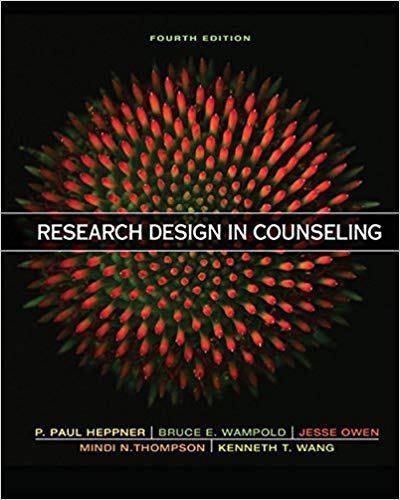
Research Design in Counseling, 4th Edition by Paul Heppner - Test Bank

Research Design in Counseling, 4th Edition by Paul Heppner - Test Bank   Instant Download - Complete Test Bank With Answers     Sample Questions Are Posted Below   CHAPTER 5: Identifying Interests and Operationalizing Topics: Forget That Perfect Study     True/False questions   It is not recommended for students to bring their own …

$19.99

Research Design in Counseling, 4th Edition by Paul Heppner – Test Bank


Instant Download – Complete Test Bank With Answers


Sample Questions Are Posted Below


CHAPTER 5: Identifying Interests and Operationalizing Topics: Forget That Perfect Study


True/False questions


  1. It is not recommended for students to bring their own observations and beliefs into their research topics.


Answer: False


  1. A great deal of research in counseling involves extending the results of previous research.


Answer: True


  1. It is essential for researchers to focus on investigating a few constructs only and not to try to do too much in developing an original contribution.


Answer: True


  1. In the context of identifying a research idea, theory and research from one topic can be extended to another related topic.


Answer: True


  1. Identifying a topic of research is the same as developing a specific research question or hypothesis that can guide research.


Answer: False


  1. The function of a testable research question or hypothesis is to provide direction for experimental inquiry.


Answer: True


  1. Once a research question enters the formative stage and an investigator continues to develop the design and methodologies of a particular study, the original research question cannot be changed.


Answer: False


  1. Operational definitions are referred to as a sort of manual of instructions that spells out what an investigator must do to measure or manipulate research variables during the procedures of a study.


Answer: True


  1. A problem arises when researchers investigate a given construct but develop different operational definitions for it.


Answer: True


  1. Depression scores on a standardized test, such as the MMPI-Depression scale, are examples of independent variables.


Answer: False


Multiple choice questions


  1. Identify a main component in the process of selecting a research topic and developing a research idea into a testable hypothesis.
  2. Developing an original research method
  3. Identifying research variables
  4. Working as an apprentice for an experienced researcher
  5. Creating a new assessment instrument


Answer: b


  1. Identify a major federal grant funding agency for counseling research.
  2. Federal Bureau of Psychology Research (FBPR)
  3. National Association of Health (NAH)
  4. Institute of Educational Foundation (IEF)
  5. The National Science Foundation (NSF)


Answer: d


  1. Which of the following is considered riskier for inexperienced counselors and researchers?
  2. Beginning research training by working closely within their advisor’s research interests
  3. Using their own observations about a topic as a source of ideas for research topics
  4. Spending precious time reading literature review articles and handbooks
  5. Attending more closely to the constructs that have been used in the previous research


Answer: b


  1. Which of the following is a reason to pay particular attention to the discussion section of articles when specifying research questions and hypotheses?
  2. The summary statement is the easiest way to understand complex data.
  3. There may be explicit discussion of future research needs.
  4. This section holds the references the author used.
  5. This section strives to clarify unanswered research questions.


Answer: b


  1. _____ essentially ask what some phenomena or events are like and explain the variables of interest with questions such as how much, how often, what percentage, and so on.
  2. Descriptive questions
  3. Hypothetical questions
  4. Difference questions
  5. Divergent questions


Answer: a


  1. _____ explore the degree to which two or more research constructs are related or vary together.
  2. Quasi-experiments
  3. Demand characteristics
  4. Reliability estimates
  5. Relationship questions


Answer: d


  1. The primary function of an operational definition in the development of a research idea is to:
  2. clarify the operation of a study’s methodology.
  3. define the constructs involved in a particular study.
  4. define the organization of one’s references and citations.
  5. clarify how variables operate relative to each other.


Answer: b


  1. The independent variable in a research study is the variable that is:
  2. manipulated or controlled.
  3. derived from the dependent variable.
  4. held constant.
  5. affected by the dependent variable.


Answer: a


  1. In nonexperimental studies of research, the _____ in a regression equation are sometimes referred to as independent variables.
  2. predictor variables
  3. ordinal variables
  4. criterion variables
  5. dichotomous variables


Answer: a


  1. Alan is new to the field of research. He has chosen a simple research project to understand the overall sequence of steps to be followed in developing the research idea. He has successfully completed the stage of identifying research variables. Which of the following steps should Alan take to begin the collection and analysis of relevant data?
  2. He should determine the number of participants.
  3. He should define the target population.
  4. He should select participants.
  5. He should create a participant pool.


Answer: b

Additional information

Add Review

Your email address will not be published. Required fields are marked *