Subtotal: $634.95

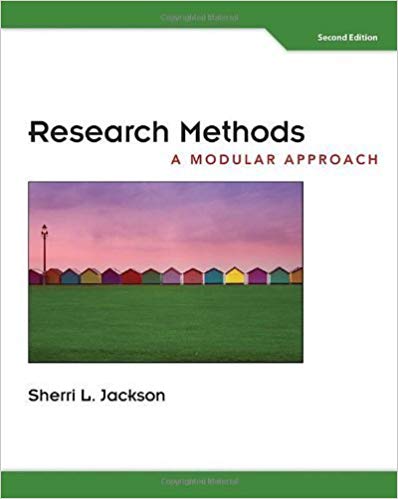
Research Methods A Modular Approach 2nd Edition by Jackson - Test Bank

Research Methods A Modular Approach 2nd Edition by Jackson - Test Bank   Instant Download - Complete Test Bank With Answers     Sample Questions Are Posted Below   Module 5 Defining, Measuring, and Manipulating Variables Chapter Outline   Defining Variables Properties of Measurement Scales of Measurement Nominal Scale Ordinal Scale Interval Scale Ratio Scale …

$19.99

Research Methods A Modular Approach 2nd Edition by Jackson – Test Bank


Instant Download – Complete Test Bank With Answers


Sample Questions Are Posted Below


Module 5

Defining, Measuring, and Manipulating Variables

Chapter Outline


Defining Variables
Properties of Measurement
Scales of Measurement
Nominal Scale
Ordinal Scale
Interval Scale
Ratio Scale
Discrete and Continuous Variables
Types of Measures
Self-report Measures
Tests
Behavioral Measures
Physical Measures
Summary


Review of Key Terms


Absolute Zero—A property of measurement in which assigning a score of zero indicates an absence of the variable being measured.


Behavioral Measures—Measures taken by carefully observing and recording behavior.


Continuous Variables—Variables that usually fall along a continuum and allow for fractional amounts.


Discrete Variables—Variables that usually consist of whole number units or categories and are made up of chunks or units that are detached and distinct from one another.


Equal Unit Size—A property of measurement in which a difference of 1 means the same amount throughout the entire scale.


Identity—A property of measurement in which objects that are different receive different scores.


Interval Scale—A scale in which the units of measurement (intervals) between the numbers on the scale are all equal in size.


Magnitude—A property of measurement in which the ordering of numbers reflects the ordering of the variable.


Nominal Scale—A scale in which objects or individuals are broken into categories that have no numerical properties.


Operational Definition—A definition of a variable in terms of the operations (activities) a researcher uses to measure or manipulate it.


Ordinal Scale—A scale in which objects or individuals are categorized and the categories form a rank order along a continuum.


Physical Measures—Measures of bodily activity (such as pulse or blood pressure) that may be taken with a piece of equipment.


Ratio Scale—A scale in which, in addition to order and equal units of measurement, there is an absolute zero that indicates an absence of the variable being measured.


Reactivity—A possible reaction by participants in which they act unnaturally because they know they are being observed.


Self-report Measures—Usually questionnaires or interviews that measure how people report that they act, think, or feel.


Tests—A measurement instrument used to assess individual differences in various content areas.


Web Resources

For step-by-step practice and information, have your students check out the Statistics and Research Methods Workshops at http://www. cengage.com/psychology/workshops. In addition, practice quizzes, vocabulary flashcards, and more are available at http://www.cengage.com/psychology/jackson


Answers to Module Exercises


  1. Alternative “c” represents an operational definition of depression.


  1. a. This is a cognitive self-report measure.
  2. This is a behavioral self-report measure.
  3. This is an affective self-report measure. It is also a type of test.
  4. This is a test.
  5. This is a behavioral measure.
  6. This is a physical measure.


Test Items


Multiple Choice Questions


  1. Which of the following represents the best operational definition of hunger?
    a. that empty, gnawing feeling that you get in your stomach
    b.      not having eaten for 18 hours.
    c.      the number of stomach growls reported in a ten-minute time interval.
    d.      all of the alternatives are equally good.

Answer: b


  1. A definition of a variable in terms of the activities a research uses to measure or manipulate it is a(n):
    a. operational definition
    b.      functional definition
    c.      well-defined variable
    d.      measure definition

Answer: a


  1. A property of measurement in which objects that a different receive different scores is _____.
    a. identity
    b.      magnitude
    c.      equal unit size
    d.      absolute zero


Answer: a


  1. A property of measurement in which the ordering of numbers reflects the ordering of the variable is _____.
    a. identity
    b.      magnitude
    c.      equal unit size
    d.      absolute zero


Answer: b


  1. A property of measurement in which a difference of 1 is the same amount throughout the entire scale is _____.
    a. identity
    b.      magnitude
    c.      equal unit size
    d.      absolute zero


Answer: c


  1. A property of measurement in which assigning a score of zero indicates an absence of the variable being measured is _____.
    a. identity
    b.      magnitude
    c.      equal unit size
    d.      absolute zero


Answer: d


  1. Political affiliation is to the _____ property of measurement as inches are to the _____ property of measurement.
    a. magnitude; identity
    b.      equal unit size; magnitude
    c.      absolute zero; equal unit size
    d.      identity; equal unit size


Answer: d


  1. Arranging a group of individuals from tallest to shortest represents the _____ property of measurement.
    a. identity
    b.      magnitude
    c.      equal unit size
    d.      absolute zero

Answer: b


w9.   Number on a football jersey is to the _____ scale of measurement as temperature measured on the Fahrenheit scale is to the _____ scale or measurement.
a.      ordinal; interval
b.      interval; nominal
c.      nominal; ratio
d.      nominal; interval

Answer: d


  1. Class rank is to the _____ scale of measurement as weight is to the _____ scale of measurement.
    a. ordinal; ratio
    b. ordinal; nominal
    c.      nominal; interval
    d.      interval; ratio

Answer: a


  1. Which of the following represents data arranged on an interval-ratio scale?
    a. ranking of contestants in a beauty contest
    b.      reaction time in seconds to complete a task
    c.       categorizing subjects according to their gender
    d.      letter grade on an exam

Answer: b


  1. Time is to the _____ scale of measurement as ethnicity is to the _____ scale of measurement.
    a. ratio; ordinal
    b. ratio; nominal
    c.      interval; nominal
    d.      ordinal; ratio

Answer: b


  1. A scale of measurement in which objects or individuals are assigned to categories that have no numerical properties is a _____ scale.
    a. nominal
    b. ordinal
    c.      interval
    d.      ratio


Answer: a


  1. A scale of measurement in which objects or individuals are categorized and the categories form a rank order along a continuum is a _____ scale.
    a. nominal
    b. ordinal
    c.      interval
    d.      ratio


Answer: b


  1. A scale of measurement in which the units of measurement between the numbers on the scale are all equal in size is a _____ scale.
    a. nominal
    b. ordinal
    c.      interval
    d.      ratio


Answer: c


  1. A scale of measurement in which, in addition to order and equal units of measurement, there is an absolute zero that indicates an absence of the variable being measured is a _____ scale.
    a. nominal
    b. ordinal
    c.      interval
    d.      ratio


Answer: d


  1. Discrete variables are to _____ as continuous variables are to _____.
    a. whole units; whole units and/or fractional amounts
    b. whole units and/or fractional amounts; whole units
    c.      usually nominal and ordinal; usually interval and ratio
    d.      both a and c

Answer: d


  1. Which of the following is NOT a type of measure?
    a. a self-report measure
    b. a test
    c.      an operational definition
    d.      a behavioral measure

Answer: c


w19. Which of the following is NOT a type of self-report measure?
a.      behavioral self-report measure
b.      physical self-report measure
c.      cognitive self-report measure
d.      affective self-report measure

Answer: b


  1. Which of the following statements is TRUE?
    a. A test is a measurement instrument used to assess individual differences in various content
    areas.
    b.      An aptitude test measures an individual’s competence in an area.
    c.      An achievement test measures an individual’s potential to do something.
    d.      All of these statements are true .

Answer: a


  1. Which of the following is FALSE?
    a. Behavioral measures are usually questionnaires or interviews that measure how people
    report that they act, think, or feel.
    b.      Self-report measures are measures taken by carefully observing and recording others’
    behavior(s).
    c.      Physical measures usually involve using an aptitude or achievement test.
    d.      All of these statements are false.

Answer: d


w22. Sara decided to have participants in her study of the relationship between diet and weight keep a journal of everything they ate each day. The type of measurement that Sara is employing is known as a(n):
a.      behavioral self-report measure.
b.      cognitive self-report measure.
c.      affective self-report measure.
d.      aptitude test.


Answer: a


  1. A blood pressure reading is to a _____ measure as observing how many patrons in a fast food restaurant take advantage of free drink refills is to a ______ measure.
    a. physical; behavioral self-report
    b. behavioral; physical
    c.      physical; behavioral
    d.      behavioral; cognitive self-report


Answer: c


Short Answer/Essay Questions


  1. What is an operational definition? Give an operational definition of intelligence.

    An operational definition is a definition of a variable in terms of the operations (activities) a researcher uses to measure or manipulate it. Thus, an operational definition of intelligence could be based on one’s score on an intelligence test or on one’s ability to solve a problem that the researcher has determined requires intellectual ability.

  2. Identify the four scales of measurement noting the properties of measurement each scale has.

    The nominal scale has the property of identity; the ordinal scale has the properties of identity and magnitude; the interval scale has the properties of identity, magnitude, and equal unit size; and the ratio scale has the properties of identity, magnitude, equal unit size, and a true zero.

  3. Provide an example of a variable measured on a(n): nominal scale, ordinal scale, interval scale, and ratio scale.

    Nominal: gender; ethnicity
    Ordinal: letter grade; class rank
    Interval: Fahrenheit temperature; SAT score
    Ratio: percentage grade on an exam; weight

  4. Identify the three types of self-report measures discussed in the text and briefly describe each.

    Behavioral self-report measures ask people to report how often they do something.
    Cognitive self-report measures ask people to report what they think about something.
    Affective self-report measures ask individuals to report how they feel about something.

  5. Explain the difference between discrete and continuous variables.

    A discrete variable consists of whole number units or categories and is made up of chunks or units that are detached and distinct from one another. A continuous variable is a variable that usually falls along a continuum and allows for fractional amounts.

  6. What is reactivity and why is it a concern when taking behavioral measures?

    Reactivity is a possible reaction by participants in which they act unnaturally because they know they are being observed. It is obviously a concern when taking behavioral measure because these measures involve carefully observing and recording behavior.

Additional information

Add Review

Your email address will not be published. Required fields are marked *