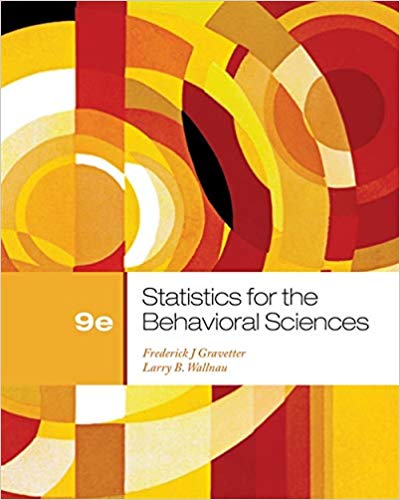
Statistics for the Behavioral Sciences 9th Edition By Frederick J Gravetter - Test Bank

Statistics for the Behavioral Sciences 9th Edition By Frederick J Gravetter - Test Bank   Instant Download - Complete Test Bank With Answers     Sample Questions Are Posted Below       Chapter 5: z-Scores       Chapter Outline   5.1 Introduction to z-Scores 5.2 z-Scores and Location in a Distribution The z-Score …

$19.99

Statistics for the Behavioral Sciences 9th Edition By Frederick J Gravetter – Test Bank


Instant Download – Complete Test Bank With Answers


Sample Questions Are Posted Below


Chapter 5: z-Scores


Chapter Outline


5.1 Introduction to z-Scores

5.2 z-Scores and Location in a Distribution

The z-Score Formula

Determining a Raw Score (X) from a z-Score

Other Relationships Between z, X, μ, and σ

5.3 Using z-Scores to Standardize a Distribution

Demonstration of a z-Score Transformation

Using z-scores to Make Comparisons

5.4 Other Standardized Distributions Based on z-Scores

Transforming z-Scores to a Distribution with a Predetermined µ and σ

5.5  Computing z-Scores for a Sample

Standardizing a Sample Distribution

5.5 Looking Ahead to Inferential Statistics


Learning Objectives and Chapter Summary


  1. Students should understand that a z-score provides a precise description of a location in a distribution.


The sign of the z-score tells whether the location is above the mean (+) or below the mean (–).  The numerical value of the z-score tells the distance from the mean measured in standard deviations.


  1. Students should be able to transform X values into z-scores, and transform z-scores into X values.


For simple numbers, the z-score definition is the best method for transforming X values into z-scores.  The z-score formula helps to organize the calculation for more difficult numbers.

X  –  µ                           X – M

z  =  ¾¾¾       or       z  =  ¾¾¾

σ                                   s


  1. Students should understand and be able to describe the effects of standardizing a distribution by transforming the entire set of X values into z-scores.


The transformation does not affect the shape of the distribution, but after scores are transformed into z-scores the mean always becomes zero and the standard deviation always becomes one.  Thus, different distributions become equivalent and comparable

(µ = 0 and σ = 1) after they have been transformed to z-scores.


  1. Students should be able to use z-scores to transform any distribution into a standardized distribution with a predetermined mean and a predetermined standard deviation.


This type of standardization is a two step operation: (1) the original scores are transformed into z-scores, and (2) the z-scores are transformed into X values using the predetermined mean and standard deviation.


Other Lecture Suggestions


  1. A demonstration similar to Example 5.1 is a good way to introduce the value and the purpose of z-scores. Note that a score, by itself, does not provide much information.  Adding information about the mean still does not completely describe where the score is located.  In order to precisely describe a score’s location, you must know the score and the mean and the standard deviation.  A z-score combines all of this information into a single value.


  1. Note that asking students to compute a z-score is equivalent to asking where the score (X value) is located in the distribution. For example, given a distribution with µ = 100 and σ = 10, you could ask, “What is the z-score corresponding to X = 90?”  An equivalent questions is, “Where is X = 90 located?”


  1. Although most problems can be solved using the z-score definition or the z-score formula, many students gain a better understanding if they can actually see the problem presented as a frequency distribution graph. For example, suppose that a problem states, “For a distribution with a standard deviation of σ = 4, a score of X = 52 corresponds to z = –2.00.  What is the mean for this distribution?”  Instead of solving the problem using a formula, sketch a distribution (normal curve works well) and locate the unknown mean with a vertical line through the center.  Then ask the students where z = –2.00 is located.  Identify the location in your sketch using two more vertical lines located at one standard deviation and two standard deviations below the mean.  Finally, label the left hand line with X = 52 and label the distance between lines with σ = 4 (twice). At this point, most students should see that the mean is 8 points above X = 52, so that µ = 60.


  1. One demonstration of standardizing a distribution is to show that the standardization process involves “re-labeling” each score. Using Figure 5.5 as a model, you can sketch the original distribution and label the X values along the horizontal axis.  Then add a second horizontal line and label the z-score values.  In Figure 5.5, for example, X = 110 is simply relabeled as z = +1.00.  If you are continuing the standardization process to create a distribution with a predetermined mean and standard deviation, you can add a third horizontal line for the new, standardized scores (see Figure 5.7).  In this case, each score in the original distribution is relabeled as a z-score, and then the z-scores are relabeled as new, standardized X values.


Exam Items for Chapter 5


Multiple-Choice Questions


  1. (www) What position in the distribution corresponds to a z-score of z = +2.00?
  2. above the mean by 2 points
  3. above the mean by a distance equal to 2 standard deviations
  4. below the mean by 2 points
  5. below the mean by a distance equal to 2 standard deviations


  1. Which of the following z-score values represents the location closest to the mean?
  2. z = +0.50
  3. z = +1.00
  4. z = –1.00
  5. z = –2.00


  1. For a population with µ = 80 and σ = 10, what is the z-score corresponding to

X = 95?

  1. +0.25
  2. +0.50
  3. +0.75
  4. +1.50


  1. (www) For a population with a standard deviation of σ = 6, what is the z-score corresponding to a score that is 12 points above the mean?
  2. z = 1
  3. z = 2
  4. z = 6
  5. z = 12


  1. For a population with µ = 80 and σ = 6, what is the z‑score corresponding to X = 68?
  2. –0.50
  3. –2.00
  4. +2.00
  5. –12.00


  1. For a population with µ = 40 and σ = 8, what is the z‑score corresponding to X = 46?
  2. +0.50
  3. +0.75
  4. +1.00
  5. +1.50


  1. For a population with μ = 100 and σ = 20, what is the X value corresponding to z = –0.75?
  2. 85
  3. 95
  4. 105
  5. 115


  1. (www) For a population with µ = 80 and σ = 10, what is the X value corresponding to

z = –0.50?

  1. –5
  2. 85
  3. 75
  4. 79.5


  1. For a population with µ = 40 and σ = 8, what is the X value corresponding to z = 1.50?
  2. 44
  3. 50
  4. 52
  5. 58


  1. A population distribution has σ = 6. What position in this distribution is identified by a z-score of z = +2.00?
  2. two points above the mean
  3. two points below the mean
  4. twelve points above the mean
  5. twelve points below the mean


  1. For an exam with a mean of M = 74 and a standard deviation of s = 8, Mary has a score of X = 80, Bob’s score corresponds to z = +1.50, and Sue’s score is located above the mean by 10 points. If the students are placed in order from smallest score to largest score, what is the correct order?
  2. Bob, Mary, Sue
  3. Sue, Bob, Mary
  4. Mary, Bob, Sue
  5. Mary, Sue, Bob


  1. On an exam with μ = 52, you have a score of X = 44. Which value for the standard deviation would give you the highest position in the class distribution?
  2. σ = 2
  3. σ = 4
  4. σ = 8
  5. cannot determine from the information given


  1. (www) On an exam with μ = 52, you have a score of X = 56. Which value for the standard deviation would give you the highest position in the class distribution?
  2. σ = 2
  3. σ = 4
  4. σ = 8
  5. cannot determine from the information given


  1. A population has μ = 50. What value of σ would make X = 55 a central, representative score in the population?
  2. σ = 1
  3. σ = 5
  4. σ = 10
  5. cannot determine with the information given


  1. You have a score of X = 65 on an exam. Which set of parameters would give you the best grade on the exam?
  2. a. μ = 60 and σ = 10
  3. b. μ = 60 and σ = 5
  4. c. μ = 70 and σ = 10
  5. d. μ = 70 and σ = 5


  1. (www) A population of scores has µ = 44.  In this population, a score of X = 40 corresponds to z = –0.50.   What is the population standard deviation?
  2. 2
  3. 4
  4. 8
  5. –8


  1. A population of scores has µ = 80. In this population, a score of X = 86 corresponds to

z = +2.00.   What is the population standard deviation?

  1. 2
  2. 3
  3. 6
  4. 12


  1. In a population with σ = 8, a score of X = 44 corresponds to a z-score of z = –0.50. What is the population mean?
  2. μ = 36
  3. μ = 40
  4. μ = 48
  5. μ = 52


  1. In a population of scores, X = 83 corresponds to z = –0.50 and X = 93 corresponds to z = +2.00. What are the values for the population mean and standard deviation?
  2. m = 85 and s = 4
  3. m = 85 and s = 2
  4. m = 81 and s = 4
  5. m = 81 and s = 6


  1. For a sample with M = 50 and s = 12, what is the X value corresponding to z = –0.25?
  2. 47
  3. 53
  4. 46
  5. 54


  1. A sample of n = 20 scores has a mean of M = 45 and a standard deviation of s = 8. In this sample, what is the z-score corresponding to X = 57?
  2. z = 12/20 = 0.60
  3. z = 1.00
  4. z = 1.50
  5. z = 2.00


  1. (www) A sample has M = 72 and s = 4. In this sample, what is the X value corresponding to

z = –2.00?

  1. X = 70
  2. X = 68
  3. X = 64
  4. X = 60


  1. In a sample with M = 40 and s = 8, what is the z-score corresponding to X = 38.
  2. z = –0.25
  3. z = –0.50
  4. z = 0.25
  5. z = 0.50


  1. For a sample with M = 80, a score of X = 88 corresponds to z = 2.00. What is the sample standard deviation?
  2. 2
  3. 4
  4. 8
  5. 16


  1. For a sample with s = 12, a score of X = 73 corresponds to z = -1.00. What is the sample mean?
  2. M = 61
  3. M = 67
  4. M = 79
  5. M = 85


  1. For a sample of n = 30 scores, X = 45 corresponds to z = 1.50 and X = 40 corresponds to z = +1.00. What are the values for the sample mean and standard deviation?
  2. M = 35 and s = 10
  3. M = 30 and s = 15
  4. M = 35 and s = 15
  5. M = 30 and s = 10


  1. In N = 25 games last season, the college basketball team averaged µ = 76 points with a standard deviation of σ = 6. In their final game of the season, the team scored 89 points.  Based on this information, the number of points scored in the final game was _____.
  2. a little above average
  3. far above average
  4. above average, but it is impossible to describe how much above average
  5. There is not enough information to compare last year with the average.


  1. (www) Under what circumstances is a score that is 15 points above the mean an extreme score relatively far from the mean?
  2. when the population mean is much larger than 15
  3. when the population standard deviation is much larger than 15
  4. when the population mean is much smaller than 15
  5. when the population standard deviation is much smaller than 15


  1. Under what circumstances is a score that is located 5 points above the mean a central value, relatively close to the mean?
  2. when the population mean is much less than 5
  3. when the population mean is much greater than 5
  4. when the population standard deviation is much less than 5
  5. when the population standard deviation is much greater than 5


  1. (www) If an entire population with μ = 60 and σ = 8 is transformed into z-scores, then the distribution of z-scores will have a mean of ___ and a standard deviation of ___.
  2. 0 and 1
  3. 60 and 1
  4. 0 and 8
  5. 60 and 8 (unchanged)


  1. A population with µ = 85 and σ = 12 is transformed into z-scores. After the transformation, what is the standard deviation for the population of z-scores?
  2. σ = 12
  3. σ = 1.00
  4. σ = 0
  5. cannot be determined from the information given


  1. For any distribution, what is the z-score corresponding to the mean?
  2. 0
  3. 1
  4. N
  5. cannot be determined from the information given


  1. For any distribution, what is the z-score corresponding to the median?
  2. 0
  3. 1
  4. N
  5. cannot be determined from the information given


  1. A sample of n = 20 scores is transformed into z-scores. What is the mean for the set of 20

z-scores?

  1. 0
  2. 1
  3. 10
  4. cannot be determined without more information


  1. (www) Last week Sarah had exams in Math and in Spanish.  On the Math exam, the mean was µ = 30 with σ = 5, and Sarah had a score of X = 45.  On the Spanish exam, the mean was µ = 60 with σ = 8 and Sarah had a score of X = 68.    For which class should Sara expect the better grade?
  2. Math
  3. Spanish
  4. The grades should be the same because the two exam scores are in the same

location.

  1. There is not enough information to determine which is the better grade.


  1. Last week Sarah had exams in Math and in Spanish. On the Math exam, the mean was µ = 40 with σ = 5 and Sarah had a score of X = 45. On the Spanish exam, the mean was µ = 60 with σ = 8 and Sarah had a score of X = 68. For which class should Sara expect the better grade?
  2. Math
  3. Spanish
  4. The grades should be the same because the two exam scores are in the same location.
  5. There is not enough information to determine which is the better grade.


  1. Using z‑scores, a population with µ = 37 and σ = 6 is standardized so that the new mean is

µ = 50 and σ = 10.  After the standardization, one individual has a score of X = 55.  What was this individual’s score in the original distribution?

  1. X = 40
  2. X = 42
  3. X = 43
  4. cannot be determined with the information given


  1. (www) A distribution with µ = 55 and σ = 6 is being standardized so that the new mean and standard deviation will be µ = 50 and σ = 10. When the distribution is standardized, what value will be obtained for a score of X = 58 from the original distribution?
  2. X = 53
  3. X = 55
  4.   X = 58
  5. X = 61


  1. A distribution with µ = 35 and σ = 8 is being standardized so that the new mean and standard deviation will be µ = 50 and σ = 10. In the new, standardized distribution your score is X = 45.  What was your score in the original distribution?
  2. X = 30
  3. X = 31
  4. X = 39
  5. X = 45


  1. A sample with M = 85 and s = 12 is transformed into z-scores. After the transformation, what are the values for the mean and standard deviation for the sample of z-scores?
  2. M = 85 and s = 12
  3. M = 0 and s = 12
  4. M = 85 and s = 1
  5. M = 0 and s = 1


True/False Questions


  1. A score with a value less than or equal to the mean will have a z-score that is less than or equal to zero.


  1. Any individual with a positive z-score has a score greater than the mean.


  1. If two individuals in the same population have identical X scores, they also will have identical z‑scores.


  1. For a population with a mean of μ = 80, any score greater than 80 will have a positive z-score.


  1. For a population with a standard deviation of σ = 12, a z-score of z = +0.50 corresponds to a score that is above the mean by 6 points.


  1. For a population with a mean of μ = 80 and a standard deviation of σ = 12, a score of X = 77 corresponds to z = –0.50.


  1. For any distribution of scores, the location identified by z = +1 and the location identified by z = –1 are exactly the same distance from the mean.


  1. In a distribution with σ = 20, a score that is above the mean by 10 points will have a z-score of z = 0.50.


  1. For a population with μ = 50 and σ = 10, a score of X = 45 corresponds to z = –0.50.


  1. In a distribution with µ = 80 and σ = 20, a score of X = 95 corresponds to z = 1.50.


  1. For a population with μ = 30, a score of X = 24 corresponds to z = –2.00. The standard deviation for the population is σ = 6.


  1. In a population with σ = 4, a score of X = 48 corresponds to z = 1.50. The mean for this population is µ = 42.


  1. On an exam, Tom scored 12 points above the mean and had a z-score of +2.00. The standard deviation for the set of exam scores must be σ = 6.


  1. On an exam with σ = 6, Tom’s score of X = 54 corresponds to z = –1.00. The mean for the exam must be µ = 60.


  1. For a population with a mean of μ = 40, a score of X = 37 corresponds to z = –0.50.  The standard deviation for the population is σ = 3.


  1. For a population of exam scores, a score of X = 83 corresponds to z = +0.50 and a score of X = 89 corresponds to z = +1.50. The population mean is μ = 80.


  1. For a sample with a mean of M = 50 and a standard deviation of s = 10, a z-score of

z = +2.00 corresponds to X = 70.


  1. For a sample with M = 50 and s = 8, z = 1.50 corresponds to X = 65.


  1. For a sample with a standard deviation of s = 10, a score with a deviation of +5 will have a z-score of z = 0.50.


  1. For a sample with a standard deviation of s = 6, a z-score of z = –1.50 corresponds to a location that is 9 points above the mean.


  1. In a sample of n = 40 scores, X = 31 corresponds to z = –1.50 and X = 39 corresponds to z = +0.50. The sample mean is M = 36.


  1. For a sample with a mean of M = 76, a score of X = 72 corresponds to z = –0.50. The sample standard deviation is s = 8.


  1. For a sample with a standard deviation of s = 8, a score of X = 42 corresponds to

z =  –0.25.  The mean for the sample is M = 40.


  1. In a sample with s = 6, a score of X = 53 corresponds to z = –0.50. The mean for this sample is M = 50.


  1. If an entire population of N = 20 scores is transformed into z-scores, the set of 20 z-scores will have SS = 20.


  1. If an entire population of N = 20 scores is transformed into z-scores, the set of 20 z-scores will have SX = 0..


  1. Transforming an entire distribution of scores into z-scores will not change the shape of the distribution.


68   A population with μ = 45 and σ = 8 is standardized to create a new distribution with μ =

100 and σ = 20.  In this transformation, a score of X = 41 from the original distribution will be

transformed into a score of X = 110.


  1. A population with μ = 59 and σ = 8 is standardized to create a new distribution with μ = 100 and σ = 20. After the transformation, an individual receives a new score of X = 90.  The original score for this individual was X = 51.


  1. A professor standardizes exam scores so that all exams have μ = 50 and σ = 10. If the original scores from an exam have μ = 42 and σ = 6, then a student with an original exam score of X = 45 would receive a standardized score of X = 55.


Other Exam Items


  1. Describe the general purpose of a z‑score and explain how a z-score accomplishes this goal.


  1. Describe what happens to the mean, the standard deviation, and the shape of a distribution when all of the scores are transformed into z‑scores.


  1. (www) For a population with µ = 60 and σ = 12, find the z‑score corresponding to each of the following X values: 66, 78, 57, 48


  1. For a population with µ = 48 and σ = 8, find the X value that corresponds to each of the following z‑scores: –0.25, –1.50, 0.50, 2.00


  1. On a psychology exam with µ = 76 and σ = 12, Tom scored 9 points below the mean, Mary had a score of X = 70, and Bill had a z‑score of z = –1.00. Place these three students in order from lowest to highest score.

_______________  Student with lowest score

_______________  Student with middle score

_______________  Student with highest score


  1. For a distribution of scores, X = 40 corresponds to a z‑score of z = +1.00, and X = 28 corresponds to a z‑score of z = –0.50. What are the values for the mean and standard deviation for the distribution?  (Hint: Sketch a distribution and locate each of the z‑score positions.)


  1. A population of scores with µ = 73 and σ = 20 is standardized to create a new population with µ = 50 and σ = 10. What is the new value for each of the following scores from the original population?  Scores:  63, 65, 77, 83


Answers for Multiple-Choice Questions  (with section and page numbers from the text)


  1. b, 5.2, p. 141        11.  d, 5.5, p. 153        21.  c, 5.5, p. 153        31.  b, 5.3, p. 147
  2. a, 5.2, p. 141        12.  c, 5.2, p. 143        22.  c, 5.5, p. 153        32.  a, 5.3, p. 146
  3. d, 5.2, p. 143        13.  a, 5.2, p. 143        23.  a, 5.5, p. 153        33.  d, 5.3, p. 146
  4. b, 5.2, p. 143        14.  c, 5.2, p. 143        24.  b, 5.5, p. 153        34.  a, 5.5, p. 154
  5. b, 5.2, p. 143        15.  b, 5.2, p. 143        25.  d, 5.5, p. 153        35.  a, 5.3, p. 149
  6. b, 5.2, p. 143        16.  c, 5.2, p. 144        26.  d, 5.5, p. 153        36.  c, 5.3, p. 149
  7. a, 5.2, p. 144        17.  b, 5.2, p. 144        27.  b, 5.2, p. 143        37.  a, 5.4, p. 151
  8. c, 5.2, p. 144        18.  c, 5.2, p. 144        28.  d, 5.2, p. 141        38.  b, 5.4, p. 151
  9. c, 5.2, p. 144        19.  a, 5.2, p. 144        29.  d, 5.2, p. 141        39.  b, 5.4, p. 151
  10. c, 5.2, p. 141 20.  b, 5.5, p. 153        30.  a, 5.3, p. 148        40.  d, 5.5, p. 154


Answers for True/False Questions  (with section and page numbers from the text)


  1. T, 5.2, p. 141 51.  F, 5.2, p. 144        61.  F, 5.4,  p. 153
  2. T, 5.2, p. 141 52.  T, 5.2, p. 144       62.  T, 5.4, p. 153
  3. T, 5.2, p. 141 53.  T, 5.2, p. 144       63.  F, 5.4, p. 153
  4. T, 5.2, p. 141 54.  T, 5.2, p. 144       64.  F, 5.4, p. 153
  5. T, 5.2, p. 141 55.  F, 5.2, p. 144        65.  T, 5.3, p. 147
  6. F, 5.2, p. 143 56.  T, 5.2, p. 144       66.  T, 5.3, p. 146
  7. T, 5.2, p. 141 57.  T, 5.4, p. 153       67.  T, 5.3, p. 146
  8. T, 5.2, p. 141 58.  F, 5.4, p. 153        68.  F, 5.4, p. 149
  9. T, 5.2, p. 143 59.  T, 5.4, p. 153       69.  F, 5.4, p. 149
  10. F, 5.2, p. 143 60.  F, 5.4, p. 153        70.  T, 5.4, p. 149


Answers for Other Exam Items


  1. The purpose of a z‑score is to describe a location within a distribution using a single number. The z-score converts each X value into a signed number so that the sign tells whether the score is located above (+) or below (–) the mean, and the number identifies the distance from the mean by measuring the number of standard deviations between the score and the mean.


  1. When an entire distribution of scores is transformed into z‑scores, the resulting distribution will have a mean of zero, a standard deviation of one, and the same shape as the original distribution.


  1. z = +0.50 (above the mean by ½ standard deviation)

z = +1.50   (above the mean by 1 ½ standard deviations)

z = –0.25   (below the mean by ¼ standard deviation)

z = –1.00    (below the mean by 1 standard deviation)


  1. X = 46 (2 points below the mean)

X = 36  (12 points below the mean)

X = 52  (4 points above the mean)

X = 64  (16 points above the mean


  1. Bill: X = 64,  z = –1.00

Tom:   X = 67,  z = –0.75

       Mary:  X = 70,  z = –0.50


  1. The 12 points between the two scores corresponds to a total of 1.5 standard deviations. Therefore, σ = 8 and µ = 32.


  1. X = 63 ®  z = –0.50  ® X = 45

X = 65  ®  z = –0.40  ® X = 46

X = 77  ®  z = +0.20 ®  X = 52

X = 83  ®  z = +0.50 ®  X = 55


Additional information

Add Review

Your email address will not be published. Required fields are marked *