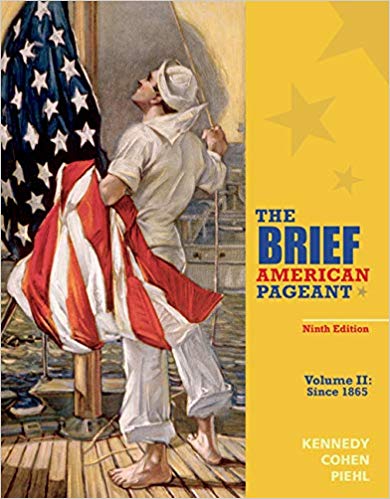
The Brief American Pageant A History of the Republic, Volume II Since 1865 9th Edition by David M. Kennedy - Test Bank

The Brief American Pageant A History of the Republic, Volume II Since 1865 9th Edition by David M. Kennedy - Test Bank   Instant Download - Complete Test Bank With Answers     Sample Questions Are Posted Below   Chapter 28—Progressivism and the Republican Roosevelt, 1901-1912 SHORT ANSWER Identify and state the historical significance of …

$19.99

The Brief American Pageant A History of the Republic, Volume II Since 1865 9th Edition by David M. Kennedy – Test Bank


Instant Download – Complete Test Bank With Answers


Sample Questions Are Posted Below


Chapter 28—Progressivism and the Republican Roosevelt, 1901-1912
SHORT ANSWER
Identify and state the historical significance of the following:
1.Henry Demarest Lloyd
ANS:  Answers will vary.
REF: Progressive Roots
2.Thorstein Veblen
ANS:  Answers will vary.
REF: Progressive Roots
3.Jacob A. Riis
ANS:  Answers will vary.
REF: Progressive Roots
4.Lincoln Steffens
ANS:  Answers will vary.
REF: Raking Muck with the Muckrakers
5.Ray Stannard Baker
ANS:  Answers will vary.
REF: Raking Muck with the Muckrakers
6.Ida Tarbell
ANS:  Answers will vary.
REF: Raking Muck with the Muckrakers
7.Robert M. (“Fighting Bob”) La Follette
ANS:  Answers will vary.
REF: Progressivism in the Cities and States | The Taft-Roosevelt Rupture
8.Hiram W. Johnson
ANS:  Answers will vary.
REF: Progressivism in the Cities and States
9.Frances E. Willard
ANS:  Answers will vary.
REF: Progressive Women
10.Florence Kelley
ANS:  Answers will vary.
REF: Progressive Women
11.Jane Addams
ANS:  Answers will vary.
REF: Progressive Roots | Political Progressivism | The “Bull Moose” Campaign of 1912
12.John Muir
ANS:  Answers will vary.
REF: Earth Control | Makers of America: The Environmentalists
13.Gifford Pinchot
ANS:  Answers will vary.
REF: Earth Control | Makers of America: The Environmentalists | Taft Splits the Republican Party
14.Woodrow Wilson
ANS:  Answers will vary.
REF: The Dollar Goes Abroad as a Diplomat | The “Bull Moose” Campaign of 1912
15.Upton Sinclair
ANS:  Answers will vary.
REF: Caring for the Consumer
16.William Howard Taft
ANS:  Answers will vary.
REF: TR Corrals the Corporations | The Rough Rider Thunders Out | Taft: A Round Peg in a Square Hole | The Dollar Goes Abroad as a Diplomat | Taft the Trustbuster | Taft Splits the Republican Party | The Taft-Roosevelt Rupture | The “Bull Moose” Campaign of 1912
17.Louis D. Brandeis
ANS:  Answers will vary.
REF: Progressive Women
18.Jack London
ANS:  Answers will vary.
REF: Earth Control
19.Eugene V. Debs
ANS:  Answers will vary.
REF: The Rough Rider Thunders Out | The “Bull Moose” Campaign of 1912
20.initiative
ANS:  Answers will vary.
REF: Political Progressivism
21.referendum
ANS:  Answers will vary.
REF: Political Progressivism
22.recall
ANS:  Answers will vary.
REF: Political Progressivism
23.direct primary
ANS:  Answers will vary.
REF: Political Progressivism
24.city manager system
ANS:  Answers will vary.
REF: Progressivism in the Cities and States
25.conservation
ANS:  Answers will vary.
REF: Earth Control | Makers of America: The Environmentalists | The Rough Rider Thunders Out
26.preservationism
ANS:  Answers will vary.
REF: Earth Control | Makers of America: The Environmentalists | The Rough Rider Thunders Out
27.social gospel
ANS:  Answers will vary.
REF: Progressive Roots
28.Australian ballot
ANS:  Answers will vary.
REF: Political Progressivism
29.Hetch Hetchy Valley
ANS:  Answers will vary.
REF: Earth Control
30.New Freedom
ANS:  Answers will vary.
REF: The “Bull Moose” Campaign of 1912
31.Progressive (“Bull Moose”) Party
ANS:  Answers will vary.
REF: The “Bull Moose” Campaign of 1912
32.anthracite coal strike of 1902
ANS:  Answers will vary.
REF: TR’s Square Deal for Labor
33.settlement house movement
ANS:  Answers will vary.
REF: Progressive Roots | Political Progressivism | Progressive Women
34.Manchurian railways
ANS:  Answers will vary.
REF: The Dollar Goes Abroad as a Diplomat
35.landing of U.S. Marines in Nicaragua (1912)
ANS:  Answers will vary.
REF: The Dollar Goes Abroad as a Diplomat
36.Women’s Christian Temperance Union
ANS:  Answers will vary.
REF: Progressive Women
37.“Roosevelt panic”
ANS:  Answers will vary.
REF: The Rough Rider Thunders Out
38.”rule of reason”
ANS:  Answers will vary.
REF: Taft the Trustbuster
39.Children´s Bureau
ANS:  Answers will vary.
REF: Progressive Women
40.muckrakers
ANS:  Answers will vary.
REF: Raking Muck with the Muckrakers
41.Seventeenth Amendment
ANS:  Answers will vary.
REF: Political Progressivism
42.“Millionaires´ Club”
ANS:  Answers will vary.
REF: Political Progressivism
43.Elkins Act (1903)
ANS:  Answers will vary.
REF: TR Corrals the Corporations
44.Hepburn Act (1906)
ANS:  Answers will vary.
REF: TR Corrals the Corporations
45.Northern Securities Company
ANS:  Answers will vary.
REF: TR Corrals the Corporations
46.Women’s Trade Union League
ANS:  Answers will vary.
REF: Progressive Women
47.Muller v. Oregon
ANS:  Answers will vary.
REF: Progressive Women
48.Lochner v. New York
ANS:  Answers will vary.
REF: Progressive Women
49.Triangle Shirtwaist fire
ANS:  Answers will vary.
REF: Progressive Women
50.Meat Inspection Act (1906)
ANS:  Answers will vary.
REF: Caring for the Consumer
51.Pure Food and Drug Act (1906)
ANS:  Answers will vary.
REF: Caring for the Consumer
52.Forest Reserve Act (1891)
ANS:  Answers will vary.
REF: Earth Control
53.Newlands Act (1902)
ANS:  Answers will vary.
REF: Earth Control
54.Audubon Society
ANS:  Answers will vary.
REF: Earth Control
55.Boy Scouts of America
ANS:  Answers will vary.
REF: Earth Control
56.Yosemite National Park
ANS:  Answers will vary.
REF: Earth Control
57.dollar diplomacy
ANS:  Answers will vary.
REF: The Dollar Goes Abroad as a Diplomat
58.Payne-Aldrich Bill
ANS:  Answers will vary.
REF: Taft Splits the Republican Party
59.Ballinger-Pinchot affair
ANS:  Answers will vary.
REF: Taft Splits the Republican Party
60.The Promise of American Life (1910)
ANS:  Answers will vary.
REF: The “Bull Moose” Campaign of 1912
61.Square Deal
ANS:  Answers will vary.
REF: TR’s Square Deal for Labor | The Rough Rider Thunders Out
62.Bureau of Corporations
ANS:  Answers will vary.
REF: TR’s Square Deal for Labor
63.New Nationalism
ANS:  Answers will vary.
REF: Taft Splits the Republican Party | The “Bull Moose” Campaign of 1912
MULTIPLE CHOICE
64.Progressive theorists believed that
a. hands-off individualism was the best way forward.
b. society could no longer afford a “laissez-faire” policy and weak government.
c. America needed to return to its preindustrial outlook and values.
d. poverty and inequality were healthy signs of a competitive society.
e. America was on a dangerous path to socialism.
ANS: B REF: Progressive Roots
65.As critics of economic inequality and social injustice, the progressives received much of their inspiration from
a. the Whig party tradition.
b. the Greenback Labor and Populist party traditions.
c. European theorists like Karl Marx and Friedrich Engels.
d. American theorists like Russell Conwell and Josiah Strong.
e. the social Darwinists.
ANS: B REF: Progressive Roots
66.Match each late-nineteenth-century social critic below with one of his notable works of social criticism:
A. Thorstein Veblen 1. Wealth Against Commonwealth
B. Lincoln Steffens 2. How the Other Half Lives
C. Jacob Riis 3. The Theory of the Leisure Class
D. Henry Demarest Lloyd 4. “The Shame of the Cities”
a. A-4, B-2, C-3, D-1
b. A-1, B-3, C-4, D-2
c. A-3, B-4, C-2, D-1
d. A-3, B-2, C-1, D-4
e. A-2, B-1, C-4, D-3
ANS: C REF: Progressive Roots | Raking Muck with the Muckrakers
67.Progressivism derived essential support from
a. opponents of women´s suffrage.
b. urban political bosses.
c. large corporations.
d. conservative Republican Congressmen.
e. exponents of the social gospel.
ANS: E REF: Progressive Roots
68.The people whom President Theodore Roosevelt labeled “muckrakers” were
a. Democratic Congressmen who attacked his administration.
b. novelists and literary critics who wrote on social themes.
c. social reformers who worked in the “muck” of the slums.
d. political reporters who became social activists.
e. journalists who specialized in uncovering corruption and social evils.
ANS: E REF: Raking Muck with the Muckrakers
69.Match each early-twentieth-century muckraker below with the target of his or her exposé.
A. David G. Phillips 1. the United States Senate
B. Ida Tarbell 2. the Standard Oil Company
C. Lincoln Steffens 3. city governments
D. Ray Stannard Baker 4. the condition of blacks
a. A-1, B-2, C-3, D-4
b. A-4, B-2, C-3, D-1
c. A-3, B-1, C-2, D-4
d. A-3, B-2, C-4, D-1
e. A-1, B-4, C-2, D-3
ANS: A REF: Raking Muck with the Muckrakers
70.Lincoln Steffens, in his series of articles entitled “The Shame of the Cities,”
a. exposed the United States Senate as a “rich men’s club.”
b. exposed the deplorable condition of blacks in urban areas.
c. laid bare the often corrupt practices of the stock market.
d. uncovered official collusion in prostitution and “white slavery.”
e. unmasked the corrupt alliance between big business and municipal government.
ANS: E REF: Raking Muck with the Muckrakers
71.The muckrakers were emblematic of the progressive reform movement because they
a. believed that only an organized movement could fight social wrongs.
b. thrived on creating publicity rather than bringing about social change.
c. believed that the cure for the ills of American democracy lay in a government of experts.
d. sought not to overthrow capitalism but to cleanse it with public knowledge and democratic controls.
e. refused to look beyond middle-class concerns.
ANS: D REF: Raking Muck with the Muckrakers
72.Progressivism is best described as
a. a tightly knit minority movement that wielded surprising influence.
b. a potent faction among Republicans.
c. more a social and cultural phenomenon than political movement.
d. a broadly dispersed majority mood.
e. the most radical third-party movement in American history.
ANS: D REF: Political Progressivism
73.One of the key goals of progressives was to curb the threat posed by
a. mass immigration.
b. feminism.
c. the gospel of wealth.
d. the radical Industrial Workers of the World.
e. monopoly power.
ANS: E REF: Political Progressivism
74.Progressive reformers sought to improve conditions for
a. common people.
b. farmers.
c. business leaders.
d. political radicals.
e. religious minorities.
ANS: A REF: Political Progressivism
75.Political progressivism
a. grew up almost entirely in the Midwest.
b. was essentially a creation of Theodore Roosevelt’s presidency.
c. emerged in both major parties, in all regions, at all levels of government.
d. rested on a small number of highly motivated activists.
e. took hold everywhere except the South.
ANS: C REF: Political Progressivism
76.According to the progressives, the cure for American democracy’s ills was
a. stronger moral leadership from the business community.
b. a third political party.
c. socialism.
d. stronger and more tightly managed political parties.
e. more democratic institutions and procedures.
ANS: E REF: Raking Muck with the Muckrakers
77.To regain the political power that the people had lost to the corporate interests, progressives advocated
a. campaign spending limits.
b. expansion of the Senate.
c. the Canadian ballot.
d. term limits.
e. direct election of U.S. senators.
ANS: E REF: Political Progressivism
78.Among their many causes, Progressives fought to
a. prohibit further immigration.
b. limit public spending on education.
c. limit suffrage in machine-run city wards.
d. end prostitution and “white slavery.”
e. eliminate the poll tax on African American voters.
ANS: D REF: Progressivism in the Cities and States
79.The progressive movement was instrumental in getting both the Seventeenth and Eighteenth amendments added to the Constitution. The Seventeenth provided for ____, and the Eighteenth provided for ____.
a. prohibition; woman suffrage
b. direct election of senators; prohibition
c. woman suffrage; income taxes
d. income taxes; direct election of senators
e. woman suffrage; direct election of senators.
ANS: B REF: Political Progressivism | Progressive Women
80.The settlement house and women’s club movements were crucial centers of female progressive activity because they
a. demonstrated that great literature and philosophy were relevant to social questions.
b. broke down the idea that women had special concerns as wives and mothers.
c. introduced many middle-class women to a broad array of urban social problems and civic concerns.
d. helped slum children learn to read Dante and Shakespeare.
e. provided the political base for women seeking public office.
ANS: C REF: Progressive Women
81.Which issue was particularly important to women in the progressive movement?
a. Ending special regulations governing women in the workplace
b. Preventing child labor in factories and sweatshops
c. Reducing tariffs on imported foods
d. Pursuing direct election initiatives
e. Passing conservation legislation to protect natural resources
ANS: B REF: Progressive Women
82.In Muller v. Oregon, the Supreme Court upheld the principle promoted by progressives like Florence Kelley and Louis Brandeis that
a. child labor under the age of fourteen should be prohibited.
b. the federal government should regulate occupational safety and health.
c. factory labor should be limited to ten hours a day, five days a week.
d. female workers should receive equal pay for equal work.
e. female workers required special rules and protection on the job.
ANS: E REF: Progressive Women
83.The public outcry after the horrible Triangle Shirtwaist fire led many states to pass
a. mandatory fire escape plans for all businesses employing more than ten people.
b. stricter labor regulations and compensation laws.
c. laws regulating the hours and conditions of child labor.
d. zoning regulations governing where factories could be located.
e. laws guaranteeing unions the right to raise safety concerns.
ANS: B REF: Progressive Women
84.The Supreme Court in Lochner v. New York dealt a setback to progressives and labor advocates by ruling that
a. a law limiting the work day to ten hours a day was unconstitutional.
b. a law providing special protection for women workers was unconstitutional.
c. a constitutional amendment would be necessary to prohibit child labor.
d. a law enabling business to fire labor organizers was constitutional.
e. fire and safety regulations were local and state responsibilities, and could not be determined by the federal government.
ANS: A REF: Progressive Women
85.The progressive-inspired city-manager system of government
a. was designed to encourage grass-roots citizen involvement.
b. was first developed and implemented in Madison, Wisconsin.
c. was designed to remove politics from municipal administration.
d. was designed to insure party responsibility for urban management.
e. opened urban politics to new immigrants.
ANS: C REF: Progressivism in the Cities and States
86.Progressive reform at the level of city government seemed to indicate that the progressives’ highest priority was
a. democratic participation.
b. governmental efficiency and non-corruption.
c. free enterprise.
d. economic equality.
e. urban planning.
ANS: B REF: Progressivism in the Cities and States
87.Theodore Roosevelt labeled the reform proposals of his administration the
a. Fair Deal.
b. New Freedom.
c. Big Stick.
d. New Deal.
e. Square Deal.
ANS: E REF: TR’s Square Deal for Labor
88.As a part of his reform program, Theodore Roosevelt advocated
a. the end of labor unions.
b. aid to corporations.
c. consumer protection.
d. rapid exploitation of natural resources.
e. strict limitations on government power.
ANS: C REF: TR’s Square Deal for Labor
89.Theodore Roosevelt ended the 1902 strike in the anthracite coal mines by
a. offering to mediate between the owners and coal miners.
b. passing legislation making the miners’ union illegal.
c. helping the mine owners to import strike breakers.
d. appealing to mine owners’ and workers’ sense of the public interest.
e. threatening to seize the mines and to operate them with federal troops.
ANS: E REF: TR’s Square Deal for Labor
90.In the anthracite coal strike in 1902, how was the federal government’s approach different from its role in previous labor disputes?
a. The coal miners’ union was officially recognized by the Department of Labor as the legal bargaining agent of the miners.
b. The mines were seized by the federal government and operated by federal troops.
c. The federal government did not automatically side with the owners.
d. A labor dispute was considered relevant to federal concerns because it affected interstate commerce.
e. Department of Labor mediators were active in the negotiations.
ANS: C REF: TR’s Square Deal for Labor
91.Which acts dealt with the subject of railroad regulation?
a. Hepburn and Forest Reserve Acts
b. Elkins and Meat Inspection Acts
c. Northern Securities and Newlands Acts
d. Newlands and Payne-Aldrich Acts
e. Elkins and Hepburn Acts
ANS: E REF: TR Corrals the Corporations
92.Theodore Roosevelt believed that large corporate trusts
a. were destroying the essential American principles of individual freedom.
b. were essentially greedy centers of power and wealth.
c. should be regulated primarily by the states.
d. should be curbed by federal power but not eliminated.
e. should be balanced by strong labor unions.
ANS: D REF: TR Corrals the Corporations
93.The real purpose of Theodore Roosevelt’s assault on trusts was to
a. protect consumers by restoring business competition.
b. demonstrate the supremacy of the government over private business.
c. slow the trend toward combination and integration in business.
d. develop a strong antitrust division in the Justice Department.
e. undermine the political appeal of the Socialists.
ANS: B REF: TR Corrals the Corporations
94.What did the Supreme Court’s “rule of reason” in the Standard Oil case decree in 1911?
a. Only reasonably argued antitrust cases would be reviewed by the high court.
b. Trusts that created an unreasonable level of combination were illegal.
c. Only trusts that were reasonably diversified were allowable under the Sherman Anti-Trust Act.
d. Trusts that acted unreasonably toward government regulators would be forced to break up.
e. Only trusts that unreasonably restrained trade were illegal.
ANS: E REF: Taft the Trustbuster
95.Passage of the Federal Meat Inspection Act was inspired by the publication of
a. Theodore Dreiser’s The Titan.
b. Jack London’s Call of the Wild.
c. Henry Demarest Lloyd’s Wealth Against Commonwealth.
d. Jacob Riis’s How the Other Half Lives.
e. Upton Sinclair’s The Jungle.
ANS: E REF: Caring for the Consumer
96.When Upton Sinclair wrote The Jungle, he intended his book to focus attention on the
a. unsanitary conditions that existed in the meat-packing industry.
b. plight of workers in the stockyards and meat-packing industry.
c. poor housing conditions in the urban slums.
d. use of chemical additives and preservatives in the meat industry.
e. unhealthy effects of beef consumption.
ANS: B REF: Caring for the Consumer
97.The first major piece of conservation legislation passed by the Roosevelt administration was the
a. Yosemite National Park Act.
b. Forest Reserve Act.
c. Newlands Act.
d. Fisheries Preservation Act.
e. Clean Water Act.
ANS: C REF: Earth Control
98.Theodore Roosevelt’s most enduring, tangible achievement and legacy may have been
a. building the Panama Canal.
b. regulating or “busting” corporate trusts.
c. mediating an end to the Russo-Japanese War.
d. promoting the cause of protecting the environment.
e. reforming the Republican party.
ANS: D REF: Earth Control | The Rough Rider Thunders Out
99.Theodore Roosevelt’s and Gifford Pinchot’s theory of conservation was that
a. the primary purpose of federal lands was to provide public recreation.
b. the federal government should manage natural resources for multiple uses.
c. natural resources should be leased to provide federal revenue.
d. wilderness areas were “temples of nature” that should be kept free of human civilization.
e. Western ranchers and loggers were best qualified to protect the local environment.
ANS: B REF: Earth Control
100.The long-term rift between conservationists and preservationists was exposed in 1913 in the controversy over
a. the creation of the national park system.
b. plans for the Hoover dam.
c. the creation of Sequoia National Forest.
d. the Pure Food and Drug Act.
e. a dam in Hetch Hetchy Valley.
ANS: E REF: Earth Control
101.The brief but punishing economic panic of 1907 was dubbed the _____ by the financial world.
a. “Roosevelt panic”
b. “Taft collapse”
c. “Wilson panic”
d. “Morgan crisis”
e. “Northern Securities recession”
ANS: A REF: The Rough Rider Thunders Out
102.With regard to economic policy, Theodore Roosevelt should be remembered as the American president who
a. tried to restore individualistic competition to the American economy.
b. “stole the clothes” of American Socialists by taking over many of their programs.
c. tried to tame adolescent American capitalism by finding a middle road between pure individualism and socialism.
d. was a strong advocate of the working class and organized labor.
e. talked about reform while serving the interests of big business.
ANS: C REF: The Rough Rider Thunders Out
103.During his time in office, Theodore Roosevelt
a. greatly increased the power and prestige of the presidency.
b. was almost constantly at odds with Congress.
c. tended to follow rather than lead public opinion.
d. operated most effectively behind the scenes.
e. held rigidly to his ideological principles.
ANS: A REF: The Rough Rider Thunders Out
104.In the election of 1908, Roosevelt´s handpicked successor _____ beat the Democrat _____ and the Socialist _____.
a. Williams Jennings Bryan, Woodrow Wilson, Victor L. Berger
b. Eugene V. Debs, William Howard Taft, William Jennings Bryan
c. William Howard Taft, Woodrow Wilson, Eugene V. Debs
d. Woodrow Wilson, Ben “Pitchfork” Tillman, Robert La Follette
e. William Howard Taft, William Jennings Bryan, Eugene V. Debs
ANS: E REF: The Rough Rider Thunders Out
105.As president, William Howard Taft
a. was a skilled politician and judge of public opinion.
b. held together the diverse wings of the Republican party.
c. was wedded more to the status quo than to change.
d. effectively persuaded Congress to follow his lead.
e. carried on the legacy of Theodore Roosevelt.
ANS: C REF: Taft: A Round Peg in a Square Hole
106.President Taft’s foreign policy was dubbed
a. big-stick diplomacy.
b. the Open Door policy.
c. the Good Neighbor policy.
d. dollar diplomacy.
e. sphere-of-influence diplomacy.
ANS: D REF: The Dollar Goes Abroad as a Diplomat
107.Taft´s signing of _____ was a major cause of the split within the Republican party during his administration.
a. the Sherman Anti-Trust Act
b. the Pure Food and Drug Act
c. the Payne-Aldrich Bill
d. an aid program for Nicaragua.
e. a bill to finance railways in Manchuria.
ANS: C REF: Taft Splits the Republican Party
108.Theodore Roosevelt decided to run for the presidency in 1912 because
a. William Howard Taft had discarded many of Roosevelt’s policies.
b. Taft decided not to run for a second term.
c. the Republican party demanded that he do so.
d. Senator Robert La Follette encouraged him to do so.
e. the Democratic party was split.
ANS: A REF: The Taft-Roosevelt Rupture
109.When Jane Addams nominated Theodore Roosevelt for president at the 1912 Progressive Party convention, it
a. was an effective tactic to get women to vote for Roosevelt.
b. guaranteed Roosevelt’s defeat by Woodrow Wilson.
c. symbolized the rising political status of women.
d. signaled that the Progressives were a radical party.
e. demonstrated his concern for international peace.
ANS: C REF: The “Bull Moose” Campaign of 1912
110.As governor of New Jersey, Woodrow Wilson established a record as a
a. mild conservative.
b. reactionary.
c. collaborator with the state’s party bosses.
d. moderate liberal.
e. passionate progressive reformer.
ANS: E REF: The “Bull Moose” Campaign of 1912
111.Theodore Roosevelt’s New Nationalism
a. pinned its economic faith on competition.
b. opposed consolidation of trusts and labor unions.
c. favored the free functioning of unregulated markets.
d. supported a broad program of federal regulation and social welfare.
e. favored state rather than federal government activism.
ANS: D REF: Taft Splits the Republican Party | The “Bull Moose” Campaign of 1912
112.Woodrow Wilson’s New Freedom
a. advocated extensive social-welfare programs.
b. advocated strong state government regulation of business.
c. favored free market entrepreneurship and breakup of large corporate combines.
d. supported health and safety regulation and minimum-wage laws.
e. stood firmly for the status quo.
ANS: C REF: The “Bull Moose” Campaign of 1912
113.The 1912 presidential election was notable because
a. it gave voters a clear choice of political and economic philosophies.
b. personalities were the only issue of the campaign.
c. it was the first time women had the right to vote nationwide.
d. the Democratic party had split.
e. the Socialists competed as a serious third party.
ANS: A REF: The “Bull Moose” Campaign of 1912
114.In the election of 1912, the New Nationalism that Roosevelt proposed and the New Freedom touted by Wilson
a. were both attempts to steal the socialists´ thunder.
b. served merely as empty slogans.
c. departed only in foreign policy views.
d. both advocated a more active government but differed on specific strategies.
e. were fundamentally opposed on the proper role of government in American life.
ANS: D REF: The “Bull Moose” Campaign of 1912
115.Match each 1912 presidential candidate below with his political party.
A. Woodrow Wilson 1. Socialist
B. Theodore Roosevelt 2. Democratic
C. William Howard Taft 3. Republican
D. Eugene V. Debs 4. Progressive
a. A-1, B-2, C-4, D-3
b. A-1, B-3, C-4, D-2
c. A-4, B-3, C-2, D-l
d. A-3, B-1, C-2, D-4
e. A-2, B-4, C-3, D-l
ANS: E REF: The “Bull Moose” Campaign of 1912
ESSAY
116.In the view of progressives, what was wrong with American society? What solutions did they propose?
ANS:  Answers will vary. REF: Progressive Roots | Raking Muck with the Muckrakers | Political Progressivism | Progressivism in the Cities and States | Progressive Women | TR’s Square Deal for Labor | TR Corrals the Corporations | Caring for the Consumer | Earth Control
117.What contributed to the reformist fervor that inspired the progressive movement? Who supported the movement? And which supporters and contributing factors to the movement’s growth were most significant, and why?
ANS:  Answers will vary. REF: Progressive Roots
118.The text authors argue that “progressivism was less a monolithic minority movement and more a broadly dispersed majority mood.” What do they mean? Do you agree? Why?
ANS:  Answers will vary. REF: Political Progressivism
119.Why did journalistic muckrakers play such a large role in the progressive movement? What does their strategy of publicizing social problems indicate about the strengths and weaknesses of American progressivism?
ANS:  Answers will vary. REF: Raking Muck with the Muckrakers
120.One of Theodore Roosevelt’s central principles was that the federal government should act as a neutral force protecting the public, national interest against the power of big business, labor, and other special interests. How successful was he in pursuing this ideal? Is it possible for the government to be completely neutral in this way?
ANS:  Answers will vary. REF: TR’s Square Deal for Labor | TR Corrals the Corporations | Caring for the Consumer | Earth Control | The Rough Rider Thunders Out
121.Identify the “three Cs” of President Roosevelt’s Square Deal. Describe what he did to bring progressive reform to each of the three areas.
ANS:  Answers will vary. REF: TR’s Square Deal for Labor | TR Corrals the Corporations | Caring for the Consumer | Earth Control
122.Compare Roosevelt’s New Nationalism and Wilson’s New Freedom programs. Which seems to you to be the most effective response to the problems of industrial society and big business monopolies?
ANS:  Answers will vary. REF: Taft Splits the Republican Party | The “Bull Moose” Campaign of 1912
123.To what extent was Theodore Roosevelt’s charge that Taft had abandoned and betrayed his policies entirely fair? Why or why not?
ANS:  Answers will vary. REF: Taft: A Round Peg in a Square Hole | Taft the Trustbuster | Taft Splits the Republican Party | The Taft-Roosevelt Rupture | The “Bull Moose” Campaign of 1912
124.Do you think that the strong emphasis that female progressives placed on extending women’s maternal instincts into the public arena of child welfare, consumer protection, sanitation, and so on strengthened the movement for women’s equality? Or did it actually reinforce the idea of separate spheres for men and women?
ANS:  Answers will vary. REF: Progressive Women
125.In summarizing his foreign policy in 1912, President Taft asserted, “The diplomacy of the present administration has sought to respond to modern ideas of commercial intercourse. This policy has been characterized as substituting dollars for bullets.” Where and how did Taft pursue this “dollar diplomacy,” as critics described it? To what degree was his prioritizing of American commercial interests justified?
ANS:  Answers will vary. REF: The Dollar Goes Abroad as a Diplomat
126.Why did women play such a prominent role in the progressive movement? In what areas were female reformers particularly central to progressivism and its achievements?
ANS:  Answers will vary. REF: Progressive Women
127.Progressives believed that “the cure for the ills of democracy was more democracy.” Apply this observation to progressive action in city and state governmental reform; then assess the accuracy of the observation.
ANS:  Answers will vary. REF: Progressivism in the Cities and States

Additional information

Add Review

Your email address will not be published. Required fields are marked *