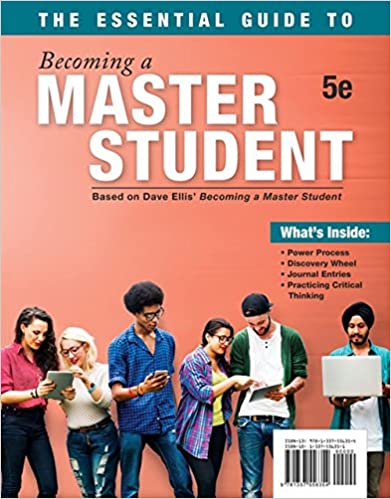
The Essential Guide to Becoming a Master Student 5th Edition by Dave Ellis - Test Bank

The Essential Guide to Becoming a Master Student 5th Edition by Dave Ellis - Test Bank   Instant Download - Complete Test Bank With Answers     Sample Questions Are Posted Below   Author: Ellis Title: The Essential Guide to Becoming a Master Student, 5e Chapter/Section Name: Maximizing Your Memory & Mastering Tests Chapter/Section Number: …

$19.99

The Essential Guide to Becoming a Master Student 5th Edition by Dave Ellis – Test Bank


Instant Download – Complete Test Bank With Answers


Sample Questions Are Posted Below


Author: Ellis

Title: The Essential Guide to Becoming a Master Student, 5e

Chapter/Section Name: Maximizing Your Memory & Mastering Tests

Chapter/Section Number: 5


  1. Being attached to getting an A is the best way to achieve one.
  2. True
  3. False

ANS: B


  1. When should you begin a major review for a big exam, such as a final?
  2. At least a week before.
  3. At least three days before.
  4. The night before.
  5. At least two weeks before.

ANS: B


  1. Repeating information out loud is more effective than reciting it in your head.
  2. True
  3. False

ANS: A


  1. Which is easiest to remember?
  2. Material we find difficult or tiresome.
  3. Material we see as abstract or theoretical.
  4. Material that is personally meaningful.
  5. Material unrelated to our existing knowledge.

ANS: C


  1. A way to improve your recall is to try to remember everything.
  2. True
  3. False

ANS: B


  1. Visual and verbal information are stored in the same part of the brain.
  2. True
  3. False

ANS: B


  1. What’s a useful technique for remembering someone’s name?
  2. Repeat it out loud.
  3. Pretend you remember it.
  4. Link the first and last names.
  5. Set a memory trap.

ANS: A


  1. Which of the following is NOT an effective way to get ready for a test?
  2. Create summary notes.
  3. Do daily reviews.
  4. Create flash cards.
  5. Try to memorize absolutely everything you’ve read.

ANS: D


  1. Preparing for a test is like a musician preparing for the stage.
  2. True
  3. False

ANS: A


  1. A good strategy for a difficult question on a test is to rewrite the question in your own words and see if that helps to answer it.
  2. True
  3. False

ANS: A


  1. Imagining the terrible things that could happen if you fail a test is a helpful way to overcome your fear of it.
  2. True
  3. False

ANS: A


  1. An important test taking technique is to:
  2. Use stress management techniques if you are feeling nervous.
  3. Focus only on the test and finish fast.
  4. Stay with a question until you can answer it.
  5. Ignore any tension you are feeling.

ANS: A


  1. Which of the following is an effective review tool?
  2. Study checklists.
  3. Mind map summary sheets.
  4. Flashcards.
  5. All of these.

ANS: D


  1. What’s an effective strategy for actually taking a test?
  2. Ask other students for the answers.
  3. Read directions quickly and move on to the more difficult questions.
  4. Look for answers in other test questions.
  5. Jot down memory aids on a separate sheet of paper.

ANS: C


  1. Skipping a question (for now) can be a useful test taking strategy.
  2. True
  3. False

ANS: A


  1. On essay tests, put your best supporting ideas and facts in your conclusion.
  2. True
  3. False

ANS: B


  1. When a test is returned to you, it is most appropriate to:
  2. file it away to study for finals.
  3. determine the source of your test errors and review your notes and textbook to answer questions correctly.
  4. swap tests with another student in class so they can give you the answers to questions you missed.
  5. read over your essay questions.

ANS: B


  1. Assumptions can help you when taking a test.
  2. True
  3. False

ANS: B


  1. Taking practice tests is a good way to prepare for a math test.
  2. True
  3. False

ANS: A


  1. In an essay question, the word analyze means that you should:
  2. clarify an idea by giving examples of it.
  3. debate and argue the pros and cons of an issue.
  4. break something into separate parts and discuss, examine, or interpret each part, then give your opinion.
  5. write a series of concise statements.

ANS: C


Additional information

Add Review

Your email address will not be published. Required fields are marked *