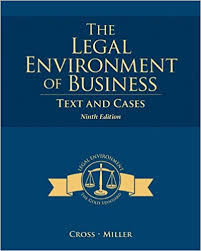
The Legal Environment of Business Text and Cases 9th Edition by Cross - Test Bank

The Legal Environment of Business Text and Cases 9th Edition by Cross - Test Bank   Instant Download - Complete Test Bank With Answers     Sample Questions Are Posted Below   Chapter 8     International Law in a Global Economy         N.B.:  TYPE indicates that a question is new, modified, …

$19.99

The Legal Environment of Business Text and Cases 9th Edition by Cross – Test Bank


Instant Download – Complete Test Bank With Answers


Sample Questions Are Posted Below


Chapter 8


International Law in a

Global Economy


N.B.:  TYPE indicates that a question is new, modified, or unchanged, as follows.


N      A question new to this edition of the Test Bank.

+       A question modified from the previous edition of the Test Bank.

=       A question included in the previous edition of the Test Bank.


TRUE/FALSE QUESTIONS


  1. The major difference between international law and national law is that government authorities can enforce national law.


ANSWER:     T                               PAGES:   Section 1                TYPE:       N

BUSPROG: Reflective                             AICPA: BB-Critical Thinking


  1. An international custom can be defined as “evidence of a general practice accepted as law.”


answer:     T                               PAGES:   Section 1                TYPE:       N

BUSPROG: Analytic                                AICPA: BB-Legal


  1. The International Court of Justice normally has authority to settle legal disputes only when nations voluntarily submit to its jurisdiction.


answer:     T                               PAGES:   Section 1                TYPE:       N

BUSPROG: Analytic                                AICPA: BB-Legal


  1. International law requires nations to honor the actions of other nations.


answer:     F                               PAGES:   Section 1                TYPE:       N

BUSPROG: Analytic                                AICPA: BB-Legal


  1. The principle of comity basically refers to legal reciprocity.


ANSWER:     T                               PAGES:   Section 1                TYPE:       N

BUSPROG: Analytic                                AICPA: BB-Legal


  1. The act of state doctrine provides that the judicial branch of one country will examine the validity of public acts committed by a recognized foreign government within the latter’s own territory.


answer:     F                               PAGES:   Section 1                TYPE:       N

BUSPROG: Analytic                                AICPA: BB-Legal


  1. The doctrine of sovereign immunity provides that only a head of state can make trea­ties with an­other nation.


ANSWER:     F                               PAGES:   Section 1                TYPE:       N

BUSPROG: Analytic                                AICPA: BB-Legal


  1. Expropriation occurs when a government seizes a privately owned business or privately owned goods for a proper public purpose and awards just compensation.


ANSWER:     T                               PAGES:   Section 1                TYPE:       +

BUSPROG: Analytic                                AICPA: BB-Legal


  1. The Foreign Sovereign Immunities Act broadly defines com­mercial activity.


ANSWER:     T                               PAGES:   Section 1                TYPE:       +

BUSPROG: Analytic                                AICPA: BB-Legal


  1. A foreign state is immune from the jurisdiction of U.S. courts unless the state is involved in commercial activity within the United States.


ANSWER:     F                               PAGES:   Section 1                TYPE:       =

BUSPROG: Analytic                                AICPA: BB-Legal


  1. Franchising is a form of licensing.


ANSWER:     T                               PAGES:   Section 2                TYPE:       =

BUSPROG: Analytic                                AICPA: BB-Legal


  1. Some countries provide insurance for their citizens’ investments abroad.


ANSWER:     T                               PAGES:   Section 3                TYPE:       N

BUSPROG: Analytic                                AICPA: BB-Legal


  1. Few countries guarantee compensation to foreign investors if their property is taken.


ANSWER:     F                               PAGES:   Section 3                TYPE:       N

BUSPROG: Analytic                                AICPA: BB-Legal


  1. To restrict or encourage exports, Congress can set quotas on various items, such as grain being sold abroad.


ANSWER:     T                               PAGES:   Section 3                TYPE:       N

BUSPROG: Analytic                                AICPA: BB-Legal


  1. The importation of goods that infringe U.S. patents is not prohibited.


ANSWER:     F                               PAGES:   Section 3                TYPE:       N

BUSPROG: Analytic                                AICPA: BB-Legal


  1. Dumping is the exporting of environmentally polluting goods to a foreign market.


ANSWER:     F                               PAGES:   Section 3                TYPE:       =

BUSPROG: Analytic                                AICPA: BB-Legal


  1. Each member of the World Trade Organization is obligated to treat other members at least as well as it treats the country that receives its most favorable treatment with regard to imports or exports.


ANSWER:     T                               PAGES:   Section 3                TYPE:       N

BUSPROG: Analytic                                AICPA: BB-Legal


  1. International contracts rarely include arbitration clauses.


answer:     F                               PAGES:   Section 4                TYPE:       N

BUSPROG: Analytic                                AICPA: BB-Legal


  1. Foreign citizens can bring civil suits in U.S. courts for injuries caused by violations of the law of nations or a treaty of the United States.


answer:     T                               PAGES:   Section 5                TYPE:       N

BUSPROG: Analytic                                AICPA: BB-Legal


  1. Generally, U.S. employers abroad must abide by U.S. discrimination laws unless to do so would violate the laws of the country where their workplaces are located.


answer:     t                               PAGES:   Section 5                TYPE:       N

BUSPROG: Analytic                                AICPA: BB-Legal


MULTIPLE CHOICE QUESTIONS


  1. Michael, a citizen of Ireland, and Nina, a citizen of the United States, enter into a contract. When Nina breaches the contract, Michael obtains an award of damages in an Irish court. He asks a U.S. court to enforce the award. The U.S. court defers to and enforces the Irish court’s decree. This is


  1. a travesty of justice.
  2. the act of state doctrine.
  3. the doctrine of sovereign immunity.
  4. the principle of comity.


ANSWER:     D                              PAGES:   Section 1                TYPE:       N

BUSPROG: Reflective                             AICPA: BB-Legal


  1. The government of North Korea violates an international law. Persuasive tactics to remedy the situation fail. The only recourse of other nations is to


  1. approve the World Trade Organization’s enforcement of the law.
  2. ask the International Court of Justice to enforce sanctions.
  3. seek enforcement of the law through the United Nations.
  4. take coercive action—sever relations, impose boycotts, go to war.


ANSWER:     D                              PAGES:   Section 1                TYPE:       =

BUSPROG: Reflective                             AICPA: BB-Legal


  1. Yokio, Ltd., and Zeno, S.A., transact an international sale of goods. At the request of these parties, a court in Portugal resolves a dispute between them. A U.S. court will most likely honor the judgment


  1. if it is consistent with U.S. laws and public policy.
  2. if it is consistent with Portuguese laws and public policy.
  3. if it does not benefit the U.S. to deny it.
  4. under no circumstances.


ANSWER:     B                              PAGES:   Section 1                TYPE:       N

BUSPROG: Reflective                             AICPA: BB-Legal


  1. Global Marketing, Inc., a U.S. firm, owns property in Honduras. The government in Honduras takes Global Marketing’s property without paying for it. A U.S. court will proba­bly not examine the validity of this act commit­ted by Honduras within its own territory, under


  1. the act of state doctrine.
  2. the doctrine of sovereign immunity.
  3. the principle of comity.
  4. the World Trade Organization .


ANSWER:    A                              PAGES:   Section 1                TYPE:       =

BUSPROG: Reflective                             AICPA: BB-Legal


  1. The basis for India to give effect to the laws and court decisions of the United States is primarily


  1. courtesy and respect.
  2. fear and intimidation.
  3. admiration and envy.
  4. payments of cash and exchanges of property.


ANSWER:     A                              PAGES:   Section 1                TYPE:       N

BUSPROG: Reflective                             AICPA: BB-Legal


  1. Mountain Mining Company, a U.S. firm, owns property in Bolivia. The government of Bolivia seizes the property for an illegal purpose without paying just compensation. This is


  1. confiscation.
  2. defalcation.
  3. dumping.
  4. expropriation.


ANSWER:     A                              PAGES:   Section 1                TYPE:       N

BUSPROG: Reflective                             AICPA: BB-Legal


  1. Reality Financial Corporation, a U.S. firm, files a suit against Switzerland in a U.S. court. Switzerland claims foreign sovereign immunity. Under the Foreign Sovereign Immunities Act


  1. Reality Financial must show that Switzerland is not entitled to sovereign immunity.
  2. Switzerland must show that it is entitled to sovereign immunity.
  3. the court must dismiss the suit without any showing.
  4. the court may hear the suit but its decision will have no effect.


ANSWER:     A                              PAGES:   Section 1                TYPE:       N

BUSPROG: Reflective                             AICPA: BB-Legal


  1. Dynamic Oil Corporation, a U.S. firm, owns property in Ecuador. When the government of Ecuador seizes the property, Dynamic Oil asks a U.S. court to order the property’s return. The court rules that Ecuador is exempt from the court’s jurisdiction. This is


  1. a travesty of justice.
  2. the act of state doctrine.
  3. the doctrine of sovereign immunity.
  4. the principle of comity.


ANSWER:     C                              PAGES:   Section 1                TYPE:       =

BUSPROG: Reflective                             AICPA: BB-Legal


  1. Optima Medico Corporation, a U.S. firm, signs a contract with Pharma Beneficial, Ltd., a Canadian firm, to give Pharma the right to sell Optima’s products in Canada. This is


  1. a distribution agreement.
  2. a joint venture.
  3. direct exporting.
  4. licensing.


ANSWER:     A                              PAGES:   Section 2                TYPE:       N

BUSPROG: Reflective                             AICPA: BB-Critical Thinking


  1. UniVision Corporation, a U.S. company, sets up a firm in Vietnam. UniVision remains in the United States and retains ownership of the Vietnamese branch, as well as authority and control over all phases of the operation. This is


  1. a franchise.
  2. a wholly owned subsidiary.
  3. a joint venture.
  4. direct exporting.


ANSWER:     B                              PAGES:   Section 2                TYPE:       N

BUSPROG: Reflective                             AICPA: BB-Critical Thinking


  1. Secure Investments, Inc., a U.S. firm, expands into international markets through a joint venture. In this situation, Secure Investments owns


  1. all of the operation.
  2. as much of the operation as Secure Investments wants.
  3. none of the operation.
  4. part of the operation.


ANSWER:     D                              PAGES:   Section 2                TYPE:       =

BUSPROG: Reflective                             AICPA: BB-Critical Thinking


  1. Big Deal! Marketing Company, a U.S. firm, signs a contract with Comercio Exterior, Ltd., a Chilean firm, to give Comercio the right to use Big Deal!’s animation techniques and characters in product promotions. This is


  1. a distribution agreement.
  2. a joint venture.
  3. direct exporting.
  4. licensing.


ANSWER:     D                              PAGES:   Section 2                TYPE:       N

BUSPROG: Reflective                             AICPA: BB-Critical Thinking


  1. Fresh Meds, Inc., a U.S. firm, contracts with Gong, Ltd., a Hong Kong firm, al­lowing Gong to use and profit from Fresh Meds’ patented products. This is


  1. a distribution agreement.
  2. a joint venture.
  3. direct exporting.
  4. licensing.


ANSWER:     D                              PAGES:   Section 2                TYPE:       =

BUSPROG: Reflective                             AICPA: BB-Critical Thinking


  1. Congresswoman Smith and other politicians want to prohibit the import of certain genetically modified agricultural products that they believe may pose a danger to domestic crops. With respect to these products’ import, Congress can


  1. do nothing.
  2. impose quotas, but not tariffs.
  3. impose tariffs, but not quotas.
  4. prohibit the imports.


ANSWER:     D                              PAGES:   Section 3                TYPE:       =

BUSPROG: Reflective                             AICPA: BB-Legal


  1. Mont Blanc S.A., a French firm, imports its goods into the United States and offers those goods for sale at “less than fair value.” “Fair value” is the price of Mont Blanc’s goods in


  1. the European market.
  2. France.
  3. the United States.
  4. the world market.


ANSWER:     B                              PAGES:   Section 3                TYPE:       +

BUSPROG: Reflective                             AICPA: BB-Legal


  1. Omega, Ltd., imports athletic shoes made in Southeast Asia into the United States. To obtain a larger share of the U.S. market, Omega sells the athletic shoes at lower prices here than in its exporting countries. With respect to these imports, the United States may


  1. do nothing.
  2. assess antidumping duties.
  3. order the return of the athletic shoes to the exporting countries.
  4. confiscate the athletic shoes without just compensation.


ANSWER:     B                              PAGES:   Section 3                TYPE:       =

BUSPROG: Reflective                             AICPA: BB-Legal


  1. The government of Korea sets a limit on the amount of rice that can be imported from the United States. This is


  1. a dumping duty.
  2. an antidumping duty.
  3. a quota.
  4. a tariff.


ANSWER:     C                              PAGES:   Section 3                TYPE:       =

BUSPROG: Reflective                             AICPA: BB-Legal


  1. The United States and other members of a certain organization agree to grant normal trade relations (NTR) status to each other with regard to im­ports and exports. This organi­zation is


  1. the Convention on Contracts for the International Sale of Goods.
  2. the International Export-Import Bank.
  3. the United Nations.
  4. the World Trade Organization.


ANSWER:     D                              PAGES:   Section 3                TYPE:       =

BUSPROG: Analytic                                AICPA: BB-Legal


  1. Suisse Internationale, a Swiss maker of athletic equipment, enters into a price fixing agreement with Total World Sports, a U.S. wholesaler of Suisse’s products. U.S. courts will apply U.S. antitrust laws if


  1. the agreement was made in Switzerland.
  2. the agreement was made in the United States.
  3. the price fixing has a substantial effect on U.S. commerce.
  4. the Swiss government agrees to be sued in the United States.


ANSWER:     C                              PAGES:   Section 5                TYPE:       N

BUSPROG: Reflective                             AICPA: BB-Legal


  1. Miranda is a U.S. citizen working in Europe for Tourist Vacations, Inc., a U.S. travel agency. Tourist fires Miranda for reasons that she believes vio­late U.S. antidis­crimination laws. Those laws apply


  1. extraterritorially.
  2. only to signatories of the North American Free Trade Agreement.
  3. only to members of the World Trade Organization.
  4. only within U.S. borders.


answer:     A                              PAGES:   Section 5                TYPE:       N

BUSPROG: Analytic                                AICPA: BB-Legal


Essay Questions


  1. Stardust Coffee Company a U.S. business firm, makes and sells distinc­tively flavored coffee beverages. Although the recipes are secret, the ingre­di­ents could be revealed and the sauces could be reconstructed with dili­gent efforts. What can Stardust do to prevent its products from being “decoded” and pirated abroad?


ANSWER:     One possibility is that Stardust Coffee Company, or any U.S. firm, or any domestic firm in any nation, can license its recipe, formula, prod­uct, or process to a foreign company to avoid the theft of the trade se­cret. The foreign firm would obtain the right to make and sell the product ac­cording to the recipe (or formula, or right to use the process, or other trade secret) and agree to keep the information confidential and to pay royalties to the licensing firm.


PAGES:         Section 2                                                                   type:       =

BUSPROG: Reflective                             AICPA: BB-Decision Modeling


  1. The management of Sweet Soft Drinks Corporation, a U.S. firm, wants to expand into foreign investment and employment markets. They are considering ei­ther opening their own production facility in a foreign country or enter­ing into a licensing agreement with a foreign firm. What are the advan­tages and disadvantages of each of these courses of action?


ANSWER:     One of the advantages of opening a wholly owned production facility, in the United States or in a foreign nation, is that all of the profits accrue to the owner. The disadvantages include the risk involved in open­ing a production facility in a foreign country. There is a possibility of the foreign government’s expropriation of the facility. Expropriation is the tak­ing of private property for a public purpose and the paying of just com­pen­sation. Foreign governments have also sometimes confiscated the property of foreign companies. Confiscation is the taking of private prop­erty for a public purpose without just compensation. Under the act of state doctrine, U.S. courts would be reluctant to intervene, either by ordering the property returned or ordering the payment of a fair price. Thus, there could be a considerable sum of money at risk in a foreign production facil­ity.

A licens­ing agreement, by contrast, involves relatively little capital investment and represents less risk of loss from a confiscation or an ex­propriation. By en­tering into a licensing agreement with a foreign firm for the rights to manufacture Sweet Soft Drinks products, or to sell products under the Sweet Soft Drinks trade­mark, the company eliminates the chance that its assets would be lost if they were confiscated. Of course, there will also be fewer profits and those will likely be in the form of royalties.


PAGES:         Sections 1 & 2                                                          type:       =

BUSPROG: Reflective                             AICPA: BB-Decision Modeling


Additional information

Add Review

Your email address will not be published. Required fields are marked *